209 results found
React2Shell (CVE-2025-55182) was a critical RCE vulnerability in React's Flight protocol, discovered by unpicking its undocumented internal workings. It leveraged how Flight deserializes complex objects and how `await` leniently handles "thenables," ultimately allowing attackers to execute arbitrary code by manipulating React's internal promise resolution logic.

MCP (Model Context Protocol) is a new standard that acts as a standardized bridge, enabling secure and efficient connections between large language models (LLMs) and external, private enterprise data sources. It addresses the complexity of traditional API integrations by standardizing data formats for AI, making agentic workflows more scalable and effective. MCP ensures LLMs have the crucial internal context needed for practical enterprise applications.

The world of artificial intelligence is experiencing unprecedented growth, profoundly impacting how we approach software development and, crucially, how we design the underlying hardware. At the heart of this evolution

For developers who've navigated the intricate waters of Makefile syntax, grappled with elusive tab-versus-spaces bugs, or struggled to achieve consistent builds across diverse operating systems like Linux, macOS, and
As developers, we often encounter the need to efficiently distribute and consume frequently updated web content. Whether it's blog posts, news articles, or media files, having a standardized way to syndicate this

As AI systems become more autonomous, traditional step-by-step governance creates fragile architectures. This article explores 'fast paths' and 'slow paths' as a solution, enabling scalable autonomy by regulating behavior through continuous observation and selective, feedback-driven intervention, rather than synchronous approval for every action.

This article highlights a common problem in web development: websites often get designed to satisfy internal stakeholders' preferences rather than serve the end-user. It argues that a website is a tool, not art, and expert design decisions based on research are frequently overruled by subjective taste, leading to suboptimal user experiences and technical challenges. The piece emphasizes a user-first approach, urging developers and stakeholders to prioritize user needs backed by data.

Stanford's youngest instructor, Rachel An Fernandez, discusses the evolving tech landscape for developers. She emphasizes the continued importance of foundational skills like C++, offers tips on using AI without 'deskilling,' and implicitly highlights the necessity of data quality and automation for robust systems, drawing parallels with freeCodeCamp's extensive resources.
Time is an abstract concept, yet its precise handling is fundamental to nearly every piece of software we build. For JavaScript developers, grappling with dates and times has historically been a significant source of

Every product experimentation team eventually confronts a common challenge when launching new features, especially those leveraging Large Language Models (LLMs): the 'Opt-In Trap'. Imagine shipping a new AI assistant

For years, the argument against introducing an interface or an abstract class in a codebase often boiled down to efficiency: "That's twice the code for the same thing." This perspective, especially prevalent in
Cult.Repo produces documentaries shedding light on the human stories behind open-source software, revealing the dedication of maintainers and the often-overlooked personal challenges they face. Their work highlights critical issues like project sustainability, fair compensation, and widespread burnout among open-source contributors. Understanding these narratives offers developers crucial insights into the health and future of the tools they depend on.

As AI models continue their exponential growth, memory capacity, bandwidth, and latency consistently present the most formidable challenges for hardware engineers. The need for larger models often forces developers into

Context Hub (`chub`) addresses LLM limitations by providing coding agents with curated, versioned documentation and skills via a CLI, augmented by local annotations and maintainer feedback. This article explores `chub`'s workflow and content model, then demonstrates building a companion relevance engine. This engine uses an additive reranking layer with extracted signals to significantly improve search accuracy for shorthand queries without altering `chub`'s core design.
The concept of sovereign AI aims to prevent any country from being left behind in the AI revolution by ensuring national control over AI data, models, and infrastructure. Key challenges include significant infrastructure constraints like power, cooling, and scarce hardware, which lead to regional disparities. This vision relies on extending Kubernetes for robust orchestration and integrating the PyTorch Stack for flexible AI development, enabling countries to build independent and secure AI ecosystems.

As software developers, we've all seen the headlines and the seductive promise: AI would become the ultimate answer engine, allowing us to code with minimal human interaction. The vision of prompting our way to perfect

This article guides developers through building an admin dashboard sidebar using `shadcn/ui` and `Shadcn Space`. It covers project setup, installing pre-built UI blocks, structuring navigation data, handling active states, and styling, demonstrating how to create a feature-rich and accessible sidebar efficiently.

Many of us developers dream of building a groundbreaking product, perhaps even a startup. The conventional wisdom often points to seeking venture capital (VC) funding as a prerequisite for scale. But what if there was

This article details how to build a secure AI-powered pull request reviewer using JavaScript, Claude, and GitHub Actions. It focuses on critical security aspects like sanitizing untrusted diff input, validating probabilistic LLM output with Zod, and employing fail-closed mechanisms to ensure robustness and prevent vulnerabilities.
AI integration often introduces significant challenges: Shadow AI poses data security risks from unapproved tool usage, while pipeline sprawl creates operational headaches with complex ETL processes. Architectural strategies like in-platform model deployments, monitored gateways, and moving to single foundation models with on-the-fly data queries can simplify governance and reduce maintenance burdens. Consolidating data into a unified warehouse further enhances control, despite potential performance trade-offs for online services.

Build responsive and accessible React UIs. This guide uses semantic HTML, mobile-first design, and ARIA to create inclusive applications, ensuring seamless user experiences across devices.

The concept of 'vibe coding,' an extreme form of dogfooding where developers avoid inspecting AI-generated code, often leads to significant quality issues. A more effective approach involves actively guiding AI tools to clean up technical debt and refactor, treating them as powerful assistants under human oversight. Ultimately, maintaining high software quality, even with AI, remains a deliberate choice for developers.
Mobile technology, while streamlining communication and access, has also ushered in an era of constant digital distraction. For developers familiar with context switching and notification fatigue, the impact on
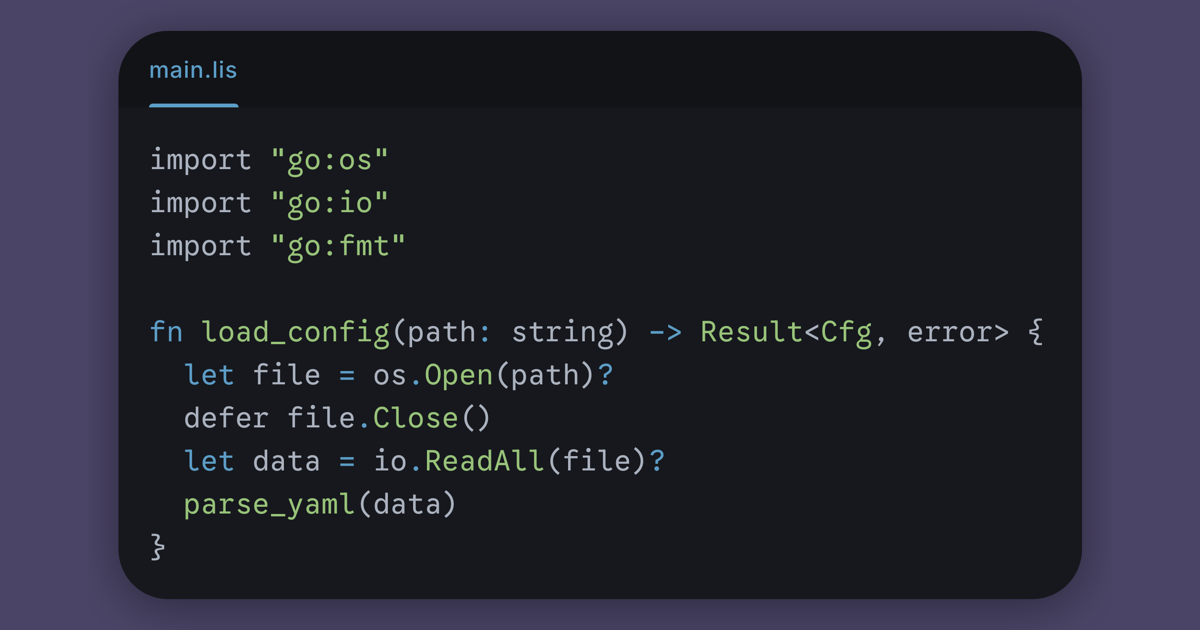
Lisette is a new language inspired by Rust's syntax and type system, but designed to compile directly to Go. It aims to combine Rust's compile-time safety features—like exhaustive pattern matching, no nil, and strong error handling—with Go's efficient runtime and extensive ecosystem. This approach allows developers to write safer, more expressive code while seamlessly leveraging existing Go tools and libraries.
An AWS engineer reported a dramatic 50% performance drop for PostgreSQL on the upcoming Linux 7.0 kernel, caused by changes to kernel preemption modes. While a revert was proposed, kernel developers suggest PostgreSQL should adapt using Restartable Sequences (RSEQ). This could mean significant performance issues for databases on Linux 7.0 until PostgreSQL is updated.
