245 results found

Meta Platforms saw its stock surge 15% last week, the best run since early 2024, following the unveiling of "Meta Compute." This new initiative aims to monetize Meta's extensive AI infrastructure by selling computing capacity and models to external clients, addressing investor concerns over massive AI spending. While Wall Street embraced the potential for significant EPS growth, Meta faces challenges, including its lack of experience in the cloud market and competition from entrenched hyperscalers.

Hugging Face CEO Clem Delangue explains why companies are abandoning proprietary AI APIs for open-source models. Driven by escalating costs and a desire for greater control, this shift highlights a critical moment in AI development and competition. This move fosters decentralization and broadens access to advanced AI tools.

Quick Verdict: A Necessary But Perilous Pivot Volkswagen is embarking on a monumental corporate overhaul, planning to slash its model lineup by up to 50% and its production capacity by a quarter. This dramatic shift,

OpenAI has publicly launched its advanced AI model, GPT-5.6 Sol, known for its cybersecurity capabilities. This launch proceeds despite the Trump administration's earlier request to restrict access to government-approved partners, with the White House now stating its engagement with AI companies is voluntary. The move signals a complex interplay between rapid AI development and evolving government oversight.

Microsoft's 2026 Surface lineup introduces new models with Snapdragon X2 chips, but their significantly higher price tags make previous 2024 editions the smarter purchase for most users. Flagship models like the Surface Laptop 7th Edition and Surface Pro 11th Edition offer strong performance and features at compelling discounted prices.

Meta has launched Muse Image, its inaugural AI image generation model from Alexandr Wang's Superintelligence Labs. Integrated across Meta AI, Instagram, and WhatsApp, the tool allows users to create images from text, modify existing photos, and even generate content featuring friends from public Instagram posts, while offering an opt-out for privacy. This marks a significant step in Meta's aggressive push into the AI domain.

A Box survey of 1,640 IT decision-makers reveals a rapid surge in enterprise AI maturity, with leading-edge companies achieving significantly higher ROI. Key factors driving this success include robust content access, formal governance frameworks, and flexible multi-model platforms, distinguishing high performers from those with ad hoc AI approaches.

Hisense has launched its UR9 RGB MiniLED TV, an affordable flagship model delivering stunning picture quality comparable to higher-end brands like Samsung and LG. Priced at $2,000 for the 65-inch, it utilizes new RGB MiniLED technology for superior color accuracy, contrast, and brightness. The UR9 also stands out as a powerful gaming TV with a 180Hz (330Hz VRR) refresh rate and a dedicated DisplayPort, making it a strong value proposition in the competitive TV market.
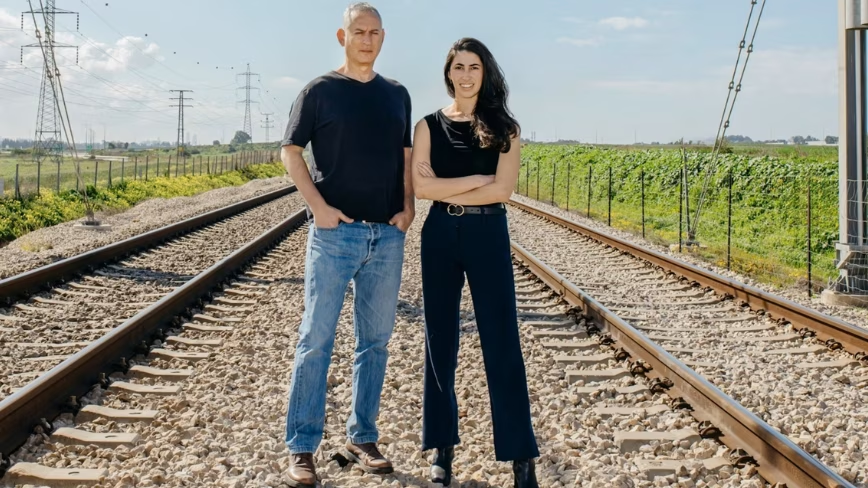
Voltify, led by co-founder Daphna Langer, has launched a revolutionary hybrid model for freight rail electrification. It combines retrofitted battery-electric locomotives with dynamic charging segments and smart microgrids, promising to cut costs by 30% and tackle critical localized pollution.

Tencent has released its Hy3 MoE model under an Apache 2.0 license, removing previous regional restrictions and making it widely accessible. At half the size of GLM-5.2, Hy3 offers significant efficiency gains, excelling in search and tool orchestration, though it trails in coding. This move positions Hy3 as a strong contender for enterprise AI solutions seeking reliability and cost-effective deployment.

Nintendo will cease selling all original Switch models across Europe by mid-February 2027, driven by a new EU regulation requiring user-replaceable batteries. This move impacts the Switch, Switch Lite, and Switch OLED, as well as some accessories. The upcoming Switch 2 will also see a minor redesign to comply.

AI costs are skyrocketing, forcing companies to adopt unconventional methods to save money. A new 'Caveman' plugin instructs advanced AI models to communicate in curt, simplified language, cutting token usage by 65%. This ironic shift from human-like AI to primal grunts highlights the industry's struggle for profitability.

This guide helps developers understand and implement informal threat modeling. It outlines seven critical questions, from identifying assets and adversaries to documenting assumptions and unaddressed threats, emphasizing that threat models are living documents. Using examples like Matrix's flawed approach and the benefits of passkeys, it demonstrates how this practice leads to more robust and user-friendly software designs.

Robert Bowling, ex-Infinity Ward strategist, has launched //18.bravo, aiming for a "radically different approach" to game development. The studio plans to share profits with employees and contractors, reject the live service model, and design games for "forever play" with open-source contingency if they close.

Anthropic's Fable 5 AI model sets a new record in freelance work automation with a 16.1% success rate on the RLI, demonstrating rapid advancement. While impressive, it won't replace human freelancers yet due to limitations in judgment and complex task management.

Quick Verdict For those looking to break free from the endless scroll of smartphone screens and immerse themselves in reading, the base-model Kindle is an excellent, budget-friendly solution. Currently discounted to

Anthropic's advanced AI model, Mythos 5, is partially reinstated for select cybersecurity and infrastructure providers after two weeks of negotiations with the Trump administration. The public-facing Fable 5 remains restricted. This limited return is an exception to an export control directive, similar to a deal granted to OpenAI's GPT-5.6, highlighting evolving US AI regulation.

If you're on the hunt for a reliable running watch that won't break the bank, the Garmin Forerunner 55 has recently become an incredibly attractive option. While it's not Garmin's most advanced model, its current deep

Liquid AI, founded by former MIT computer scientists, today launched LFM2.5-230M, its smallest AI language model yet. This 230-million-parameter foundation model is explicitly designed for on-device agentic workflows,

Microsoft increases Xbox Series console prices for the third time in two years ($100-$150 upswings) and discontinues the 2TB model. This review covers the implications, new payment options, competitive landscape, and offers a buying recommendation.

Is your Motorola phone feeling sluggish, bogged down by unnecessary pre-installed apps? You're not alone. Many budget Android phones, including Motorola models like the Moto G, come packed with what’s commonly known as

Shopify has developed a resilient AI stack featuring an LLM proxy for automatic failover between AI providers and a sophisticated distillation pipeline for creating specialized, cost-effective models. This strategy ensures continuous AI operations, avoids vendor lock-in, and significantly boosts efficiency and accuracy across its platform.

So, you’ve joined the ranks of 3D printer enthusiasts, and along the way, you’ve likely accumulated a small armada of Benchy models. These iconic little boats, often printed as a rite of passage or for calibration, can

During Amazon Prime Day 2026, the Apple Watch SE 3 has dropped to an all-time low price of $199, marking it as a significant deal for the feature-rich wearable. This model, often lauded as a "sleeper hit," received substantial upgrades including an always-on display, new gestures, 5G connectivity, and an upgraded processor. It presents a compelling value proposition, especially with no SE line update expected for at least another year, offering longevity over the soon-to-be-replaced Series 11.

The Trump administration has ordered Anthropic to take its advanced AI models, Fable 5 and Mythos 5, offline due to unspecified “national security concerns.” This move follows reports of Amazon researchers bypassing Fable 5's guardrails. While cybersecurity experts deem the ban dangerous, some speculate it could inadvertently boost Anthropic's image, positioning its models as uniquely powerful.
