
Voltify's Hybrid Model Propels Freight Rail Beyond Wires, Batteries
Voltify, led by co-founder Daphna Langer, has launched a revolutionary hybrid model for freight rail electrification. It combines retrofitted battery-electric locomotives with dynamic charging segments and smart microgrids, promising to cut costs by 30% and tackle critical localized pollution.
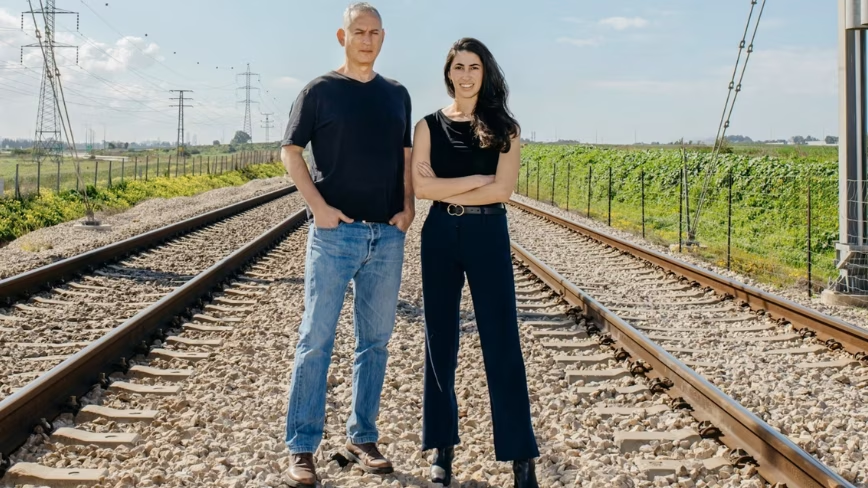
Voltify, a new player in sustainable transport co-founded by Daphna Langer, has unveiled a groundbreaking approach to electrifying freight rail. The company's innovative model aims to circumvent the prohibitive costs of full network electrification and the operational limits of battery-only locomotives, offering a pragmatic solution to decarbonize the industry without sacrificing range or requiring a complete infrastructure overhaul.
The Electrification Dilemma
Despite being the most energy-efficient method for land transport, freight rail largely depends on diesel, a significant contributor to emissions. Operators face a triple threat: volatile fuel prices, stringent environmental regulations, and aging diesel fleets. Traditional electrification strategies, such as installing overhead catenary wires across the United States' vast, privately owned 140,000-mile network, are financially unfeasible.
Meanwhile, a shift to purely battery-electric locomotives presents its own challenges. Batteries lack the energy density of diesel, storing over ten times less energy per kilogram. This leads to severe range constraints, necessitating frequent, time-consuming recharges or the impractical addition of heavy battery packs, hindering economic viability. The industry finds itself at an impasse between these two imperfect extremes.
Leapfrogging the Status Quo
Voltify's core premise rejects this binary choice. Instead, it proposes a "scale compression" strategy, electrifying only crucial segments of the rail network. This involves strategically deploying high-power charging infrastructure that can deliver energy to trains while they are in motion, alongside static charging points at depots for essential top-ups during operational pauses. Onboard battery storage then powers the locomotives across the un-electrified sections.
This intelligent distribution reframes electrification not as a monolithic infrastructure project, but as a targeted enhancement of the network's highest-value points. It promises to deliver the benefits of electrification without the monumental investment typically associated with a full system replacement.
A Three-Pillar System for Energy Orchestration
Voltify's comprehensive architecture rests on three integrated pillars. First, it focuses on locomotives by retrofitting existing diesel units into battery-electric models. This clever strategy significantly reduces capital expenditure and leverages the industry's considerable asset base, making the transition more accessible for rail operators.
Second is the charging infrastructure. Voltify employs an overhead conductor bar and pantograph system designed for both static and dynamic charging, featuring an unmanned architecture suitable for demanding rail environments. This high-throughput system is not for continuous electrification but for delivering power precisely where and when it's most effective. Manual chargers at depots provide additional flexibility.
The third pillar involves power and optimization. Voltify integrates diverse energy sources—solar generation, grid power, and advanced battery storage—into localized microgrids. These microgrids are managed by proprietary software that intelligently orchestrates energy flow, deciding in real-time when to purchase, store, or dispatch electricity based on prevailing costs and demand, thus optimizing energy efficiency and cost savings.
Beyond Decarbonization: A Compelling Business Case
While the environmental benefits are clear, Voltify's model offers a powerful economic incentive. Diesel fuel is a major and highly volatile operating expense for rail companies. Voltify estimates its system can slash energy costs by up to 30% compared to diesel, transforming electrification into a direct driver for improved operating margins rather than just a sustainability initiative. For Class I railroads, this represents a significant financial opportunity.
Furthermore, increasing regulatory pressure related to local air quality is a key accelerator. While freight rail's overall CO2 footprint might be comparatively smaller, its localized emissions of nitrogen oxides (NOx) and diesel particulate matter are highly concentrated around rail yards and port communities. These areas are often adjacent to densely populated, lower-income neighborhoods, creating severe public health burdens.
Addressing the Concentration Problem
The geographical concentration of rail emissions is a critical, often overlooked aspect. Switcher locomotives, operating continuously in fixed locations such as rail yards, expose nearby residential areas to high levels of pollutants. Research highlights a link between rail-related pollution and substantial public health costs, including thousands of premature deaths annually and billions in health damages.
Studies in California, for instance, have identified elevated cancer and asthma risks around major rail yards, disproportionately impacting vulnerable communities. The slow modernization of locomotive fleets, many of which remain in service for decades under outdated emissions standards, exacerbates this issue. Voltify's system directly addresses these localized pollution hotspots by transitioning to cleaner electric power, offering both environmental and social justice benefits.
A Holistic System Redesign for Rail's Future
Voltify’s solution transcends a simple climate narrative, addressing a multifaceted problem that encompasses technical, economic, and environmental justice dimensions. By cleverly sidestepping the need for full-network electrification while still achieving substantial decarbonization and cost reductions, Voltify presents a "leapfrog path" that previous models have failed to unlock. The success of this innovative approach hinges not only on its engineering prowess but also on the rail industry's readiness to embrace a distributed, smarter electrification paradigm.
FAQ
Q: What is Voltify's primary innovation in rail electrification?
A: Voltify's primary innovation is a hybrid electrification model that avoids full-network catenary wiring or reliance on battery-only systems. It combines battery-electric locomotives (often retrofitted from existing diesel units) with strategically placed, high-power dynamic charging segments that power trains while in motion, complemented by static depot charging.
Q: How does Voltify's system address the economic challenges of traditional rail electrification?
A: Voltify addresses economic challenges by reducing the need for expensive full-network infrastructure overhauls. Its system can cut energy costs for rail operators by up to 30% compared to diesel, transforming electrification into a clear operating margin improvement rather than just a sustainability cost.
Q: Beyond carbon emissions, what other critical problems does Voltify's technology aim to solve?
A: Beyond global CO2 reduction, Voltify specifically targets localized air quality issues. Diesel locomotives emit nitrogen oxides and particulate matter, which are highly concentrated in rail yards and port-adjacent communities, disproportionately affecting lower-income areas and contributing to significant public health problems like elevated cancer and asthma risks.
Related articles

Apple Unveils iPhone Duo: Pricey Foldable Sees Soaring Demand
Apple has officially entered the foldable smartphone arena with the long-anticipated launch of the iPhone Duo. Priced starting at a hefty $1,999, the device features a 5.4-inch outer display and a larger 7.6-inch inner

in-depth: Chicago-Area Cops Helped HSI Spy on Minnesota Anti-ICE
Chicago-area law enforcement, including local police and HSI agents, conducted undercover surveillance on Minnesota anti-ICE activists at an April 2, 2022, talk in Chicago. This operation was part of a federal conspiracy probe into 15 Minnesota activists facing felony charges related to immigration enforcement resistance. Civil liberties advocates have condemned the surveillance as a troubling intrusion into protected political activity.

Mark Wahlberg on using AI in film ‘the right way’ and being open to
Actor Mark Wahlberg believes AI has a place in filmmaking if used responsibly for enhancement, not script generation or actor replacement. At TechCrunch Disrupt, he expressed openness to an AI likeness carrying on his legacy, managed by his family, and emphasized storytelling.

Tesla Unveils Thruster-Equipped Roadster, 2028 Production Targeted
Tesla has unveiled its second-generation Roadster, featuring cold-gas thrusters co-developed with SpaceX, enabling it to jump and flip. The electric sports car demonstrated 0-60mph in an astonishing 0.81 seconds, with production targeted for 2028. This highly anticipated reveal also serves as a key recruitment tool for Tesla's ambitious AI and robotics initiatives.

AI's Confidence vs. Formal Methods' Rigor: Design Flaws & Verification
While AI accelerates code generation, formal methods remain critical for ensuring system correctness. Languages like TLA+ and tools like Quint enable developers to model and verify system designs before coding, catching subtle flaws. Quint makes formal methods more accessible with developer-friendly syntax and executability. This approach is vital for verifying AI-generated code through trace validation and model-based testing, ensuring reliability against real-world data.

Amazon Prime Video Launches AI-Powered Prime 360 for NBA Coverage
Amazon Prime Video is elevating its NBA coverage with the introduction of Prime 360, an AI-powered replay system offering immersive, 'fly through' views of the action. Kicking off its second season, Prime Video also adds Yahoo fantasy integration and gains exclusive Eastern Conference Finals rights, expanding its tech-driven sports broadcast. The new features aim to deliver a unique and interactive viewing experience for basketball fans.