32 results found

As software developers, we're constantly pushing the boundaries of what our systems can do, optimizing performance, and building resilient architectures. But how often do we apply the same rigorous approach to our own

Learn to set up and use a Large Language Model (LLM) directly on your phone, gaining privacy and offline access in three simple steps. Discover the right apps, models, and how to optimize performance.

As developers, we're rapidly integrating Large Language Models (LLMs) into AI agents, building powerful applications that can plan, execute tools, and generate complex responses. While a single-user prototype might run

Amazon has updated its terms and conditions to mandate binding arbitration and include a class action waiver for all customer disputes. This strategic move aims to prevent large-scale lawsuits, rerouting claims away from traditional courts and judicial oversight. The change marks a significant shift, especially after Amazon had previously removed similar language in 2021 following other legal challenges.
Modern Large Language Models (LLMs) are notorious black boxes. Trained on vast, unfiltered swaths of the internet, they exhibit incredible emergent capabilities, but understanding how and when these capabilities arise
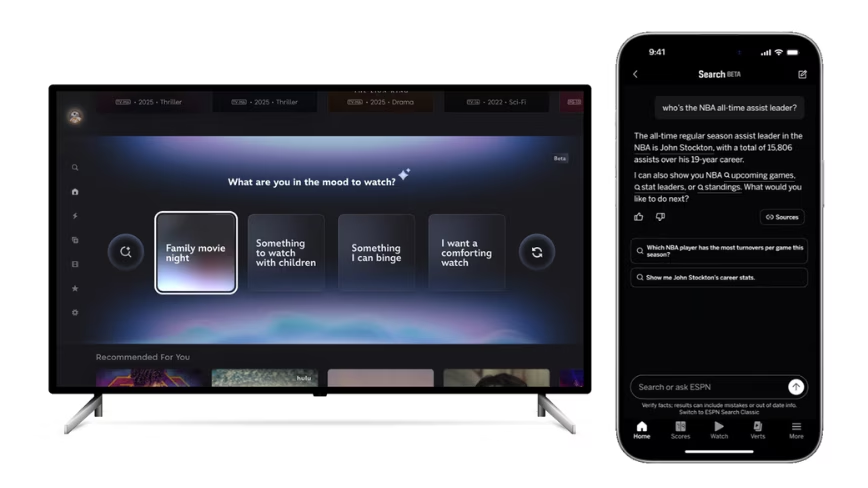
Disney+ and ESPN are conducting limited beta tests in the US for new AI-powered search features. Disney+ is enhancing content discovery through mood-based natural language recommendations, while ESPN is providing direct answers and stats from its extensive archives. An optional "Personal Intelligence" feature can also integrate with user calendars and emails for contextual assistance, signifying a broader industry trend to combat content overload and streamline user experience in streaming.

Meta is leveraging AI, especially large language models (LLMs), to rapidly develop and launch new consumer applications, marking a strategic pivot. CEO Mark Zuckerberg announced more apps are coming soon, following recent launches for Facebook Groups, Marketplace, and Instagram. This AI-driven acceleration helps Meta test ideas faster and has significantly boosted apps like Threads.

AI costs are skyrocketing, forcing companies to adopt unconventional methods to save money. A new 'Caveman' plugin instructs advanced AI models to communicate in curt, simplified language, cutting token usage by 65%. This ironic shift from human-like AI to primal grunts highlights the industry's struggle for profitability.

Chrome's Voice Dictation Gets a Natural Upgrade: Finally, Technology Understands Us Quick Verdict: Google's latest update to Chrome's voice dictation, introduced in the Chrome 151 Beta, is a subtle yet significant

TechCrunch has unveiled an updated, comprehensive AI glossary to demystify the rapidly evolving language of artificial intelligence. It provides plain-English definitions for essential terms like LLMs, AGI, and Hallucination, crucial for anyone tracking the transformative tech landscape. This resource aims to bridge the knowledge gap for professionals and enthusiasts, offering clarity on the foundational technologies, emerging capabilities, and industry challenges facing AI.

Liquid AI, founded by former MIT computer scientists, today launched LFM2.5-230M, its smallest AI language model yet. This 230-million-parameter foundation model is explicitly designed for on-device agentic workflows,

Duolingo XP Boosts: Gamification Gone Astray Quick Verdict: Duolingo remains a stellar language-learning application, celebrated for its engaging, gamified approach that effectively builds daily learning habits.
As developers, we embrace new tools that promise to accelerate our work. AI-assisted development, leveraging powerful Large Language Models (LLMs), quickly became a game-changer. However, many of us, myself included,

Microsoft has launched ASSERT, an open-source framework designed to simplify AI behavior testing. It enables developers to create comprehensive, application-specific evaluations using natural language descriptions, ensuring AI systems act as intended for particular products and services. The tool translates high-level goals into structured tests, generates scenarios, scores results, and logs execution paths.

The international AI landscape presents unique challenges and opportunities, requiring developers to think beyond traditional tech hubs. Key aspects include adapting AI models to local languages and cultures, navigating the complex global supply chain for critical hardware like semiconductors, and understanding how venture capital assesses these international ventures. Success hinges on deep local market understanding, robust technical solutions for localization, and resilience against logistical hurdles.

LLMs & Falsehoods: When Warnings Don't Stick Verdict: A Critical Flaw in AI Learning New research reveals a concerning "negation neglect" in large language models (LLMs), indicating a profound challenge in how these

Building a Retrieval Augmented Generation (RAG) system often begins with exciting prototypes, quickly demonstrating the power of injecting external knowledge into large language models (LLMs). However, the journey from

Are you scratching your head when your kids or grandkids drop terms like 'cheesin''? You're not alone! Youth culture evolves rapidly, and staying current with slang can feel like learning a new language. This guide will

Graph-Enhanced RAG: Solving LLM Context Gaps in Production In a significant evolution for large language model (LLM) deployment, a new architectural pattern is emerging that promises to resolve critical context
The rapid evolution of AI has created a dense lexicon, leaving many confused. This guide demystifies key terms like LLMs, AI agents, and hallucinations, providing a foundational understanding. Grasping this language is crucial for navigating AI's transformative impact and future.

MCP (Model Context Protocol) is a new standard that acts as a standardized bridge, enabling secure and efficient connections between large language models (LLMs) and external, private enterprise data sources. It addresses the complexity of traditional API integrations by standardizing data formats for AI, making agentic workflows more scalable and effective. MCP ensures LLMs have the crucial internal context needed for practical enterprise applications.

xAI has launched Grok 4.3, its new large language model, featuring "always-on reasoning" and advanced agentic capabilities. The model arrives with an aggressively low API pricing strategy ($1.25/$2.50 per million input/output tokens) and a sophisticated voice cloning suite called Custom Voices. While excelling in specialized legal and financial tasks, Grok 4.3 presents a complex trade-off between cost efficiency, deep reasoning, and general consistency for enterprise users.

Every product experimentation team eventually confronts a common challenge when launching new features, especially those leveraging Large Language Models (LLMs): the 'Opt-In Trap'. Imagine shipping a new AI assistant

DeepMind veteran David Silver has secured an unprecedented $1.1 billion in funding for his new British AI lab, Ineffable Intelligence, at a $5.1 billion valuation. The company aims to build a "superlearner" AI that acquires knowledge and skills purely through reinforcement learning, without relying on human data, a radical departure from current large language models.
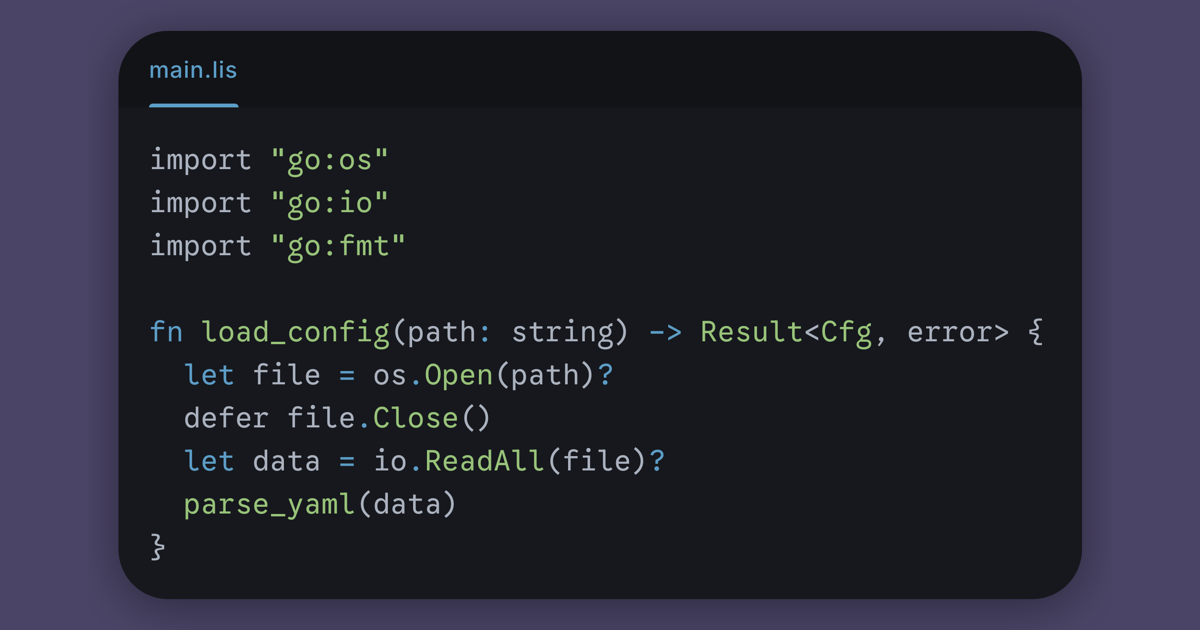
Lisette is a new language inspired by Rust's syntax and type system, but designed to compile directly to Go. It aims to combine Rust's compile-time safety features—like exhaustive pattern matching, no nil, and strong error handling—with Go's efficient runtime and extensive ecosystem. This approach allows developers to write safer, more expressive code while seamlessly leveraging existing Go tools and libraries.
