
Disney+ and ESPN Pilot AI Search for Natural Language Discovery
Disney+ and ESPN are conducting limited beta tests in the US for new AI-powered search features. Disney+ is enhancing content discovery through mood-based natural language recommendations, while ESPN is providing direct answers and stats from its extensive archives. An optional "Personal Intelligence" feature can also integrate with user calendars and emails for contextual assistance, signifying a broader industry trend to combat content overload and streamline user experience in streaming.
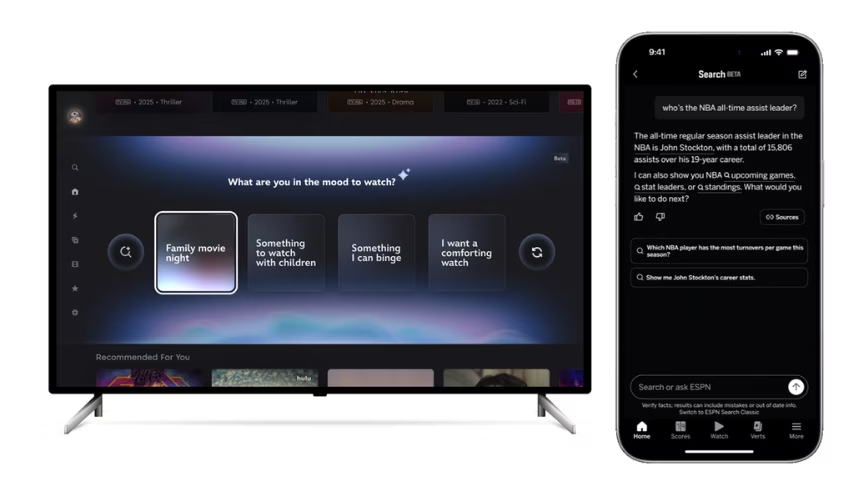
Disney+ and ESPN are diving into the artificial intelligence frontier, launching limited beta tests for AI-powered search capabilities designed to revolutionize content discovery. The Walt Disney Company announced Wednesday that these new features enable users to interact using natural language, allowing for more intuitive navigation through vast content libraries and deep data archives. This strategic move, currently in limited beta within the US, aims to combat viewer decision fatigue, a growing challenge across the competitive streaming landscape.
Revolutionizing Content Discovery on Disney+
The Disney+ beta introduces a sophisticated recommendation system that moves beyond traditional viewing history. Subscribers can now describe their mood or specific desires in plain language, whether through text or voice input. This allows the system to suggest content tailored to the immediate moment, offering a lighthearted film, for example, even if the user typically gravitates towards crime dramas. This adaptive approach promises a more personalized and relevant viewing experience, helping users transition from the common lament of "I don't know what to watch" to immediate, contextually appropriate suggestions.
ESPN's Intelligent Sports Information
Meanwhile, ESPN Search empowers sports fans to query decades of content, stats, articles, and videos using natural language. Instead of sifting through countless links, users can ask precise questions such as, "Who has the most rushing yards in a single playoff game?" The AI then provides direct answers, comprehensive statistics, and relevant supporting content drawn from ESPN’s extensive internal knowledge repositories. This marks a significant leap from keyword-based searches, offering instant, detailed information from a rich historical database.
The Rise of Personal Intelligence
A particularly innovative addition is "Personal Intelligence," an opt-in feature designed to further personalize user interactions. With explicit permission, this AI can integrate with a user's Gmail and Google Calendar, drawing contextual information to enhance responses and recommendations. For instance, a subscriber with an upcoming flight to Vancouver in their calendar could ask the app for their landing time, receiving a direct answer without needing to switch applications. This feature, which is off by default, also boasts conversational memory, allowing users to pick up complex queries, like trip planning, without starting over.
The Battle Against Content Overload
Disney's entry into advanced AI search is a direct response to the escalating "streaming wars," where major players are racing to enhance user experience and engagement. The pervasive challenge for all streaming platforms remains the same: viewers spending too much time deciding what to watch, often leading to abandonment of the viewing session altogether. This "content overload" is pushing companies towards innovative AI solutions.
Amazon's Prime Video is reportedly undergoing a significant AI-driven redesign, codenamed "Lighthouse," specifically focused on improving recommendations. Similarly, Netflix is leveraging generative AI to solve its own catalog's content overload issues. Disney's beta tests, though at an earlier stage than some competitors, highlight a collective industry bet on AI's ability to streamline content discovery and reduce decision fatigue.
Implications and Future Outlook
These AI initiatives signify a new battleground in the streaming sector, shifting the focus from sheer content volume to intelligent access and personalized curation. The success and eventual widespread rollout of Disney's and ESPN's AI features will hinge on the outcomes of these limited US beta tests, for which no official launch date has been announced. As platforms vie to help users decide what to consume fastest, AI is rapidly becoming a critical differentiator in an increasingly saturated market, defining the next front in the ongoing streaming wars.
FAQ
Q: What exactly are Disney+ and ESPN testing with AI search?
A: Disney+ is testing AI to recommend content based on a user's mood and natural language descriptions, moving beyond historical viewing data. ESPN is testing natural language search to provide direct answers, stats, and related content from its vast sports archives, spanning decades of information.
Q: What is "Personal Intelligence" and how does it work?
A: Personal Intelligence is an optional feature that, with explicit user permission, integrates with a user's Gmail and Google Calendar to provide context-aware responses and recommendations. For example, it can answer travel questions if flight details are in your calendar, and it remembers past conversations for seamless interaction. It is off by default.
Q: Why are streaming services like Disney+, ESPN, Amazon, and Netflix investing in AI search?
A: These companies are investing in AI to solve the prevalent "content overload" problem. Viewers often spend too long trying to decide what to watch, sometimes giving up entirely. AI-powered natural language search aims to make content discovery faster, more intuitive, and highly personalized, ultimately enhancing user satisfaction and engagement across their platforms.
Related articles

Apple iPhone Duo: A Daring Debut with Notable Compromises
Apple's highly anticipated iPhone Duo, priced at $2,000, has gone on pre-order. While hailed as "Apple's most exciting device in a decade" for its innovative foldable design and immersive display, it comes with significant drawbacks like the absence of FaceID and a premium camera.

Tesla Unveils Thruster-Equipped Roadster, 2028 Production Targeted
Tesla has unveiled its second-generation Roadster, featuring cold-gas thrusters co-developed with SpaceX, enabling it to jump and flip. The electric sports car demonstrated 0-60mph in an astonishing 0.81 seconds, with production targeted for 2028. This highly anticipated reveal also serves as a key recruitment tool for Tesla's ambitious AI and robotics initiatives.

Amazon Prime Video Launches AI-Powered Prime 360 for NBA Coverage
Amazon Prime Video is elevating its NBA coverage with the introduction of Prime 360, an AI-powered replay system offering immersive, 'fly through' views of the action. Kicking off its second season, Prime Video also adds Yahoo fantasy integration and gains exclusive Eastern Conference Finals rights, expanding its tech-driven sports broadcast. The new features aim to deliver a unique and interactive viewing experience for basketball fans.

regional: A two-person Seattle startup lands $1M to reinvent
Seattle startup TriMagnetix has secured $1 million to develop semiconductor chips that consume 800 times less energy and are radiation-resistant. The two-person company, leveraging nanomagnetic technology, is targeting space applications and data centers. With new funding and key partnerships, TriMagnetix aims for commercial sales within a year.

Kojima Compares Divisive New Film 'Digger' to MGS2's Prescient Vision
Gaming icon Hideo Kojima has praised the divisive 2026 film *Digger*, drawing intriguing parallels to his own prophetic game, *Metal Gear Solid 2*. Both works, he explains, uniquely explore the dangers of misinformation and a fragmented digital reality, anxieties he shares with *Digger*'s director, Alejandro González Iñárritu.
Galaxy Watch One UI 9 Beta: Promising Progress, But Patience Needed
Galaxy Watch 8, Watch Ultra, and Watch 7 are receiving a new One UI 9 Watch beta build with bug fixes and a security patch. Active development signals progress, but a stable release date remains elusive.