44 results found

Shopify has developed a resilient AI stack featuring an LLM proxy for automatic failover between AI providers and a sophisticated distillation pipeline for creating specialized, cost-effective models. This strategy ensures continuous AI operations, avoids vendor lock-in, and significantly boosts efficiency and accuracy across its platform.

AI video startup Higgsfield has launched Supercomputer 2.0, an autonomous agent framework for enterprise marketing. Built on NVIDIA technology, it claims adoption by 78 percent of Fortune 500 companies, aiming to automate full campaign lifecycles. The company also produced an AI-generated feature film in 14 days.
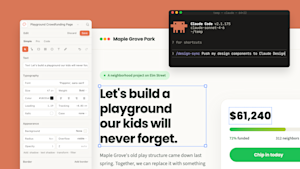
Anthropic has released a major overhaul of Claude Design, addressing its initial token-burning problem with shared usage limits and efficiency gains. The update also introduces design system imports for enterprise brand compliance and bidirectional integration with Claude Code to streamline the design-to-engineering workflow. This strategic move positions Claude Design as a critical component in Anthropic's broader vision to embed AI across the enterprise stack.

Sakana AI has launched Marlin, an "ultra deep research" agent designed for enterprise clients. Operating as a "Virtual CSO," Marlin conducts self-governing reasoning for up to eight hours to deliver comprehensive, 100+ page strategy reports. Powered by Adaptive Branching Monte Carlo Tree Search (AB-MCTS) and a multi-LLM architecture, it focuses on deep, vetted analysis over quick generation, backed by strict data privacy policies and significant venture capital.

Anthropic CEO Dario Amodei is pushing for FAA-style regulation of powerful AI models, citing public safety concerns amid rapidly advancing AI capabilities and potential misuses. This call for oversight, backed by new policy frameworks and $350 million in funding, suggests future operational, regulatory, and workforce constraints for enterprises. Key implications include potential deployment holds for frontier models, elevating AI cybersecurity to critical infrastructure status, and the need for proactive strategies to manage structural labor displacement.

Apple has introduced a groundbreaking architecture at WWDC26 for on-device AI, overcoming the long-standing DRAM memory limit. Its new AFM 3 Core Advanced model stores 20 billion parameters in NAND flash, using a unique Instruction-Following Pruning (IFP) method to dynamically load expert modules into DRAM. This innovation significantly boosts local AI capabilities for agentic workloads.

Coralogix, a software-monitoring startup, has raised $200 million in Series F funding, bringing its valuation to $1.6 billion. The company is betting on increased demand for tools to monitor and troubleshoot autonomous AI agents as they become critical in enterprise operations.

ZeroDrift, an AI compliance startup, has secured $10 million in seed funding from investors like a16z Speedrun. The company's service acts as a crucial intermediary, detecting compliance violations in AI-generated messages and rewriting them to meet regulatory standards like SOC 2 and GDPR. This rapid, oversubscribed funding round highlights the urgent demand for robust AI governance solutions as businesses scale AI adoption.

Enterprises face unprecedented challenges tracking AI ROI amidst surging, unpredictable costs. A new report shows 90% of tech leaders are uncertain, prompting a shift to Technology Business Management (TBM) to strategically align investments and manage expenditures for tangible growth.

General Motors has laid off approximately 600 salaried IT employees, over 10% of its IT department, in a strategic move to pivot towards AI-focused talent. The automaker is replacing traditional roles with experts in AI-native development, data engineering, and cloud technologies, signaling a fundamental workforce restructuring for future AI adoption.

A critical flaw dubbed "AI tool poisoning" has been uncovered in enterprise AI agent security. The vulnerability exploits AI agents' reliance on unverified tool descriptions, rendering traditional software supply chain controls insufficient for ensuring behavioral integrity. A new runtime verification layer, using behavioral specifications and a proxy, is proposed to validate tool actions and prevent sophisticated attacks like prompt injection and behavioral drift.

As autonomous AI systems become prevalent, intent-based chaos testing emerges as a critical method to prevent catastrophic failures caused by AI agents acting confidently but incorrectly. This approach addresses the limitations of traditional testing, which fails to account for AI's probabilistic nature and complex interactions. By measuring deviation from an agent's intended behavioral boundaries, this testing methodology helps ensure AI systems operate safely in unpredictable production environments.

OpenAI has updated ChatGPT to the GPT-5.5 Instant model, introducing a new partial memory feature that shows some of the context influencing AI responses. While improving transparency and accuracy, this incomplete observability layer could challenge enterprises by creating competing context logs alongside existing audit systems. Businesses must now formalize memory management to reconcile these new insights with their established processes.

Elon Musk's lawsuit against OpenAI heated up as he testified for three days, accusing the company of betraying its nonprofit mission by going for-profit. He repeatedly asserted, "You can't steal a charity," as emails and tweets surfaced. This comes amidst strong cloud earnings driven by enterprise AI spending and other tech developments.

AI coding startup Cursor is nearing a $2B+ funding round at a $50B valuation, nearly doubling its previous valuation in six months. Led by Thrive and Andreessen Horowitz, this capital injection is fueled by rapid enterprise growth and improved profitability from its proprietary AI model.

Nvidia CEO Jensen Huang took the stage at GTC 2026 on Monday to unveil the Agent Toolkit, an open-source platform for building autonomous AI agents, announcing a significant industry alignment with 17 major enterprise

Slack has announced over 30 new AI capabilities for Slackbot, marking its most significant update since the Salesforce acquisition. This transformation positions Slackbot as a full-spectrum enterprise agent capable of cross-platform meeting summaries, desktop operation, and third-party tool integration, aiming for substantial productivity gains. The update also introduces a native CRM and leverages Anthropic's Claude model, navigating competitive pressures and privacy concerns with a user-initiated, opt-in approach.

Cohere has launched Transcribe, an open-weight ASR model with a remarkable 5.42% word error rate. This model offers enterprises state-of-the-art accuracy, comparable to closed APIs, while allowing on-premise deployment to address data residency, control, and latency concerns. Transcribe currently leads the Hugging Face ASR leaderboard, outperforming Whisper and other industry leaders.

VentureBeat's Transform 2026 conference is actively seeking the most innovative autonomous agent technologies for its annual Innovation Showcase. Scheduled for July 14-15 in Menlo Park, the event aims to feature up to 10 companies pioneering solutions in enterprise agentic orchestration, LLMOps, RAG infrastructure, and AI security. Selected innovators will gain exposure to industry leaders, direct feedback, and exclusive VentureBeat editorial coverage.
