20 results found

Netflix is laying off approximately 1,000 employees, or six percent of its global workforce, in its largest-ever job cut. This move targets product, tech, HR, and legal teams to reduce costs and re-prioritize investments despite recent financial growth.
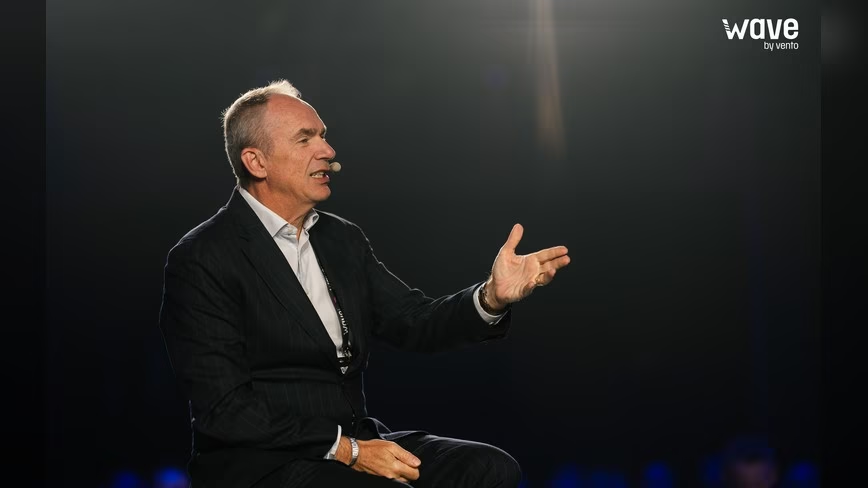
Jean-Christophe Laloux, incoming EIF chief, announced that funds backed by the European Tech Champions Initiative now hold 15 unicorn companies. He detailed plans to expand the initiative to support smaller funds and attract co-investors, emphasizing the importance of scaling European startups within the continent for "sovereignty." The EIF will prioritize investments in deep tech, including AI, biotech, defense, and cleantech.

OpenAI has reportedly told investors its annualized revenue is nearing $50 billion, a significant $20 billion less than previous projections. This update highlights pressures on the AI giant to justify massive investments and comes amidst a delayed IPO.

GM and LG Energy Solution are investing $1 billion to mass-produce advanced lithium manganese-rich (LMR) battery cells at their Spring Hill, Tennessee plant by 2028. This move aims to deliver 33% higher energy density than LFP at the same cost for large EVs, marking a strategic departure from European LFP investments.

Meta Platforms has launched the "Meta Enterprise Platform," a new initiative to bring its AI technologies to businesses, leveraging its full tech stack including Muse. The company has hired MongoDB CEO Chirantan "CJ" Desai to lead this strategic push. Desai's appointment and Meta's enterprise pivot aim to monetize significant AI investments, while MongoDB's shares dropped over 17% following Desai's sudden departure.

Brian Ward, CEO of Saudi Arabia's $38 billion Savvy Games Group, is stepping down, with PIF Governor Turqi Alnowaiser taking over. Savvy owns major mobile companies like Niantic (*Pokémon Go*) and Scopely, and is acquiring Moonton Games. This shift highlights Saudi Arabia's deep dive into gaming, including the separate $55 billion EA acquisition, raising questions about strategy and the industry's future.

Open-weight AI companies are becoming prime acquisition targets in Silicon Valley, with Nvidia reportedly set to acquire Hugging Face for $13 billion. This follows Nvidia's $6 billion purchase of Poolside and Stripe's $7 billion acquisition of OpenRouter, signaling a strategic shift by tech giants to diversify AI investments and gain control over model development. These deals reflect a growing demand for cost-effective, customizable AI solutions and a desire to reduce reliance on dominant frontier labs. Experts predict increased adoption as AI workflows mature, fostering a more specialized and open AI ecosystem.

Artificial intelligence is revealing critical limitations in traditional network architectures, which were not built to handle the unpredictable, real-time traffic demanded by modern AI workloads. This shift necessitates treating the network as a strategic, intelligent control layer, crucial for AI performance, reliability, and cost-efficiency. Enterprises must adopt dynamic, secure, and software-defined networks to truly leverage their AI investments.
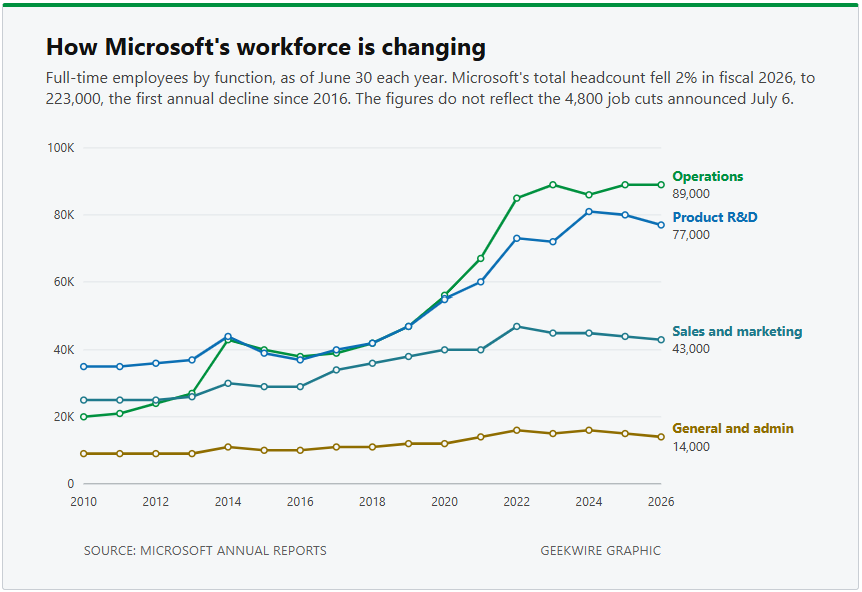
Microsoft's total headcount dropped for the first time in a decade, fueled by a second consecutive decline in R&D roles, despite record revenue growth. This strategic shift reflects the company's adaptation to the AI era, including significant investments in AI infrastructure and a reallocation of engineering talent to customer-facing roles.
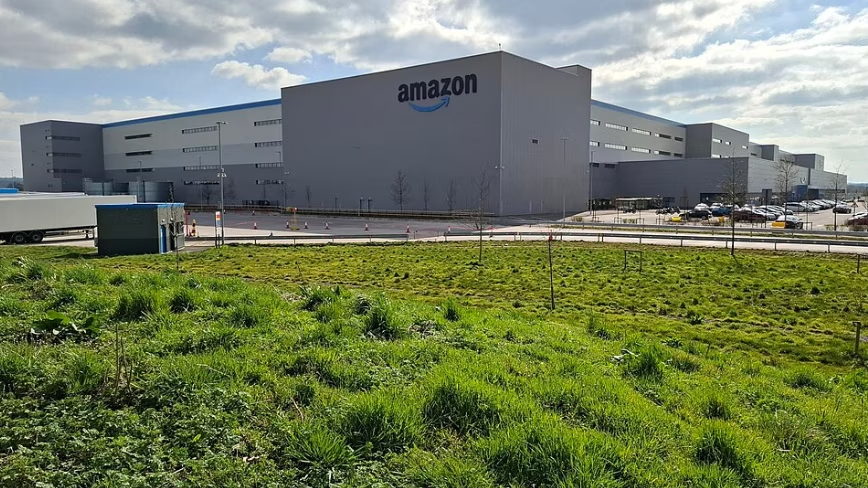
Amazon has shut down its AGI Lab, a San Francisco team dedicated to human-level AI, barely 18 months after its formation. This move, part of wider layoffs, signals Amazon's retreat from the frontier AI race, pivoting instead to selling AI services and infrastructure through AWS and external investments.

Massive investments in artificial intelligence are unexpectedly driving up consumer costs, creating a ripple effect across various sectors. From pricier electronics and surging electricity bills to more expensive software subscriptions, AI's demand for resources is fueling inflation. While future benefits are promised, current spending is leading to immediate price hikes for Americans.

Amidst record-breaking AI investments, a new trend called "together tech" is emerging, focusing on human connection and real-world experiences. Startups like Brynn Putnam's Board and the cyberdeck movement are gaining traction by prioritizing in-person social interaction over purely digital engagement, signaling a compelling counter-narrative in the startup landscape.
Schneider Electric projects its India data-centre business to outpace company-wide growth, potentially becoming its largest segment within 3-5 years. This is driven by India's massive planned data-centre expansion from 1.5 GW to 6-8 GW, bridging a significant gap between data consumption and capacity. Strategic investments, a strong Q1 2026 performance, and India's cost advantages underpin this outlook, despite challenges like rising material costs.

Former OpenAI staffers and AI safety nonprofits warn that Elon Musk's xAI poses "unpriced risks" to SpaceX's IPO due to its poor safety record. A letter to investors highlights incidents like Grok generating harmful content and xAI's lack of standard safety protocols, potentially leading to increased regulation and litigation for the rocket company. They urge greater transparency and robust safety investments from xAI.

Enterprises face unprecedented challenges tracking AI ROI amidst surging, unpredictable costs. A new report shows 90% of tech leaders are uncertain, prompting a shift to Technology Business Management (TBM) to strategically align investments and manage expenditures for tangible growth.
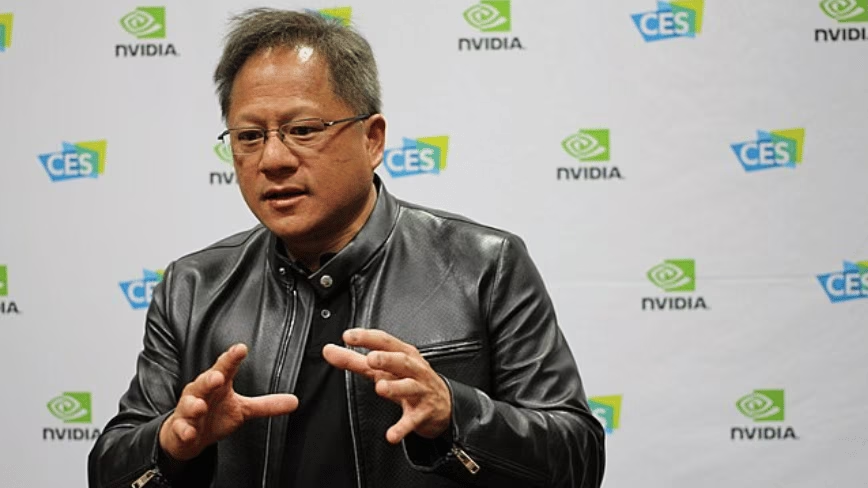
NVIDIA has committed over $40 billion to AI equity investments in the first four months of 2026, including a $30 billion stake in OpenAI. This strategy, which also includes significant investments in companies like CoreWeave, IREN, and Corning, aims to ensure compute capacity is built around NVIDIA's GPUs, influencing the entire AI value chain. While bolstering NVIDIA's data-center revenue, the aggressive approach raises questions about "circular financing" and potential regulatory scrutiny.

Europe's tech sector saw over $1.1 billion in funding and fund closes from March 23-29, with significant investments flowing into deep tech, AI infrastructure, and a diverse range of sectors including biotech, space, and defense. This highlights a strategic continental focus on foundational innovations and long-term technological advancements.

Toyota, long cautious on EVs, is now accelerating with new models and US plant investments, betting on the long game while rivals retreat, aiming to meet future US EV demand.
The US government is reportedly considering forcing Tencent to divest its major gaming investments, including stakes in Epic Games and Riot Games. Citing national security concerns over data collection, this ongoing investigation could significantly reshape the global gaming industry.

Meta's flagship metaverse service, Horizon Worlds, is decoupling from its Quest VR platform and shifting its focus predominantly to mobile. This strategic pivot follows significant financial losses in Meta's mixed reality division and internal layoffs, signaling a move away from an all-encompassing VR metaverse vision toward mobile engagement, augmented reality, and AI investments.
