74 results found

AI coding tools have fundamentally altered software development economics, making building code faster and cheaper than extensive planning. This shift has moved the bottleneck from execution to strategic judgment, requiring engineers and leaders to prioritize problem identification, design, and rapid iteration. Companies like Synthesia are pioneering new development models focused on speed of learning over sheer code output.
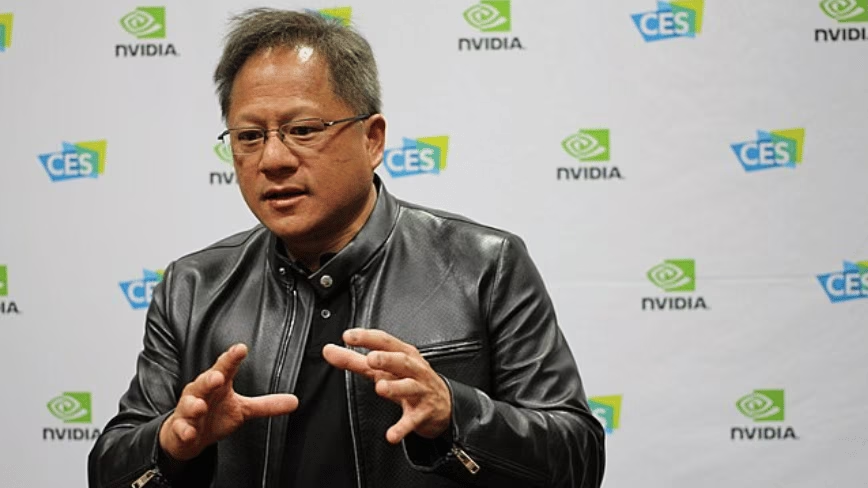
NVIDIA has committed over $40 billion to AI equity investments in the first four months of 2026, including a $30 billion stake in OpenAI. This strategy, which also includes significant investments in companies like CoreWeave, IREN, and Corning, aims to ensure compute capacity is built around NVIDIA's GPUs, influencing the entire AI value chain. While bolstering NVIDIA's data-center revenue, the aggressive approach raises questions about "circular financing" and potential regulatory scrutiny.

Uber's CTO revealed a long-term plan to equip its millions of drivers' cars with sensors, transforming them into a vast data collection grid for autonomous vehicle (AV) companies. This expansion of their AV Labs program aims to address the critical data bottleneck in AV development. The strategy positions Uber as a key infrastructure provider in the self-driving sector, potentially granting it significant leverage and financial benefit.

Former Tesla President Jon McNeill's new book reveals how he thrived under Elon Musk's demanding leadership. It offers an insider's guide to navigating the high-pressure environment that shaped one of the world's most valuable companies.

Amazon has partnered with FedEx Office, allowing customers to easily return items at over 1,500 locations nationwide. This move significantly expands Amazon's no-box, no-label return network, enhancing convenience for shoppers. The collaboration also marks a re-engagement between the two companies after their logistics split in 2019, focusing on a streamlined customer experience.

The exciting wearables market is increasingly entangled in complex legal battles, from health trackers like Whoop suing competitors Bevel and Polar, to smart glasses companies accusing Meta of patent infringement. This review explores how these lawsuits could stifle innovation and impact consumer choices.

Gateway Capital, founded by Dana Guthrie, has completed the first close of its $25 million target Fund II, enabling immediate investment operations. The Milwaukee-based firm plans to back at least 20 Midwest-focused companies with average checks between $500,000 and $600,000, targeting sectors like supply chain, logistics, and manufacturing AI.

Senator Ed Markey's investigation found that leading autonomous vehicle companies, including Waymo and Tesla, are refusing to disclose how often their AVs need remote human assistance. This lack of transparency has led Markey to call for a federal probe by the NHTSA and to propose new legislation aimed at imposing stricter guardrails on AV remote operations.

Smartsheet has announced four C-suite changes, including two new hires and two promotions, as CEO Rajeev Singh continues to build his leadership team after recent layoffs. Separately, fashion rental startup Armoire has appointed Morgan Cundiff as head of product and machine learning. Additionally, long-time Microsoft director Javier Páramo has launched AIQLinea, a new Redmond-based startup focused on guiding companies through AI adoption strategies.

Aetherflux, founded by Robinhood co-founder Baiju Bhatt, is reportedly raising a Series B round of $250M-$350M at a $2 billion valuation, with Index Ventures leading. The startup has strategically pivoted from space solar power to developing space data centers for AI, aiming to launch its first orbital data center by 2027. This move places Aetherflux in a competitive emerging market alongside other major space companies.

A New Mexico jury has found Meta Platforms Inc. liable for deliberately misleading users about product safety and engaging in unethical trade practices, imposing a $375 million penalty. This historic verdict is the first of its kind, emerging from a state investigation that used decoy accounts to expose potential child exploitation on Meta's platforms. The ruling could set a precedent for numerous other lawsuits against social media companies.

The new Crosslake Connection of Sound Transit's Link light rail 2 Line opens Saturday, connecting Seattle and the Eastside. Tech companies like Microsoft and Lime are actively participating in celebrations across 10 stations. This expansion is set to transform commutes for thousands of tech workers, promising a significant shift in regional transportation dynamics.

VentureBeat's Transform 2026 conference is actively seeking the most innovative autonomous agent technologies for its annual Innovation Showcase. Scheduled for July 14-15 in Menlo Park, the event aims to feature up to 10 companies pioneering solutions in enterprise agentic orchestration, LLMOps, RAG infrastructure, and AI security. Selected innovators will gain exposure to industry leaders, direct feedback, and exclusive VentureBeat editorial coverage.

Air Street Capital, led by solo General Partner Nathan Benaich, has closed its third fund at $232 million, making it Europe's largest solo GP venture fund ever. This significant milestone challenges traditional VC structures and highlights a growing LP confidence in Benaich's focused thesis on AI-first companies, including strategic ventures into defence tech and key partnerships like the one with NVIDIA.

The world of retro gaming has seen a vibrant resurgence, and few companies cater to this niche with as much dedication and quality as 8BitDo. Known for their meticulously crafted controllers that blend classic designs

Sears Home Services publicly exposed millions of AI chatbot conversations, including phone calls and text chats, containing sensitive customer data like names, addresses, and repair details. Discovered by a security researcher, the leak also included extended audio recordings capturing private ambient conversations. This incident highlights critical privacy and reputational risks as companies integrate AI into customer service.

Sumo Digital is partnering with Arm to test groundbreaking AI-powered neural technology for mobile chips, aiming for "PC-quality graphics on mobile." This collaboration could usher in a new era of visually stunning and immersive mobile gaming experiences. Both companies, despite recent challenges, are committed to pushing the boundaries of portable entertainment.

Target Hospitality, a company known for operating an ICE detention facility, is rapidly expanding into the burgeoning market of "man camps" to house workers building massive AI data centers. The firm has secured over $132 million in contracts to construct and manage temporary villages, including one for a 1.6-gigawatt data center in Texas, signaling a significant pivot to capitalize on the AI infrastructure boom. This move highlights a new lucrative opportunity for companies with expertise in large-scale, remote housing solutions.

WASHINGTON D.C. – Major technology companies, including industry giants like Microsoft, Meta, OpenAI, Google, Oracle, Amazon, and xAI, gathered at the White House on Wednesday to sign a nonbinding pledge championed by

Washington state's House Bill 2515, aimed at regulating data centers for environmental and ratepayer protection, has failed to pass. The bill's demise followed significant lobbying efforts and public opposition from major tech companies like Microsoft and Amazon, despite support from environmental groups and consumer advocates.

AI agents are fundamentally disrupting the traditional SaaS business model, leading to a "SaaSpocalypse" as companies shift from buying to building their own software. This has caused market tremors, wiped out significant value from SaaS stocks, and prompted a freeze on new SaaS IPOs, forcing the industry to adapt to new pricing models and AI-native competition.

Block, Jack Dorsey's company, cut over 4,000 staff (40%) despite strong financial performance, attributing it to new AI efficiencies and a pivot to an "intelligence-native" operational model. This move, driven by a focus on "agentic AI infrastructure," signals a fundamental shift in how tech companies might scale and manage operations. It prompts other enterprises to audit their own workflows for similar AI-driven consolidation.

A Google Vice President warns that two specific types of generative AI startups—LLM wrappers and AI aggregators—are facing significant threats to their long-term viability. These companies are experiencing mounting pressure, including shrinking profit margins and a critical lack of differentiation, due to the rapid evolution of generative AI technology.
Startup founders face immense pressure to accelerate AI adoption amidst tighter funding and rising costs. While cloud credits, GPUs, and foundation models simplify getting started, early infrastructure choices can lead to unforeseen consequences and hidden costs as companies grow. This blog post explores the challenges and the importance of foresight in the fast-paced AI startup landscape.
