59 results found

The U.S. government blocked Polestar from selling new vehicles due to its Chinese ownership, while oddly sparing its sister brand, Volvo, also owned by Geely. This opaque and inconsistent regulatory decision, despite Polestar's efforts to localize production, creates significant market unpredictability. It serves as a stark warning for developers and businesses operating in globalized tech sectors about the impact of arbitrary geopolitical interventions.
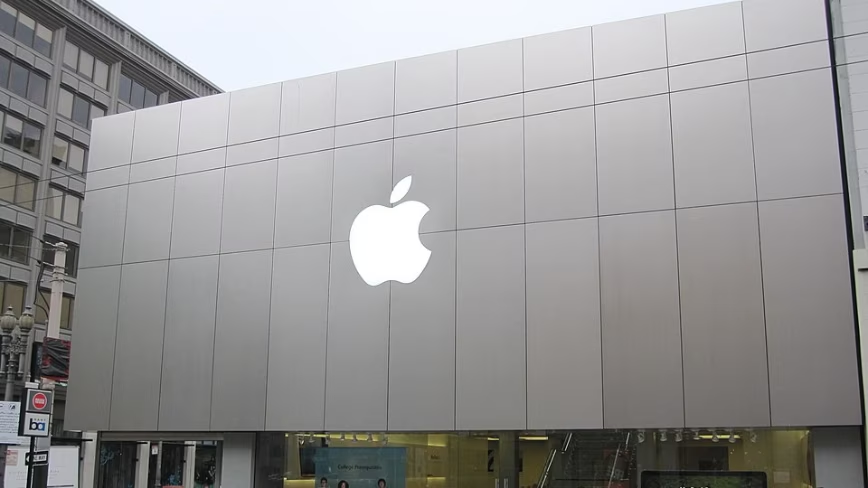
Apple is actively lobbying the US government for formal approval to acquire memory chips from ChangXin Memory Technologies (CXMT), China's foremost DRAM manufacturer, which is currently on the Pentagon's military-linked

The Trump administration has lifted its ban on Anthropic's powerful Mythos 5 AI, allowing over 100 U.S. government agencies and companies, including non-American staff, to use it. This decision, two weeks after both Mythos 5 and Fable 5 were pulled, comes with "appropriate safeguards," though Fable 5 remains restricted.

Nearly 100 prominent cybersecurity experts have signed an open letter condemning the US government's ban on Anthropic's Fable 5 and Mythos 5 AI models. They argue the move disarms defenders, creates market uncertainty, and risks America's AI leadership without justifiable cause, potentially benefiting adversaries more than protecting national security.

Anthropic's recent decision to suspend access to its newest AI models, Fable 5 and Mythos 5, for all foreign nationals following a U.S. government directive has sent ripples across the global technology industry. In

Bank of England Governor Andrew Bailey has warned that artificial intelligence may soon require rationing due to its escalating energy demands outstripping available power supplies. He stated that governments face "very big social choices" in prioritizing AI applications, citing examples like healthcare versus defense. Evidence of grid strain is already emerging in the EU and US, underscoring the urgency of this infrastructural challenge.

Verdict: Ambitious but Risky Transformation HMRC’s Making Tax Digital (MTD) for Income Tax represents one of the UK government's most significant digital transformation projects to date. Its move to mandatory quarterly
President Trump signed an executive order Tuesday, establishing voluntary government oversight for new AI models. This reverses his prior hands-off approach, balancing innovation with national security by asking companies for a 30-day review.

President Trump has signed an executive order creating a voluntary framework for AI companies to share advanced models with the federal government before release. This initiative aims to bolster secure innovation and protect critical infrastructure, reflecting a shift from the administration's previous hands-off approach to AI safety. Companies opting for pre-release review may receive confidentiality protections.

The United States government's substantial $2 billion investment in quantum computing, highlighted by the creation of the Anderon quantum foundry, represents a bold move to secure a leading position in this

Apple, Google, and Meta have rolled out new opt-in features to combat sophisticated government spyware targeting at-risk individuals like journalists and dissidents. These protections, including Apple's Lockdown Mode, Google's Advanced Protection Program, Android's Advanced Protection Mode, and WhatsApp's Strict Account Settings, harden devices and accounts against tools that grant attackers full data access. Experts strongly recommend activating these proven defenses.

Samsung Electronics and its largest labor union are engaging in crucial negotiations Monday to prevent an 18-day strike. The dispute centers on profit sharing from the AI boom, with the Prime Minister warning of severe economic repercussions and hinting at emergency government intervention.
The digital landscape is constantly evolving, and a recent announcement from OpenAI and the Government of Malta signals a potentially transformative shift in how artificial intelligence is integrated into society. This

Newly appointed Disney CEO Josh D’Amaro faces an unexpected battle with the Trump administration as Disney-owned ABC accuses the FCC of violating its First Amendment rights. The dispute centers on an FCC investigation into “The View” over the “equal time” rule, despite the show's long-standing exemption. This confrontation marks a pivotal moment for D'Amaro, challenging Disney's past strategies of appeasement and forcing a direct stand against government pressure.

This comprehensive review examines the shocking incident where twin brothers, minutes after being fired, deleted 96 government databases. It highlights critical failures in HR, IT security, and incident response, offering crucial lessons for organizations.

U.S. prosecutors revealed the Russian ransomware gang Karakurt accessed government databases and used law enforcement ties to evade taxes and military service, following the sentencing of hacker Deniss Zolotarjovs. This highlights Russia's role as a cybercriminal "safe haven."

Anthropic CEO met White House Chief of Staff over national security concerns about the Mythos AI model. It automates cyberattacks, prompting urgent government assessment.

France is making a strategic shift from Windows to Linux across government systems, driven by digital sovereignty. This move aims to reduce reliance on U.S. tech and gain control over national data, despite facing significant implementation challenges.

Ars Technica reports on the Trump administration's escalating efforts to unmask an ICE critic on Reddit, moving from a standard summons to a secret grand jury subpoena, sparking significant privacy and free speech concerns for online users and platforms.

Anthropic has launched its Claude Mythos Preview model, claiming it poses an unprecedented existential threat to cybersecurity by autonomously discovering vulnerabilities and developing exploits. Released initially to a select group via Project Glasswing, the AI’s ability to create complex "exploit chains" is forcing industry and government leaders to reconsider defensive strategies. Experts argue this signals a shift from reactive patching to a proactive "secure by design" approach in software development.

France announced plans to transition government computers from Microsoft Windows to Linux to reduce reliance on U.S. tech and achieve "digital sovereignty." This decision, driven by geopolitical tensions and weaponized sanctions by the Trump administration, is part of a broader European effort to secure digital independence. The open-source nature of Linux offers transparency and control, aligning with France's strategic goals.
Ireland is stepping onto a significant stage in digital identity with its new Government Digital Wallet, currently undergoing a crucial pilot phase. This isn't just another app; it’s a government-backed initiative

Quick Verdict: Steer Clear of The White House App In the world of government digital outreach, the official "The White House" app stands out for all the wrong reasons. Promising "Unparalleled access to the Trump

Understanding recent regulatory changes can feel overwhelming, especially when it concerns essential home technology like your internet router. The U.S. government, through the Federal Communications Commission (FCC),

A new TIGA report reveals the UK games development sector is facing its "most severe downturn on record," with a 4.5% year-on-year employment fall and a significant drop in new studio formation. Larger studios were hit hardest, while mobile and PC development saw substantial declines. TIGA attributes this to weak global sales and poor financing, urging government intervention like enhancing the Video Games Expenditure Credit to stimulate recovery and prevent further job losses.
