26 results found

Elon Musk's SpaceX is building a secret Texas foundry to produce gas turbine blades, aiming to accelerate AI data center power by 18 months. This addresses a critical energy bottleneck, but faces environmental backlash over pollution and health risks from gas turbines.

Nvidia is extending its AI dominance beyond GPUs, focusing on system-level data orchestration within massive data centers. Post-earnings, the company's Vera Rubin architecture, including the Vera CPU, is proving crucial for efficient data management, optimizing performance and energy use. This shift towards smarter data traffic control marks a new competitive front in AI infrastructure, where Nvidia currently holds a commanding lead.

xpander.ai, founded by former AWS principal engineers, has launched its enterprise AI agent platform and secured $7.5M in seed funding. The platform offers a vendor-neutral control plane, featuring a 'Universal Harness,' to help companies manage, govern, and orchestrate the growing sprawl of AI agents, addressing challenges like isolated workflows and vendor lock-in.

Embattled AI hedge fund Situational Awareness has invested a further $400 million into chip startup Source Foundry, bringing its total backing to $500 million. This significant move comes despite the fund recently selling off much of its public portfolio and seeing its assets under management drop from $20 billion to $10 billion. The investment underscores a continued strategic focus on critical AI infrastructure, even after recent market struggles.

AI infrastructure startup Naïve has raised $28.5 million in Series A funding led by Nexus Venture Partners to automate the complex process of setting up and running a business. With over 30,000 developer customers, Naïve's platform allows AI agents to handle tasks from incorporation to payments, and is now focusing on optimizing the high operational costs of AI agent fleets.

Artificial intelligence is revealing critical limitations in traditional network architectures, which were not built to handle the unpredictable, real-time traffic demanded by modern AI workloads. This shift necessitates treating the network as a strategic, intelligent control layer, crucial for AI performance, reliability, and cost-efficiency. Enterprises must adopt dynamic, secure, and software-defined networks to truly leverage their AI investments.
Quick Verdict Nvidia's potential $250 billion financing for OpenAI's massive 10-gigawatt Ohio data center is a monumental move, signaling a profound shift in AI infrastructure. While promising OpenAI greater autonomy
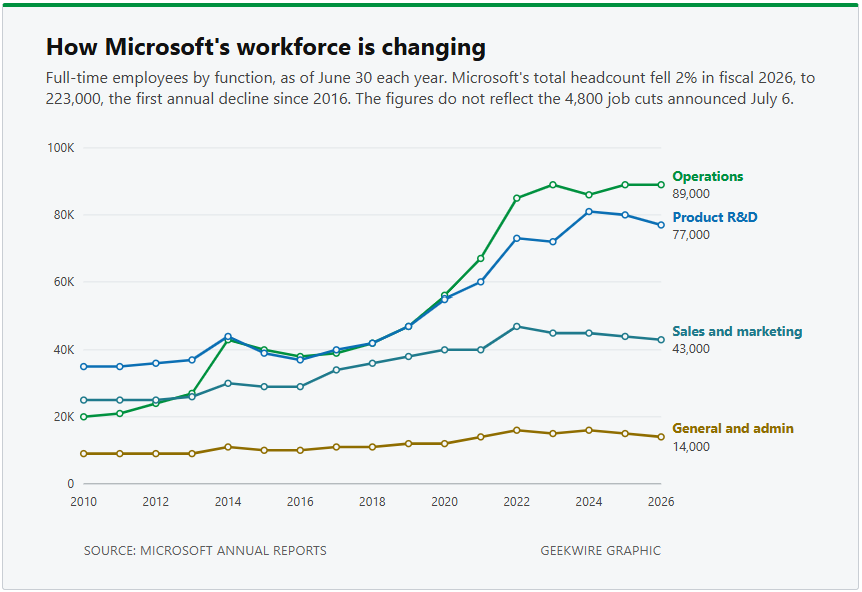
Microsoft's total headcount dropped for the first time in a decade, fueled by a second consecutive decline in R&D roles, despite record revenue growth. This strategic shift reflects the company's adaptation to the AI era, including significant investments in AI infrastructure and a reallocation of engineering talent to customer-facing roles.

Meta Platforms saw its stock surge 15% last week, the best run since early 2024, following the unveiling of "Meta Compute." This new initiative aims to monetize Meta's extensive AI infrastructure by selling computing capacity and models to external clients, addressing investor concerns over massive AI spending. While Wall Street embraced the potential for significant EPS growth, Meta faces challenges, including its lack of experience in the cloud market and competition from entrenched hyperscalers.

Shopify has developed a resilient AI stack featuring an LLM proxy for automatic failover between AI providers and a sophisticated distillation pipeline for creating specialized, cost-effective models. This strategy ensures continuous AI operations, avoids vendor lock-in, and significantly boosts efficiency and accuracy across its platform.

Microsoft has dramatically cut water consumption in its data centers by 90% since its earliest facilities, achieving a 0.27 liters per kilowatt-hour rate last year. The company also announced it is globally water positive for the first time, replenishing more water than it withdraws. These efforts come as public concern grows over data center environmental impacts, leading to similar initiatives from Amazon and Google.

CoreWeave, the AI cloud provider, is set to join the Nasdaq-100 Index on June 22, 2026, a mere 15 months post-IPO. Transitioning from crypto mining, the company boasts rapid revenue growth and a massive backlog but faces significant debt and concentration risks. This inclusion validates its position as a core tech player.

Google has slashed the price of its budget AI Plus subscription to $4.99/month and doubled storage to 400GB for U.S. consumers. This aggressive move signals an escalating price war in the AI market, potentially commoditizing AI infrastructure and challenging valuations for companies like OpenAI and Anthropic.
Intel, Foxconn, and SambaNova Systems have partnered to build rackscale AI infrastructure, unveiled at Computex 2026. This collaboration targets the shift from AI training to inference, aiming to re-establish Intel Xeon CPUs at the core of data centers by pairing them with SambaNova's SN-50 RDUs for efficient, cost-effective performance. Foxconn will handle system integration and develop CPU-dense variants.

The narrative around AI capital expenditure (capex) often feels monolithic: NVIDIA, hyperscalers, data centers, power demand—all bundled into a single "AI infrastructure" idea. As fellow developers, we know real-world

AI infrastructure firm CoreWeave has doubled its Bellevue office space to 36,000 square feet, signifying a major expansion of its engineering hub. This move highlights Bellevue's accelerating emergence as a premier AI development center in the Seattle region, attracting significant investment and talent. The company's growth reflects the broader trend of AI leaders converging on the Eastside.

Billionaire Kevin O’Leary and the Trump administration claim that widespread U.S. protests against data center construction are orchestrated by China and foreign propaganda, despite a lack of conclusive evidence. This narrative is being met with skepticism from a broad range of allies and critics who point to legitimate local concerns and widespread public opposition to AI infrastructure.
Schneider Electric projects its India data-centre business to outpace company-wide growth, potentially becoming its largest segment within 3-5 years. This is driven by India's massive planned data-centre expansion from 1.5 GW to 6-8 GW, bridging a significant gap between data consumption and capacity. Strategic investments, a strong Q1 2026 performance, and India's cost advantages underpin this outlook, despite challenges like rising material costs.

The web intelligence industry is rapidly evolving to meet the escalating demands of advanced AI, particularly for multimodal data processing and autonomous AI agents. Innovations in data extraction, infrastructure, and user-friendly tools are crucial for powering the next wave of artificial intelligence. These developments are building the essential links between vast web data and sophisticated AI models.

Europe's tech sector saw over $1.1 billion in funding and fund closes from March 23-29, with significant investments flowing into deep tech, AI infrastructure, and a diverse range of sectors including biotech, space, and defense. This highlights a strategic continental focus on foundational innovations and long-term technological advancements.

Target Hospitality, a company known for operating an ICE detention facility, is rapidly expanding into the burgeoning market of "man camps" to house workers building massive AI data centers. The firm has secured over $132 million in contracts to construct and manage temporary villages, including one for a 1.6-gigawatt data center in Texas, signaling a significant pivot to capitalize on the AI infrastructure boom. This move highlights a new lucrative opportunity for companies with expertise in large-scale, remote housing solutions.

The Nordic region is experiencing an unprecedented boom in data center construction, driven by the insatiable energy demands of artificial intelligence. Tech giants and specialized 'neocloud' providers are flocking to countries like Norway, Sweden, and Finland, drawn by abundant, cheap, and renewable energy, naturally cool climates, and available land. This shift marks a strategic move away from traditional European tech hubs, positioning the Arctic edge as a vital new frontier for AI infrastructure.

Block, Jack Dorsey's company, cut over 4,000 staff (40%) despite strong financial performance, attributing it to new AI efficiencies and a pivot to an "intelligence-native" operational model. This move, driven by a focus on "agentic AI infrastructure," signals a fundamental shift in how tech companies might scale and manage operations. It prompts other enterprises to audit their own workflows for similar AI-driven consolidation.

Kilo has launched KiloClaw, a fully managed service designed to deploy OpenClaw agents into production in under 60 seconds. This platform removes infrastructure complexities, provides secure and always-on hosting, and integrates with Kilo Gateway for access to over 500 AI models. Kilo also introduced PinchBench, an open-source benchmark for agentic tasks, aiming to democratize AI agent deployment for a wider audience.

GeekWire's top stories for the week of Feb. 15, 2026, highlight Microsoft's new RTO policy and leadership changes at Xbox and Remitly. Washington state is setting new terms for data centers, while Seattle-area startups Temporal and Duckbill secured significant funding rounds. The tech community also paid tribute to desktop publishing pioneer Paul Brainerd.
