164 results found

Silicon Valley's startup scene is experiencing a dramatic shift for young founders. While AI has democratized building, enabling early success and significant funding, it also brings immense pressure for rapid growth and constant public performance. This creates a high-stakes environment where founders face intense scrutiny and ethical dilemmas alongside unprecedented opportunities.

Onyx Security, an Israeli startup, has secured a $113 million Series B funding round, valuing it at $640 million. The company's "secure AI control plane" sits between enterprise AI agents and critical systems, inspecting and blocking unauthorized actions to keep humans in control. This investment addresses the growing need for AI agent accountability as autonomous AI rapidly takes over enterprise operations, a market already seeing significant investment and activity.

TechCrunch Disrupt 2026, held Oct 13-15 in San Francisco, features an AI Stage presented by Google for Startups. It will explore how AI is reshaping business models, creating security gaps like the 'agent security gap,' and pioneering new job categories like the 'GTM Engineer.' Industry leaders will share insights on topics from enterprise AI security to the future of video intelligence.
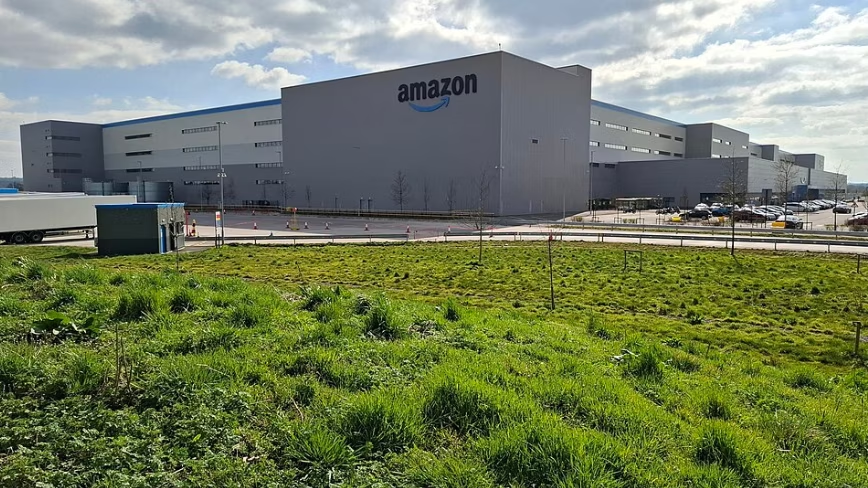
Amazon has shut down its AGI Lab, a San Francisco team dedicated to human-level AI, barely 18 months after its formation. This move, part of wider layoffs, signals Amazon's retreat from the frontier AI race, pivoting instead to selling AI services and infrastructure through AWS and external investments.

Defense technology powerhouse Anduril is reportedly seeking a new funding round that could propel its valuation to an astonishing $100 billion, a move that would underscore its meteoric rise in the defense sector. This

Vietnam's culture ministry has unveiled a draft decree that would allow users under 16 to maintain social media accounts but prohibit them from posting, commenting, or reacting. This protective measure, while unique globally, faces significant age-verification and enforcement challenges.

NEW YORK – Runway, a prominent name in artificial intelligence, today unveiled its new Media Router, a strategic move designed to position the company as a foundational infrastructure layer for the rapidly expanding
San Francisco-based startup Poolside announced the release of Laguna S 2.1 on July 21, 2026, a 118-billion-parameter open-weight model engineered for agentic coding. The company positions this new model as a crucial

Microsoft is enhancing security for enterprise users of OneDrive and SharePoint, blocking screenshots of sensitive PDFs in Edge starting August. This protection, tied to Purview Information Protection labels, aims to prevent data leaks. However, the feature is exclusive to Microsoft Edge, requiring organizations to enforce its use for full effectiveness.

Uber and Waymo are locked in a contentious battle over proposed robotaxi regulations in Washington D.C., with Uber pushing a "hybrid" model to protect human drivers and Waymo poised to gain a market advantage under the current bill. This regulatory clash highlights broader industry debates over autonomous vehicle deployment and market control. Simultaneously, Uber is expanding its global delivery presence with a $14.8 billion acquisition of Delivery Hero, while other mobility startups secure significant funding.

Meta has secured a patent for an AI system capable of continuously recording user voice, transcribing it, and analyzing it for emotional states. This technology, designed for "continuous emotional monitoring," integrates audio data with contextual factors like location and medication timing, raising significant privacy concerns. Amazon previously abandoned a similar product due to public backlash.

Fora, the innovative AI-powered travel agency, has officially joined the ranks of billion-dollar companies, announcing a $60 million Series D funding round that solidifies its unicorn status. The capital injection, led
Cloudflare has launched Precursor, a new defense system, in response to bots now generating over 57% of all web traffic. Precursor monitors entire user sessions to distinguish humans from sophisticated bots, moving beyond traditional single-check methods. This initiative is part of a broader strategy to classify and manage AI agents, control content reuse, and rebuild the web's foundational infrastructure for a machine-dominated internet.

Seattle-based startup Augmodo has successfully closed a $21 million funding round, boosting its valuation to $350 million. This significant investment is set to accelerate the company’s expansion of its spatial AI

The exponential growth of AI is fueling an unprecedented surge in natural gas power plant construction, threatening global clean energy targets and driving up electricity costs. In response, clean energy advocates are battling on multiple fronts, including state-level legislative mandates and a strategic pivot to influencing utility regulators to allow tech giants to build their own renewable energy infrastructure directly into the grid. This fight for grid access is seen as the decisive factor for future energy policy.

Seattle's tech sector is seeing major shifts, with Microsoft cutting 4,800 jobs and overhauling Xbox. Amidst this, the startup scene thrives, showing a surge in hardware on the GeekWire 200. AI is rapidly transforming how founders build and operate, driving efficiency and innovation across all ventures.

New York-based investment firm Subversive ETFs has filed with the SEC to launch two novel “Ex-Elon” exchange-traded funds (ETFs), offering investors a mechanism to track major market indexes while intentionally

AI law startup Norm announced Tuesday it has successfully closed a $120 million Series C funding round, propelling the nearly three-year-old company to a $1.2 billion valuation and officially granting it unicorn status.

Station F is intensifying its focus on the European AI ecosystem with the upcoming second batch of its F/ai accelerator program. Aiming for rapid commercialization, the program helps startups achieve significant revenue, backed by major tech partners and VCs. This initiative reinforces Station F's role as a critical hub for nurturing AI talent and innovation on the continent.

India's IT ministry has ordered Meta to immediately remove Instagram ads promoting child sexual exploitation and abuse material (CSEAM) and explain how they passed review within seven days. This action follows a BBC investigation that revealed paid ads redirecting users to illegal content, placing Meta's critical 'safe harbour' protection at risk in its largest user market.
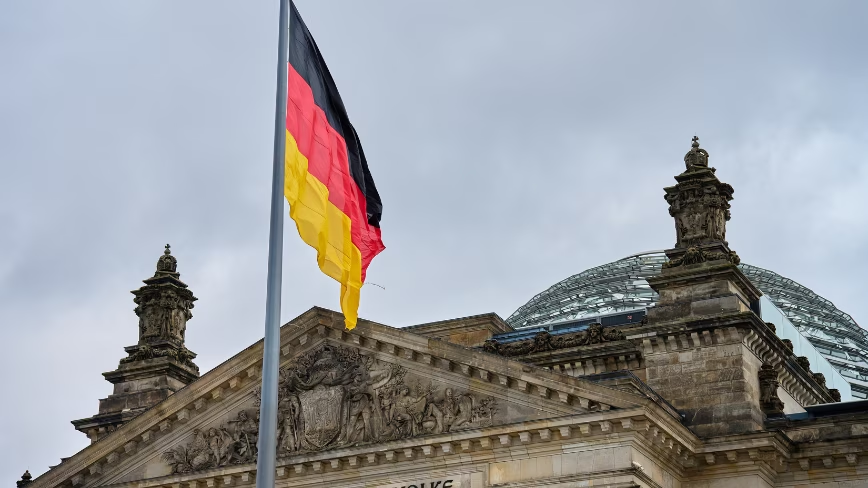
Germany's traditionally conservative cooperative and savings banks are set to offer cryptocurrency trading to millions of customers. This pivotal shift, driven by the EU's MiCA regulation, brings digital asset trading into the mainstream through trusted financial institutions, despite lingering concerns about market volatility.

The browser wars have entered a new phase in 2026, shifting focus from search engine dominance to AI acting on users' behalf. While Chrome and Safari remain market leaders, a new wave of alternative browsers is emerging. These include AI-powered options like Perplexity's Comet and OpenAI's Atlas, privacy-focused browsers such as Brave and Ladybird, and "mindful browsers" like Opera Air. This diversification reflects a growing demand for specialized browsing experiences beyond the mainstream.

Seattle startup studio Conduit Venture Labs has launched Sniff, an iOS app connecting neighbors through their dogs. Founded by Amish Patel, it aims to combat urban loneliness by fostering real-world connections among pet owners in geofenced communities.

Seattle angel investor Charles Fitzgerald criticizes Washington Gov. Bob Ferguson's new Economic Development Council as backward-looking, lacking startup and VC representation, and ignoring AI. He argues the council's composition and focus overlook critical drivers of future economic growth and fail to address the state's deteriorating business climate.

OpenAI has officially unveiled its first piece of physical hardware: the “Codex Micro.” This dedicated macro pad is designed to enhance the workflow for developers who regularly use OpenAI’s AI coding tool, Codex. The
