
startups: Amazon just shut its AGI Lab, and quit a race it never led
Amazon has shut down its AGI Lab, a San Francisco team dedicated to human-level AI, barely 18 months after its formation. This move, part of wider layoffs, signals Amazon's retreat from the frontier AI race, pivoting instead to selling AI services and infrastructure through AWS and external investments.
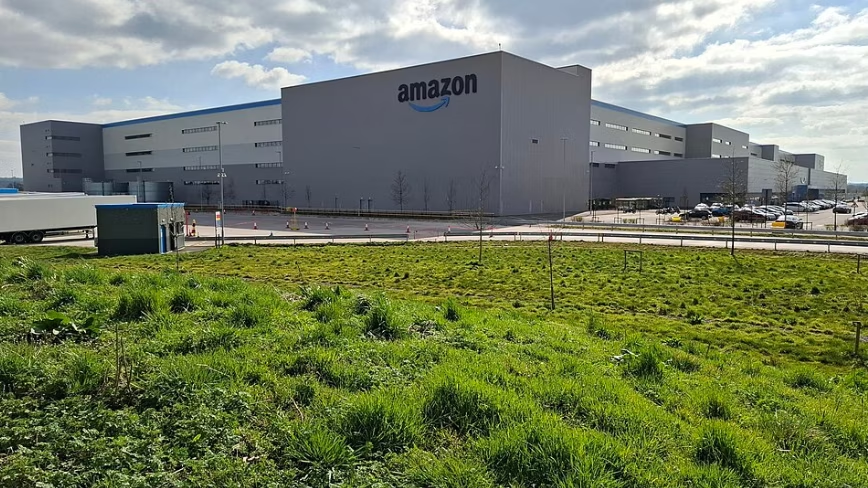
Amazon has quietly ceased its pursuit of human-level artificial intelligence (AGI), shutting down its dedicated AGI Lab in San Francisco. Established just 18 months ago in December 2024, the lab's closure is part of a series of layoffs within Amazon's AGI organization, signaling a strategic retreat from the intensely competitive frontier-model AI race. This move underscores Amazon's evolving priorities in the artificial intelligence landscape.
Reported by The Information and Reuters, the AGI Lab was specifically tasked with developing AI agents capable of greater utility for businesses. Its dissolution sees staff affected by layoffs, though the exact scale of these job cuts remains undisclosed at this time.
This decision was foreshadowed by significant leadership changes. Rohit Prasad, the executive overseeing Amazon's AGI efforts, departed at the end of last year, followed by David Luan, the AGI Lab's head, who left in February. Following these exits, Amazon integrated its remaining AGI activities under Peter DeSantis, alongside its existing chip and quantum technology teams.
Amazon, in its official statement, characterized the decision as a strategic pivot rather than a surrender in the AI domain. A company spokesperson affirmed Amazon's ongoing commitment to building large AI models, deeming it one of their most crucial endeavors. The company explained that this "sharpening our focus on the initiatives that matter most for customers" necessitated "eliminating some roles within parts of our AGI organization." This language suggests a re-prioritization of internal resources towards more immediately profitable or customer-facing AI applications.
This development is the latest in a series of workforce reductions at Amazon, which saw 16,000 jobs cut in January, aligning with a broader trend across the tech industry where companies are streamlining teams, often citing AI as a factor in efficiency gains. The swift closure of a specialized lab and the departure of its top leaders in quick succession speaks volumes about the challenges and shifts within Amazon's internal AI development ambitions.
While Amazon has invested substantially in artificial intelligence, its internal model development has historically not achieved the same prominence as some of its rivals. Instead, Amazon's primary AI strategy has largely revolved around leveraging its Amazon Web Services (AWS) division. AWS continues to pour vast sums into AI infrastructure, effectively positioning Amazon as a provider of the "picks and shovels" for the entire AI industry.
This infrastructure-first approach allows businesses to access powerful AI capabilities and deploy advanced AI agents that integrate directly into their operations, without Amazon needing to lead in the development of the absolute smartest foundational models. Furthermore, Amazon has opted for significant external investments, notably committing tens of billions of dollars to Anthropic, an AI safety and research company. This external bet highlights a strategy of participation in the frontier AI race through partnership and investment, rather than direct, internal, high-risk development.
The move also occurs amidst growing industry discourse questioning whether current large language models are indeed the direct pathway to achieving true general intelligence. Whether Amazon aligns with this skepticism or is simply prioritizing a more pragmatic, profit-driven approach, the message is clear. The company aiming to power the AI endeavors of countless others has decided to step back from the direct pursuit of building the most advanced AI brain itself. Its ambitious plans for artificial intelligence are increasingly directed towards the lucrative business of selling AI services and infrastructure, as evidenced by initiatives like the AI-first redesign of Prime Video, rather than pioneering revolutionary AI invention from within.
In essence, Amazon's shuttering of its AGI Lab marks a significant re-calibration of its AI strategy. The company is pivoting away from the resource-intensive, high-stakes race to develop human-level AI internally. Instead, it is doubling down on its strengths: providing the foundational infrastructure and tools via AWS, and strategically investing in external AI innovators. This shift solidifies Amazon's role as a critical enabler in the global AI ecosystem, focusing on commercializing AI technologies rather than spearheading the frontier of AGI research.
FAQ
Q: What was Amazon's AGI Lab?
A: Amazon's AGI Lab was a specialized team based in San Francisco, established in December 2024. Its primary mission was to develop artificial general intelligence (AGI) with the goal of creating more useful AI agents for businesses.
Q: Why did Amazon decide to close its AGI Lab?
A: The closure of the AGI Lab is attributed to broader layoffs within Amazon's AGI organization. The company stated this decision reflects a strategic move to "sharpen its focus" on initiatives deemed most critical for its customers, suggesting a re-evaluation of its direct participation in the frontier AI development race.
Q: What does Amazon's current AI strategy entail?
A: Amazon's current AI strategy emphasizes providing robust AI infrastructure and services through Amazon Web Services (AWS). This involves selling the essential tools and platforms for other companies to develop and deploy AI, along with strategic external investments in leading AI firms, such as its multi-billion dollar commitment to Anthropic. The focus has shifted from internal AGI leadership to being a key enabler and provider in the wider AI ecosystem.
Related articles

Tesla Set to Finally Unveil Second-Generation Roadster on October 1
The much-anticipated second generation of the Tesla Roadster, a halo vehicle promising revolutionary performance, is finally slated for a public unveiling on October 1. After years of delays and a protracted development

Seattle Warned on Big Tech Reliance; Microsoft/OpenAI Sued; Apple's
A new City of Seattle study warns of the city's risky economic over-reliance on a few dominant tech companies. Simultaneously, the Seattle Times and Newsday are suing Microsoft and OpenAI for alleged AI training data theft, while Apple's new foldable iPhone Duo evokes memories of Microsoft's defunct Surface Duo.

in-depth: The Best 3-in-1 Apple Charging Stations After Testing 30
Wired has released its top picks for 3-in-1 Apple charging stations, extensively tested for iPhone, Apple Watch, and AirPods. The guide highlights six leading models, from premium speedy options to budget-friendly and compact designs, all focused on decluttering and optimizing charging for Apple users.

Nscale Adds Former OpenAI Exec Fidji Simo to Board Ahead of IPO
Nscale, the U.K.-based AI data center startup, has appointed former OpenAI, Meta, and Instacart executive Fidji Simo to its board of directors. This high-profile addition comes as Nscale prepares for a potential IPO this fall, leveraging Simo's extensive experience in scaling major tech platforms and guiding a company through a successful public offering.

Microsoft comms chief Frank Shaw to exit after nearly three decades
Frank X. Shaw, Microsoft's long-serving chief communications officer, will exit at year-end after nearly three decades shaping the company's message through pivotal periods. Shaw, 64, is not retiring but plans a break before his next move, leaving behind a legacy of adapting communications for a digital age and embracing AI tools. Microsoft is now searching for his successor.

Apple AirPods 5 Now Available for Preorder
Apple's AirPods 5 are now available for preorder, with an official launch date of September 18th. The new standard $129 model features active noise cancellation, a premium feature previously exclusive to higher-end AirPods. An upgraded $149 model offers wireless charging, longer battery life, and touch controls.