41 results found

Building a Retrieval Augmented Generation (RAG) system often begins with exciting prototypes, quickly demonstrating the power of injecting external knowledge into large language models (LLMs). However, the journey from

Are you scratching your head when your kids or grandkids drop terms like 'cheesin''? You're not alone! Youth culture evolves rapidly, and staying current with slang can feel like learning a new language. This guide will

Graph-Enhanced RAG: Solving LLM Context Gaps in Production In a significant evolution for large language model (LLM) deployment, a new architectural pattern is emerging that promises to resolve critical context

The rapid evolution of AI has created a dense lexicon, leaving many confused. This guide demystifies key terms like LLMs, AI agents, and hallucinations, providing a foundational understanding. Grasping this language is crucial for navigating AI's transformative impact and future.

MCP (Model Context Protocol) is a new standard that acts as a standardized bridge, enabling secure and efficient connections between large language models (LLMs) and external, private enterprise data sources. It addresses the complexity of traditional API integrations by standardizing data formats for AI, making agentic workflows more scalable and effective. MCP ensures LLMs have the crucial internal context needed for practical enterprise applications.
xAI has launched Grok 4.3, its new large language model, featuring "always-on reasoning" and advanced agentic capabilities. The model arrives with an aggressively low API pricing strategy ($1.25/$2.50 per million input/output tokens) and a sophisticated voice cloning suite called Custom Voices. While excelling in specialized legal and financial tasks, Grok 4.3 presents a complex trade-off between cost efficiency, deep reasoning, and general consistency for enterprise users.

Every product experimentation team eventually confronts a common challenge when launching new features, especially those leveraging Large Language Models (LLMs): the 'Opt-In Trap'. Imagine shipping a new AI assistant

DeepMind veteran David Silver has secured an unprecedented $1.1 billion in funding for his new British AI lab, Ineffable Intelligence, at a $5.1 billion valuation. The company aims to build a "superlearner" AI that acquires knowledge and skills purely through reinforcement learning, without relying on human data, a radical departure from current large language models.
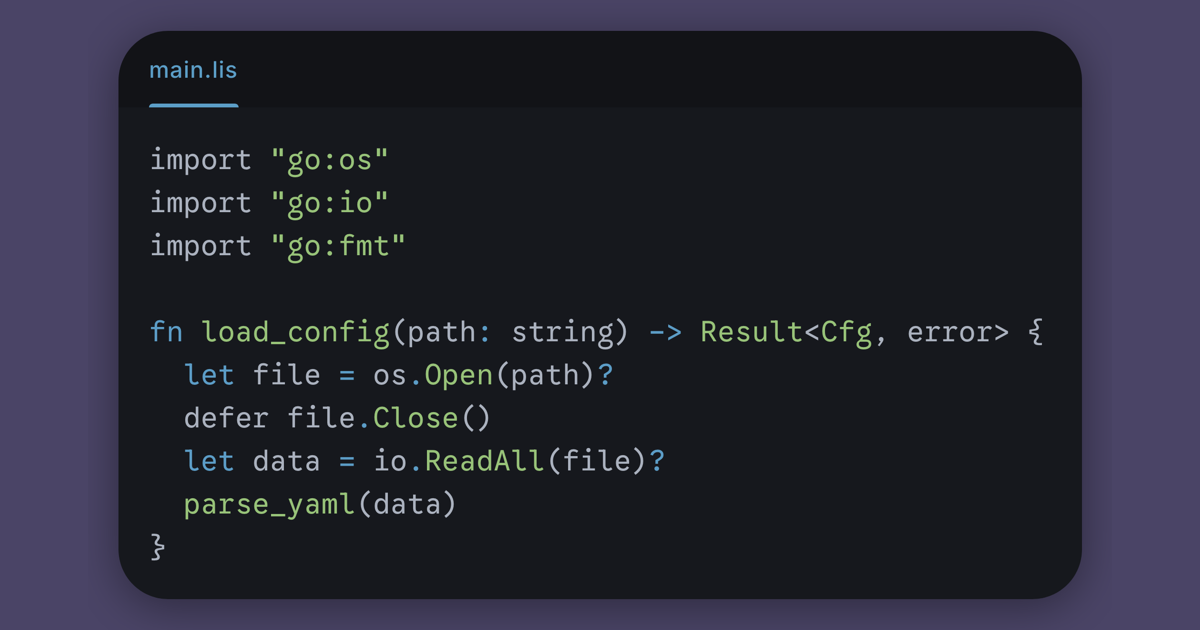
Lisette is a new language inspired by Rust's syntax and type system, but designed to compile directly to Go. It aims to combine Rust's compile-time safety features—like exhaustive pattern matching, no nil, and strong error handling—with Go's efficient runtime and extensive ecosystem. This approach allows developers to write safer, more expressive code while seamlessly leveraging existing Go tools and libraries.

OCSF, an open-source framework, is rapidly standardizing cybersecurity data across vendors, streamlining threat detection and investigation. Its adoption is critical for managing AI's increasing complexities in security operations.

Crimson Desert promises grand medieval fantasy, but its narrative and world-building are deeply flawed. Anachronistic language, contradictory lore, and inconsistent character roles constantly break immersion, making the ambitious title feel uninspired. If creators don't invest in the story, why should players?
Bravo's 'Real Housewives' franchise, celebrating its 20th anniversary in March 2026, has evolved into a powerhouse for internet memes. Its dramatic, unscripted moments have reshaped digital communication, offering a universal language of emotional expression that resonates even with non-viewers.

The promise of Artificial Intelligence (AI) in software development has captured the industry's imagination. Large Language Models (LLMs) and AI agents are touted as revolutionary tools capable of dramatically boosting
The dream of autonomous robots seamlessly integrating into our lives has long been a staple of science fiction. Today, with the rapid advancements in large language models (LLMs) and robotics, this future is closer than

Google Maps is rolling out significant updates, including the Gemini-powered 'Ask Maps' for natural language queries and a redesigned 'Immersive Navigation' with 3D views and enhanced driver assistance. These features promise a more intuitive and personalized mapping experience, leveraging advanced AI to transform trip planning and real-time guidance.
For many developers, the inner workings of Large Language Models (LLMs) can feel like a black box. While powerful, the scale and complexity of production-grade LLMs often obscure their foundational principles. Andrej