
US Army inks massive $20B contract with defense tech firm Anduril
The U.S. Army announced late Friday a landmark 10-year contract with defense technology startup Anduril, a deal that could be valued at up to $20 billion. This significant agreement is set to streamline the Army's

The U.S. Army announced late Friday a landmark 10-year contract with defense technology startup Anduril, a deal that could be valued at up to $20 billion. This significant agreement is set to streamline the Army's procurement of Anduril's commercial solutions, consolidating over 120 separate actions into a single enterprise contract.
The extensive agreement includes Anduril's comprehensive suite of hardware, software, infrastructure, and services. It begins with an initial five-year "base period," with an option to extend for an additional five years, signaling a long-term commitment to the Palantir-named firm.
A New Era for Military Software Procurement
The consolidation of procurement actions underscores a broader strategic shift within the Department of Defense (DoD) towards more agile and efficient acquisition of modern technological capabilities. Gabe Chiulli, the chief technology officer at the DoD’s Office of the Chief Information Officer, highlighted the urgency of this transition.
“The modern battlefield is increasingly defined by software,” Chiulli stated. “To maintain our advantage, we must be able to acquire and deploy software capabilities with speed and efficiency.” This contract with Anduril appears to be a direct response to that imperative, aiming to accelerate the integration of cutting-edge tech into military operations.
Anduril's Meteoric Rise and Visionary Founder
Anduril, co-founded by Palmer Luckey, has rapidly ascended in the defense tech landscape. Luckey is widely recognized for previously founding VR company Oculus, which he sold to Facebook (now Meta). His departure from Facebook followed controversy surrounding a news report about his donation to a pro-Trump political group, though Luckey has consistently maintained his political views were misrepresented by the media.
Despite past controversies, Luckey and Anduril have reportedly found favor within certain political circles. A recent feature in The New York Times indicated that Luckey’s vision for transforming the U.S. military with autonomous systems, including fighter jets, drones, and submarines, has resonated with the second Trump administration. Anduril, named after a magical sword from “The Lord of the Rings” like Palantir, reported approximately $2 billion in revenue last year, according to the NYT.
The company’s rapid growth is also reflected in market speculation, with separate reports suggesting Anduril is in discussions to raise a new funding round that could value the company at $60 billion.
Navigating the Complexities of Defense Contracts
This substantial contract announcement for Anduril comes at a time when other major technology companies are navigating turbulent waters with the Department of Defense. The DoD is currently embroiled in a legal dispute with AI firm Anthropic, which is suing the department after being designated a supply chain threat following a failed contract negotiation.
Similarly, OpenAI, another prominent AI company, has faced consumer backlash and experienced at least one executive departure in the wake of signing its own deal with the Pentagon. These incidents highlight the intricate challenges and public scrutiny often associated with tech companies partnering with the defense sector, making Anduril's $20 billion agreement particularly noteworthy in the current climate.
FAQ
Q: What is the significance of this $20 billion contract? A: The contract, valued at up to $20 billion over 10 years, is highly significant because it consolidates over 120 separate procurement actions for Anduril’s commercial solutions into a single enterprise agreement. This aims to streamline and accelerate the U.S. Army's acquisition and deployment of modern software and hardware capabilities, which the Department of Defense views as crucial for maintaining an advantage on the increasingly software-defined battlefield.
Q: Who is Palmer Luckey and what is his connection to Anduril? A: Palmer Luckey is the co-founder of Anduril. He is also known for founding Oculus, a virtual reality startup he sold to Facebook (now Meta). Luckey left Facebook after a controversy regarding political donations. His vision for remaking the U.S. military with autonomous technologies like fighter jets and drones is central to Anduril's mission and has reportedly garnered support from the second Trump administration.
Q: What kind of technology will Anduril provide under this contract? A: Under the terms of the agreement, Anduril will provide a comprehensive suite of its commercial solutions, including hardware, software, infrastructure, and services. The company specializes in defense technology, with a focus on autonomous systems, artificial intelligence, and advanced sensing for military applications.
Related articles
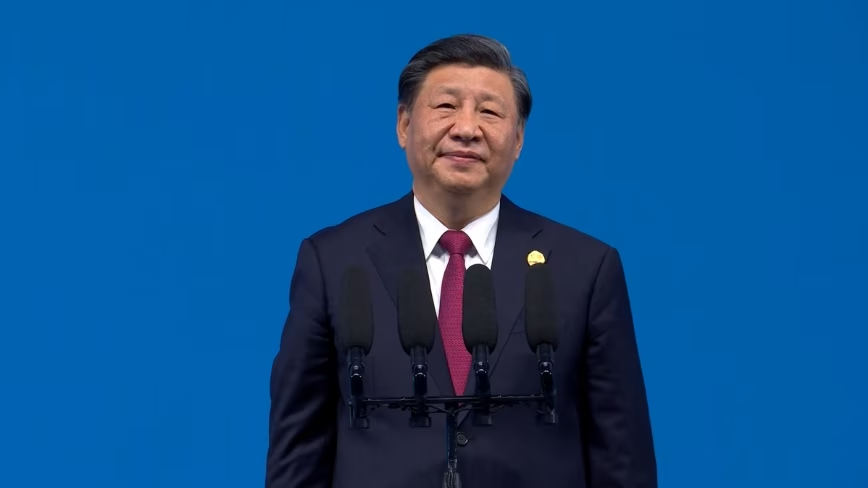
Xi pitches open-source AI to BRICS amid domestic curb debates
Chinese President Xi Jinping proposed a China-led open-source AI community and invited BRICS nations to join the World AI Cooperation Organization (WAICO) at the recent BRICS summit. This push for global collaboration contrasts sharply with Beijing's ongoing internal debates about restricting its own advanced AI models. Meanwhile, the EU's comprehensive AI Act, with its clear, enforceable rules for open-source AI, highlights a significant divergence in global AI governance approaches.

StarCraft Returns in 2030 as Open-World Shooter
Blizzard Entertainment announced a new StarCraft game, an open-world shooter, set to release in 2030. Unveiled at BlizzCon by VP Dan Hay, this marks the series' return after over a decade and a significant genre shift from its real-time strategy roots. The cinematic trailer showcased a gritty human-Zerg conflict, with many fans hoping for a traditional RTS follow-up.

Tesla Set to Finally Unveil Second-Generation Roadster on October 1
The much-anticipated second generation of the Tesla Roadster, a halo vehicle promising revolutionary performance, is finally slated for a public unveiling on October 1. After years of delays and a protracted development

Seattle Warned on Big Tech Reliance; Microsoft/OpenAI Sued; Apple's
A new City of Seattle study warns of the city's risky economic over-reliance on a few dominant tech companies. Simultaneously, the Seattle Times and Newsday are suing Microsoft and OpenAI for alleged AI training data theft, while Apple's new foldable iPhone Duo evokes memories of Microsoft's defunct Surface Duo.
Google's AI Branding Fix: A Clearer Vision for Gemini
This article critiques Google's fragmented AI branding, proposing a unified 'Gemini Intelligence' system to simplify user experience and strengthen Gemini's identity.

in-depth: The Best 3-in-1 Apple Charging Stations After Testing 30
Wired has released its top picks for 3-in-1 Apple charging stations, extensively tested for iPhone, Apple Watch, and AirPods. The guide highlights six leading models, from premium speedy options to budget-friendly and compact designs, all focused on decluttering and optimizing charging for Apple users.