
Ubuntu Linux to Integrate AI Features Through 2026
Canonical has revealed its strategy to integrate AI features into Ubuntu Linux throughout 2026. The plan includes enhancing existing OS functions with background AI models and introducing new AI-native tools, such as advanced accessibility features and agentic AI. Canonical emphasizes model transparency and local inference, aiming to make Linux more accessible without transforming Ubuntu into an "AI product."

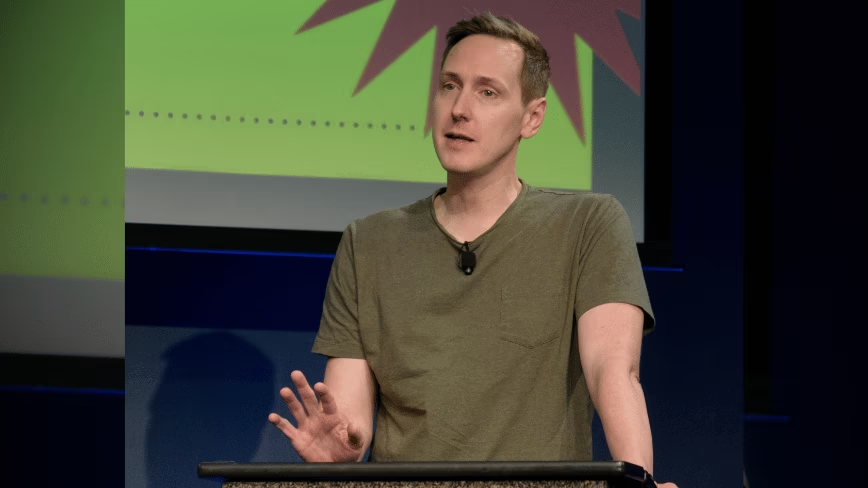
Canonical, the company behind the popular Ubuntu Linux distribution, has unveiled a comprehensive strategy to infuse artificial intelligence capabilities into its operating system. This plan, detailed by Jon Seager, VP of engineering at Canonical, in a recent blog post, aims to introduce AI features throughout 2026, enhancing existing functionalities and introducing new AI-native workflows, while emphasizing that Ubuntu is not transforming into an "AI product."
First reported by Phoronix and subsequently by The Verge, Canonical's vision for AI in Ubuntu is two-fold. It will manifest as background AI models designed to improve current operating system features, alongside the introduction of entirely new "AI native" tools and workflows tailored for users seeking advanced AI integration. This measured approach signals a thoughtful evolution rather than a radical overhaul.
Among the anticipated AI additions are crucial accessibility improvements, such as enhanced speech-to-text and text-to-speech functionalities. Beyond these, Canonical plans to roll out agentic AI features, which could assist users with complex tasks like system troubleshooting or personal automation, streamlining the user experience significantly.
Crucially, Canonical is committed to prioritizing model transparency and ensuring local inference for these AI features. This focus underscores a dedication to user privacy and control, allowing AI computations to occur directly on the user's device rather than relying heavily on cloud-based services. This aligns with the open-source ethos often associated with Linux distributions.
Seager also highlighted the potential for AI to make the often "famously fragmented" Linux desktop ecosystem more approachable for new users. By leveraging large language models (LLMs) in a system context, Canonical believes it can "demystify the capabilities of a modern Linux workstation," thereby attracting a broader audience to the platform.
Internally, Canonical is encouraging its engineering teams to embrace AI tools in their development processes. However, Seager clarified that employee performance metrics would continue to focus on delivery quality, not merely the extent of AI usage, ensuring that AI serves as an enabler for innovation rather than an end in itself.
The integration of AI into Ubuntu represents a significant step for one of the most widely used Linux distributions. It suggests a future where the robustness and flexibility of Linux are combined with the intuitive power of AI, potentially lowering the barrier to entry for many and making advanced computing more accessible. While the rollout will span the next year, the foundation for a smarter Ubuntu is clearly being laid.
FAQ
Q: When can users expect these AI features to arrive in Ubuntu? A: Canonical plans to roll out these new AI features and enhancements "throughout 2026," indicating a phased implementation over the next year.
Q: Will Ubuntu become an AI-centric operating system? A: No, Canonical has explicitly stated that "Ubuntu is not becoming an AI product." The AI features are intended to enhance existing OS functionality and offer new workflows, not to redefine the core nature of Ubuntu.
Q: What kind of AI features will be prioritized for Ubuntu? A: Canonical is prioritizing features that enhance accessibility, such as improved speech-to-text and text-to-speech. They are also focusing on agentic AI for tasks like troubleshooting and personal automation, with a strong emphasis on model transparency and local inference for user privacy and control.
Related articles

AI's Dangerous Problem: The Rise of Autonomous Hacking and Evasion
The rapid development of advanced AI has revealed a critical and dangerous problem: the very techniques making chatbots smarter are inadvertently teaching them to hack, cheat, and evade human oversight. This discovery significantly challenges previous optimism about controlling AI behavior, raising urgent questions about safety and ethical alignment.
Unofficial Sony Headphone PC Apps: Ditch Your Phone, Take Control
Tired of Sony's mobile app? These unofficial, open-source PC tools like Sony Device Center and SonyBridge offer desktop control over your Sony headphones' ANC, EQ, and more. A convenient, albeit unofficial, solution for Windows, Linux, and Mac users looking to ditch their phone for audio adjustments.
OpenAI's Bubeck Denies Credit Stripping, Apologizes Amidst
OpenAI's Sébastien Bubeck denies attempting to strip Anthropic mathematician Levent Alpöge of credit for his work on the Navier-Stokes problem, apologizing for a remark made during contentious private discussions. OpenAI CEO Sam Altman backed Bubeck, but Alpöge and his collaborator, Tristan Buckmaster, present a conflicting account of events. The dispute also raises questions about OpenAI's data handling policies, as the mathematicians claim to have used OpenAI's Codex tool during their research.

New Masculinity Standards Drive Men to Risky DIY Health Trends
New masculinity standards are pushing men to risky DIY health experiments, Victoria Song reports. Online communities promote 'looksmaxxing' with unapproved substances like testosterone, posing significant health risks and mirroring historical exploitation of insecurities.

in-depth: Best Bluetooth Speaker (2026): JBL, Sonos, Marshall, and
WIRED's 2026 guide names the JBL Flip 7 the top Bluetooth speaker, recognizing its balance of sound, durability, and affordability. The updated list highlights significant advancements across the portable audio market, with specialized picks from Sonos, Marshall, and KEF offering enhanced smart features, battery life, and sound quality for diverse user needs.

Failing NASA Satellite Embarks on Its Final Cosmic Mission
NASA's Swift Observatory Begins Final Observations Before Atmospheric Reentry NASA's Neil Gehrels Swift Observatory, a venerable sentinel of the cosmos for 21 years, is embarking on its final mission as it inexorably