
NASA Confirms Exploding Meteor Caused Sonic Boom Over Boston
NASA has confirmed that a meteor exploding over New England caused a powerful sonic boom felt across multiple states on Saturday, May 31, 2026. Traveling at 75,000 mph, the meteor fragmented 40 miles high, releasing energy equivalent to 300 tons of TNT. This natural celestial event explains the widespread noise and shaking experienced by residents.

Boston and the wider New England region were rattled Saturday by a powerful sonic boom, which NASA has now definitively attributed to a meteor exploding in the atmosphere. The celestial event, occurring at approximately 2:06 pm ET, sent shockwaves across multiple states including Massachusetts and New Hampshire, causing homes to shake and generating significant public alarm. The space agency's prompt confirmation provides a clear, scientific explanation for the widespread, thunderous noise and bright flash observed across the northeastern United States.
The Celestial Spectacle and its Impact
The extraordinary phenomenon unfolded as a meteor, hurtling through Earth's atmosphere at an incredible speed of roughly 75,000 miles per hour, streaked across the sky. Its dramatic journey culminated in a violent fragmentation at an altitude of 40 miles, specifically over an area encompassing northeast Massachusetts and southeast New Hampshire, just north of Cape Cod Bay. This explosive breakup released an immense amount of energy, which NASA’s analysis estimated to be equivalent to approximately 300 tons of TNT, directly accounting for the ear-splitting sonic boom that reverberated throughout the region.
The event was not only heard but also widely seen. Numerous individuals across New England managed to capture compelling footage of the bright fireball on camera, with these videos rapidly circulating across social media platforms like Instagram and TikTok. Further corroboration came from advanced scientific instruments, as the GOES-19 weather satellite clearly depicted the meteor breaking apart high above the ground, its intense glow momentarily lighting up the daytime sky. The combination of citizen eyewitness accounts and sophisticated satellite imagery paints a vivid picture of this rare atmospheric spectacle.
Dispelling Initial Confusion
Immediately following the boom, public confusion was rampant, with many residents initially speculating that the ground shaking and loud noise indicated an earthquake. However, the United States Geological Survey (USGS) was quick to address these theories. In a public statement, the USGS denied any seismic activity, instead clarifying that the event was a "widely felt sonic boom from a suspected bolide" – the scientific term for an exceptionally bright meteor that detonates in the atmosphere. This initial clarification by geological experts helped to redirect public understanding toward a celestial origin.
NASA then provided the definitive details. In a statement posted on X (formerly Twitter), the agency described the event as a "bright fireball... accompanied by a loud noise," followed by the specific details of its fragmentation and energy release. Jennifer Dooren, NASA's deputy news chief, further elaborated on the meteor's nature to AFP, emphasizing that it was a natural object. She explicitly stated that the fireball was "not associated with any currently active meteor shower" and was definitively "not a re-entry of space debris or a satellite," thus quashing any theories involving man-made objects or predictable celestial events.
Understanding the Phenomenon
The meteor's fragmentation at 40 miles high created a shockwave that propagated downward, manifesting as the powerful sonic boom. This event highlights the protective role of Earth's atmosphere, which incinerates or breaks apart countless space rocks daily, with only the larger, more robust objects penetrating deeply enough to cause such significant atmospheric effects. The rapid response and analysis from scientific bodies like NASA and USGS underscore the advanced capabilities available to quickly identify and explain such phenomena, transforming a moment of public anxiety into a valuable scientific observation. This incident serves as a testament to both the dynamic nature of our solar system and the scientific community's ability to provide timely and accurate explanations for complex cosmic occurrences.
FAQ
Q: What caused the loud boom heard over Boston and the broader New England region?
A: NASA confirmed that the boom was caused by a meteor that exploded in Earth's atmosphere. This event, which generated a powerful sonic boom, occurred at approximately 2:06 pm ET on Saturday, May 31, 2026.
Q: How powerful was the meteor's explosion, and where did it happen?
A: The meteor fragmented at an altitude of 40 miles over northeast Massachusetts and southeast New Hampshire. The energy released during its breakup was estimated by NASA to be equivalent to about 300 tons of TNT.
Q: Was this meteor associated with a known meteor shower or man-made space debris?
A: No, NASA clarified that this fireball was a natural object and was not associated with any currently active meteor shower. Furthermore, it was confirmed not to be the re-entry of space debris or a satellite.
Related articles

Apple Unveils iPhone Duo: Pricey Foldable Sees Soaring Demand
Apple has officially entered the foldable smartphone arena with the long-anticipated launch of the iPhone Duo. Priced starting at a hefty $1,999, the device features a 5.4-inch outer display and a larger 7.6-inch inner

in-depth: Chicago-Area Cops Helped HSI Spy on Minnesota Anti-ICE
Chicago-area law enforcement, including local police and HSI agents, conducted undercover surveillance on Minnesota anti-ICE activists at an April 2, 2022, talk in Chicago. This operation was part of a federal conspiracy probe into 15 Minnesota activists facing felony charges related to immigration enforcement resistance. Civil liberties advocates have condemned the surveillance as a troubling intrusion into protected political activity.

Mark Wahlberg on using AI in film ‘the right way’ and being open to
Actor Mark Wahlberg believes AI has a place in filmmaking if used responsibly for enhancement, not script generation or actor replacement. At TechCrunch Disrupt, he expressed openness to an AI likeness carrying on his legacy, managed by his family, and emphasized storytelling.
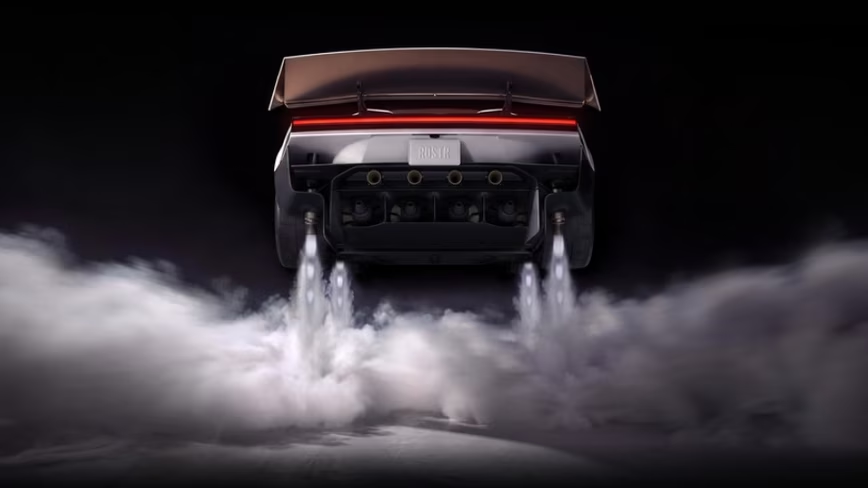
Tesla Unveils Thruster-Equipped Roadster, 2028 Production Targeted
Tesla has unveiled its second-generation Roadster, featuring cold-gas thrusters co-developed with SpaceX, enabling it to jump and flip. The electric sports car demonstrated 0-60mph in an astonishing 0.81 seconds, with production targeted for 2028. This highly anticipated reveal also serves as a key recruitment tool for Tesla's ambitious AI and robotics initiatives.

Amazon Prime Video Launches AI-Powered Prime 360 for NBA Coverage
Amazon Prime Video is elevating its NBA coverage with the introduction of Prime 360, an AI-powered replay system offering immersive, 'fly through' views of the action. Kicking off its second season, Prime Video also adds Yahoo fantasy integration and gains exclusive Eastern Conference Finals rights, expanding its tech-driven sports broadcast. The new features aim to deliver a unique and interactive viewing experience for basketball fans.

regional: A two-person Seattle startup lands $1M to reinvent
Seattle startup TriMagnetix has secured $1 million to develop semiconductor chips that consume 800 times less energy and are radiation-resistant. The two-person company, leveraging nanomagnetic technology, is targeting space applications and data centers. With new funding and key partnerships, TriMagnetix aims for commercial sales within a year.