
K2 Space Opens Seattle Engineering Hub for Mega-Satellites
California-based K2 Space, a rapidly growing player in the aerospace sector, has announced the opening of a new satellite engineering office in the Seattle area, with Bellevue being the targeted location. The move,

California-based K2 Space, a rapidly growing player in the aerospace sector, has announced the opening of a new satellite engineering office in the Seattle area, with Bellevue being the targeted location. The move, revealed on July 1, 2026, is a strategic expansion designed to bolster the company's ambitious plans for developing "mega-class," high-power satellites for both government and commercial clients, tapping into the Pacific Northwest's rich talent pool.
K2 Space's Vision for "Big" Satellites
Founded in 2022, K2 Space has quickly made a name for itself by bucking the industry trend of miniaturization, instead focusing on massive, powerful satellites. The company has already secured over $500 million in capital and registered more than $1 billion in contracts. Its manufacturing operations are based in Torrance, California, complemented by a policy and strategy office in Washington, D.C.
This "go-big" strategy recently bore fruit with the successful launch of its first "mega-class" satellite, Gravitas, in March 2026 aboard a SpaceX Falcon 9 rocket. This two-ton, 20-kilowatt spacecraft carried a dozen undisclosed payload modules for various customers, including the Department of Defense. Just last month, K2 Space was also confirmed as a key supplier for the U.S. Space Force’s next-generation military communications network, further validating its approach. The company aims to ramp up production to hundreds of satellites annually by 2030 to meet anticipated market demand.
Why the Pacific Northwest?
Karan Kunjur, CEO and co-founder of K2 Space, emphasized the strategic importance of the Seattle expansion. He noted that the region was a "natural fit" given its strong reputation as an aerospace and engineering hub. The new office will serve critical functions, with the Seattle team contributing to advanced flight software, autonomy, and the intricate low-level systems essential for K2's high-performance satellites. With over 300 employees globally, K2 Space already has several team members working remotely in the Seattle area, and establishing a local office will provide crucial support for these employees and attract new talent.
Seattle: America's Satellite City
K2 Space’s arrival further solidifies Seattle’s standing as a global epicenter for satellite development and manufacturing. The region is home to facilities responsible for building more than half of the world's active satellites, a statistic heavily influenced by SpaceX's Starlink manufacturing plant in Redmond. Amazon's rival Project Kuiper constellation satellites are produced nearby in Kirkland.
The vibrant local ecosystem includes other prominent satellite manufacturers such as Starcloud in Redmond, Xplore in Bellevue, and Portal Space Systems in Bothell. South of the city, Tukwila hosts production facilities for BlackSky and Starfish Space. Beyond manufacturing, other California-based firms like Cowboy Space (formerly Aetherflux), which focuses on data center satellites, and Sophia Space, an orbital data center startup, also maintain engineering presences in the Seattle area. Even Jeff Bezos’ Blue Origin, headquartered in Kent, Washington, is actively pursuing satellite initiatives like Terawave and Project Sunrise, a proposed data-center constellation, with job postings indicating significant roles for its Seattle-area facilities.
Future Implications
The establishment of K2 Space's Seattle engineering hub signals a continued boom for the region's burgeoning space industry. By focusing on cutting-edge technologies for large, powerful satellites, the new office will not only generate high-skilled jobs but also drive innovation in a critical segment of the space economy. This expansion underscores Seattle's magnetic appeal for companies at the forefront of orbital technology, ensuring its sustained leadership in an increasingly competitive global space race.
FAQ
Q: What kind of satellites does K2 Space build?
A: K2 Space specializes in "mega-class," high-power satellites designed for both government and commercial applications, distinguishing itself from companies focused on smaller satellite designs.
Q: Why did K2 Space choose the Seattle area for its new engineering office?
A: The company selected Seattle due to its established reputation as a leading aerospace and engineering hub, the presence of a skilled talent pool, and to provide a physical base for existing remote employees in the region.
Q: What is the significance of K2 Space's Gravitas satellite?
A: Gravitas represents K2 Space's inaugural two-ton, 20-kilowatt "mega-class" satellite, launched in March 2026. It carried multiple undisclosed payloads for various clients, including the Department of Defense, showcasing the company's robust satellite capabilities.
Related articles

Apple Unveils iPhone Duo: Pricey Foldable Sees Soaring Demand
Apple has officially entered the foldable smartphone arena with the long-anticipated launch of the iPhone Duo. Priced starting at a hefty $1,999, the device features a 5.4-inch outer display and a larger 7.6-inch inner

in-depth: Chicago-Area Cops Helped HSI Spy on Minnesota Anti-ICE
Chicago-area law enforcement, including local police and HSI agents, conducted undercover surveillance on Minnesota anti-ICE activists at an April 2, 2022, talk in Chicago. This operation was part of a federal conspiracy probe into 15 Minnesota activists facing felony charges related to immigration enforcement resistance. Civil liberties advocates have condemned the surveillance as a troubling intrusion into protected political activity.

Mark Wahlberg on using AI in film ‘the right way’ and being open to
Actor Mark Wahlberg believes AI has a place in filmmaking if used responsibly for enhancement, not script generation or actor replacement. At TechCrunch Disrupt, he expressed openness to an AI likeness carrying on his legacy, managed by his family, and emphasized storytelling.

Ars Technica's Rocket Report: Your Essential Space Industry Briefing
Quick Verdict Ars Technica's Rocket Report, presented by veteran space reporter Stephen Clark, offers an invaluable and meticulously organized weekly (or similar frequency, implied by "Edition 9.15") digest of the most
Tesla Unveils Thruster-Equipped Roadster, 2028 Production Targeted
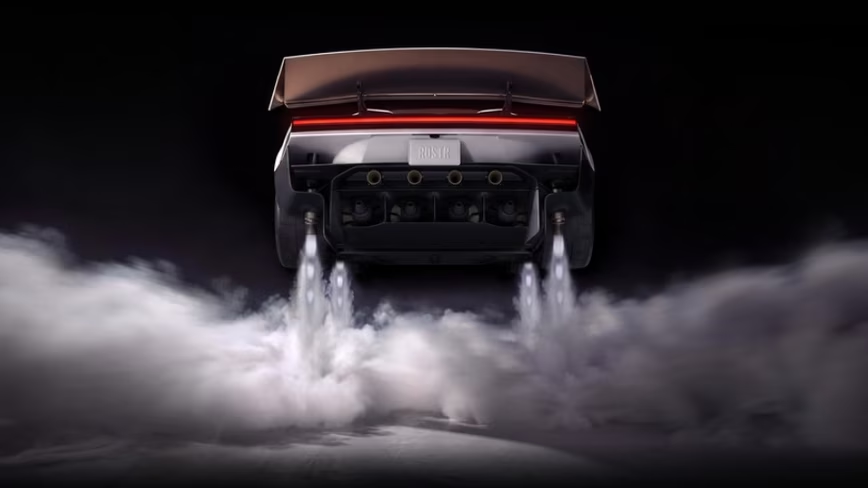
Tesla has unveiled its second-generation Roadster, featuring cold-gas thrusters co-developed with SpaceX, enabling it to jump and flip. The electric sports car demonstrated 0-60mph in an astonishing 0.81 seconds, with production targeted for 2028. This highly anticipated reveal also serves as a key recruitment tool for Tesla's ambitious AI and robotics initiatives.

Amazon Prime Video Launches AI-Powered Prime 360 for NBA Coverage
Amazon Prime Video is elevating its NBA coverage with the introduction of Prime 360, an AI-powered replay system offering immersive, 'fly through' views of the action. Kicking off its second season, Prime Video also adds Yahoo fantasy integration and gains exclusive Eastern Conference Finals rights, expanding its tech-driven sports broadcast. The new features aim to deliver a unique and interactive viewing experience for basketball fans.