
GeoLibre 1.0: Cloud-Native GIS for the Modern Developer Stack — Key
For too long, geospatial data visualization and analysis have been associated with heavy desktop applications and intricate server setups. While powerful, traditional GIS tools often present steep learning curves,
For too long, geospatial data visualization and analysis have been associated with heavy desktop applications and intricate server setups. While powerful, traditional GIS tools often present steep learning curves, deployment complexities, and friction in collaborative, web-first workflows. Enter GeoLibre 1.0, a new entrant promising a lightweight, cloud-native GIS platform designed to streamline how developers interact with spatial data. Built from the ground up with modern web technologies, GeoLibre aims to deliver a unified experience across desktop and browser environments, emphasizing fast, local, and cloud-native operations.
The GeoLibre Philosophy: Lightweight and Cloud-Native
GeoLibre 1.0 is engineered with a compelling modern stack to achieve its core tenets. It leverages Tauri to provide a consistent application experience, whether deployed as a desktop app or running purely in a web browser. The user interface is built with React and TypeScript, ensuring a responsive and robust frontend. For interactive mapping, GeoLibre relies on MapLibre GL JS, offering dynamic map manipulation with support for various basemaps and integrated on-map tools like Measure and Bookmark. Visualization of complex 3D scenes and large datasets is further empowered by deck.gl.
A standout technical decision is the integration of DuckDB-WASM Spatial. This powerful in-browser analytical database allows GeoLibre to perform complex spatial SQL queries directly within the browser, dramatically reducing the need for server-side processing for many common operations. This architecture not only enhances performance for local and remote data streams but also bolsters privacy, as data processing occurs client-side. The entire workspace adapts responsively, from desktop screens down to mobile browsers.
Data Ingestion: Beyond Traditional GIS
GeoLibre 1.0 excels in its versatile data handling capabilities, supporting both local and remote datasets. Developers can load a wide array of formats and services, moving beyond typical shapefiles and GeoJSON to embrace cloud-native paradigms:
- Web Services: XYZ, WMS, WFS, WMTS, ArcGIS, and STAC services.
- Cloud Formats: GeoParquet, FlatGeobuf, PMTiles, and Zarr. These are crucial for efficient handling of large-scale geospatial data in cloud environments.
- Rasters: Cloud Optimized GeoTIFF (COG) and traditional GeoTIFF, along with MBTiles.
- 3D Data: LiDAR, Gaussian splats, and 3D Tiles, indicating a focus on modern visualization needs.
- Databases: Direct connections to DuckDB and PostgreSQL databases.
Once loaded, data attributes can be inspected in a table, and layers can be styled using data-driven symbology. Projects are saved in a .geolibre.json format, facilitating easy sharing and reopening.
Processing and Analysis: In-Browser and Sidecar Power
GeoLibre offers a robust suite of processing tools, intelligently leveraging both in-browser capabilities and Python sidecar engines for optimal performance and flexibility:
- Vector Tools: Common operations like buffer, centroids, convex hull, dissolve, and clip are powered by Turf.js for in-browser execution. For more intensive tasks, an optional GeoPandas sidecar engine is available.
- Raster Tools: Functions such as hillshade, slope, aspect, reproject, and clip are executed via a rasterio Python sidecar, providing powerful image processing capabilities.
- Conversion: A dedicated menu allows conversion of data to cloud-native formats like GeoParquet, FlatGeobuf, PMTiles, and COG, streamlining data preparation for cloud workflows.
- Whitebox Geoprocessing: Batch geoprocessing can be performed using the Whitebox toolbox via the optional Python sidecar.
- SQL Workspace: The integrated SQL Workspace allows execution of DuckDB Spatial SQL queries directly in the browser against loaded layers, local files, or remote URLs. It intelligently handles bare URLs, streaming remote files efficiently using HTTP range requests. Results can be added to the map or exported as CSV or GeoParquet.
Extend and Integrate: Plugins and Python
GeoLibre 1.0 provides a robust plugin architecture and a built-in marketplace, allowing developers to activate built-in plugins (e.g., layer control, basemaps, Overture Maps, LiDAR, time slider) or install, update, and remove external plugins.
For developers embedded in the Python ecosystem, GeoLibre offers a powerful integration. The full GeoLibre application can be embedded within a Jupyter notebook using the geolibre Python package. This enables a leafmap-style API for programmatic map manipulation (add_geojson, add_tile_layer, add_cog), with bidirectional synchronization so UI edits are reflected and readable back in Python scripts. This bridging of UI and scripting environments is a significant boon for data scientists and analysts.
Try It Out: Browser Demo and Embeddability
One of GeoLibre's most appealing features for developers is its live browser demo. This static site, hosted on GitHub Pages, runs entirely client-side, making it private by design with no analytics or server accounts. It's an excellent way to explore the UI, load URL-based layers, style data, and test plugins without any installation.
The browser demo also highlights GeoLibre's embeddability, a practical takeaway for web developers. You can embed map-focused views into other applications or websites using specific URL query parameters:
https://viewer.geolibre.app/?url=https://share.geolibre.app/giswqs/3d-tiles.geolibre.json
For compact layouts, layout=compact uses icon-only toolbar buttons. To hide panels, use panels=none, panels=hidden, panels=hide, panels=off, or hidePanels=true.
For a fully chrome-free, map-only embed, the &maponly parameter hides the toolbar, panels, and status bar:
https://viewer.geolibre.app/?url=https://share.geolibre.app/giswqs/3d-tiles.geolibre.json&maponly
These capabilities underscore GeoLibre's flexibility as a component for web-based geospatial solutions.
Conclusion
GeoLibre 1.0 presents a compelling, modern alternative to traditional GIS platforms. Its cloud-native architecture, robust data format support, powerful in-browser processing via DuckDB-WASM Spatial, and seamless integration with Python position it as a valuable tool for developers seeking efficient, flexible, and privacy-conscious geospatial workflows. With its stability as a prototype and clear roadmap, GeoLibre is poised to evolve further as a key player in the open-source GIS landscape.
FAQ
Q: What's the core technology stack enabling GeoLibre's "cloud-native" and "lightweight" claims?
A: GeoLibre achieves this through a combination of Tauri (for cross-platform desktop/web deployment), React and TypeScript (for the responsive UI), MapLibre GL JS (for interactive mapping), and critically, DuckDB-WASM Spatial (for in-browser spatial SQL processing). deck.gl also contributes to advanced visualizations.
Q: How does GeoLibre handle geospatial data processing, particularly for large or complex datasets?
A: GeoLibre employs a hybrid approach: in-browser processing for vector data using Turf.js and spatial SQL queries with DuckDB-WASM Spatial, which efficiently handles remote files via HTTP range requests. For more computationally intensive tasks like raster operations or batch geoprocessing, it leverages Python sidecar engines such as GeoPandas, rasterio, and the Whitebox toolbox.
Q: Can GeoLibre be integrated into existing Python development environments and workflows?
A: Yes, GeoLibre offers deep integration with Python. Through the geolibre Python package, the entire application can be embedded within Jupyter notebooks. This provides a programmatic API for map manipulation and data addition, with two-way synchronization, allowing developers to interact with the map both through the UI and via Python code, facilitating complex analytical workflows.
Related articles

AI's Impact on Malware Detection: Next-Gen Protection Deep Dive
The landscape of cybersecurity has transformed dramatically. Gone are the days when a simple virus attached itself to a file, easily quarantined by an antivirus scanner. Today, malware is sophisticated, multifaceted,

AI Cybersecurity: The Perpetual Cat and Mouse Game
In the rapidly evolving digital landscape, the interplay between artificial intelligence and cybersecurity has created a dynamic, ceaseless challenge—a true cat and mouse game. AI is not merely a tool for defense; it's
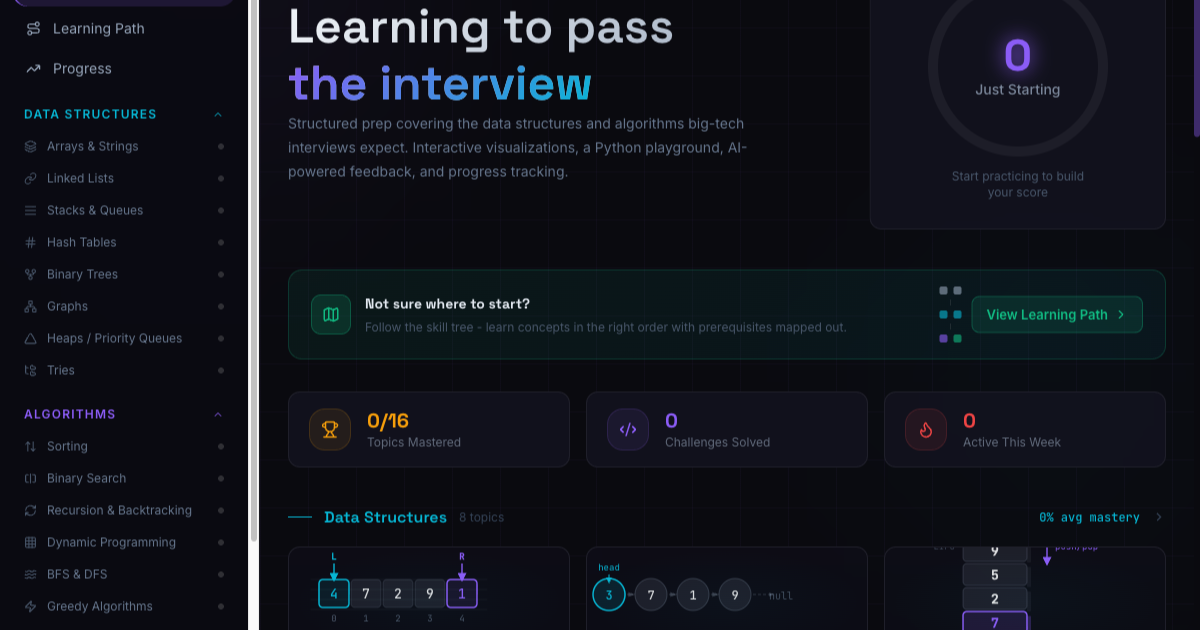
Learningto/Pass: Free, AI-Powered Interview Prep for Developers
Landing a role at a top-tier tech company often hinges on mastering complex data structures and algorithms, coupled with a solid grasp of system design. The problem for many aspiring software developers is that quality
The Composite Design Pattern: Unifying Individual Objects and Groups
As software engineers, we frequently encounter scenarios where we need to manage collections of objects that can be either individual entities or groups containing other entities. Think of a file system with files and

in-depth: A Stealth Startup Thinks It Just Hacked the Memory
Kepler Computing has emerged from stealth with a new chip architecture using 3D stacking and proprietary materials to solve the global memory shortage, bypassing expensive EUV lithography. Backed by $468M and a US Commerce Department commitment, the startup aims to boost HBM and SRAM density, essential for the AI boom.
Java's Secret Weapon: How Age Powers Its AI Future
Java's extensive history is a key AI superpower, offering a stable foundation for agent-generated code and an unparalleled dataset for training AI models. Its mature ecosystem of libraries and agentic harnesses further enable developers to build robust, integrated AI applications. This positions Java as a powerful, reliable choice for future AI-driven software development.