
FADU FS-SSD: A Glimpse into the Future of Storage
FADU's File-Semantic SSD moves the filesystem directly into the drive, aiming to dramatically reduce host CPU overhead for file operations, especially for GPUs and DPUs. Promising early results, but a long wait for samples (Q3 2027).
Quick Verdict
FADU's File-Semantic SSD (FS-SSD) represents a bold, potentially game-changing leap in storage architecture. By embedding the file system directly within the SSD's flash, it promises to liberate host CPUs, GPUs, and DPUs from the significant overhead of file operations. While initial performance figures are impressive, particularly in maintaining high operations per second even with limited host CPU resources, its Q3 2027 sample availability means this is a technology for tomorrow's data centers, not today's builds. It addresses a critical bottleneck in high-performance computing, but its real-world impact and broader ecosystem adoption remain to be seen.
Introduction: Reimagining Storage for the AI Era
In the demanding landscape of modern data centers, where GPUs and DPUs are increasingly central to AI, machine learning, and high-performance computing, the traditional storage stack has become a bottleneck. Host CPUs spend a considerable portion of their cycles – FADU estimates around 30% in GPUDirect Storage random-read workloads – simply managing file systems and block layers. This is where FADU, a South Korean fabless SSD controller designer, steps in with its innovative File-Semantic SSD (FS-SSD). Announced at the 2026 OCP Global Summit, this technology aims to fundamentally shift how file access is handled, moving the intelligence closer to the data itself.
Under the Hood: The FS-SSD Advantage
The core innovation of the FS-SSD is straightforward yet profound: it integrates the file system directly into the SSD's flash memory. This radical approach allows GPUs, DPUs, and Network Interface Cards (NICs) to directly open and read files without requiring intervention from the host filesystem, the block layer, or even the storage-server CPU. FADU has chosen to implement this using the NFSv3 protocol, a strategic decision given its lightweight nature (21 operations), operating system and filesystem agnosticism, and stateless design, which minimizes firmware overhead. This means existing NVMe-oF over RDMA and TCP networks can be utilized without new transport mechanisms.
The drive’s internal architecture is designed for efficiency. It merges the file system and flash translation layer, building a file layer from F2FS. This ensures that node and data blocks are naturally aligned with flash pages and erase units. A key benefit is a drastically reduced DRAM mapping metadata overhead – approximately 0.1% of NAND capacity (1 GB per TB), similar to a standard SSD, but with about 95% of that DRAM becoming a hot-path node cache. Furthermore, FS-SSD eliminates the "double garbage collection" issue often seen with host F2FS, where both the host and drive perform cleanup, leading to 63% lower write amplification in FADU's prototype testing.
Performance Promises and Early Numbers
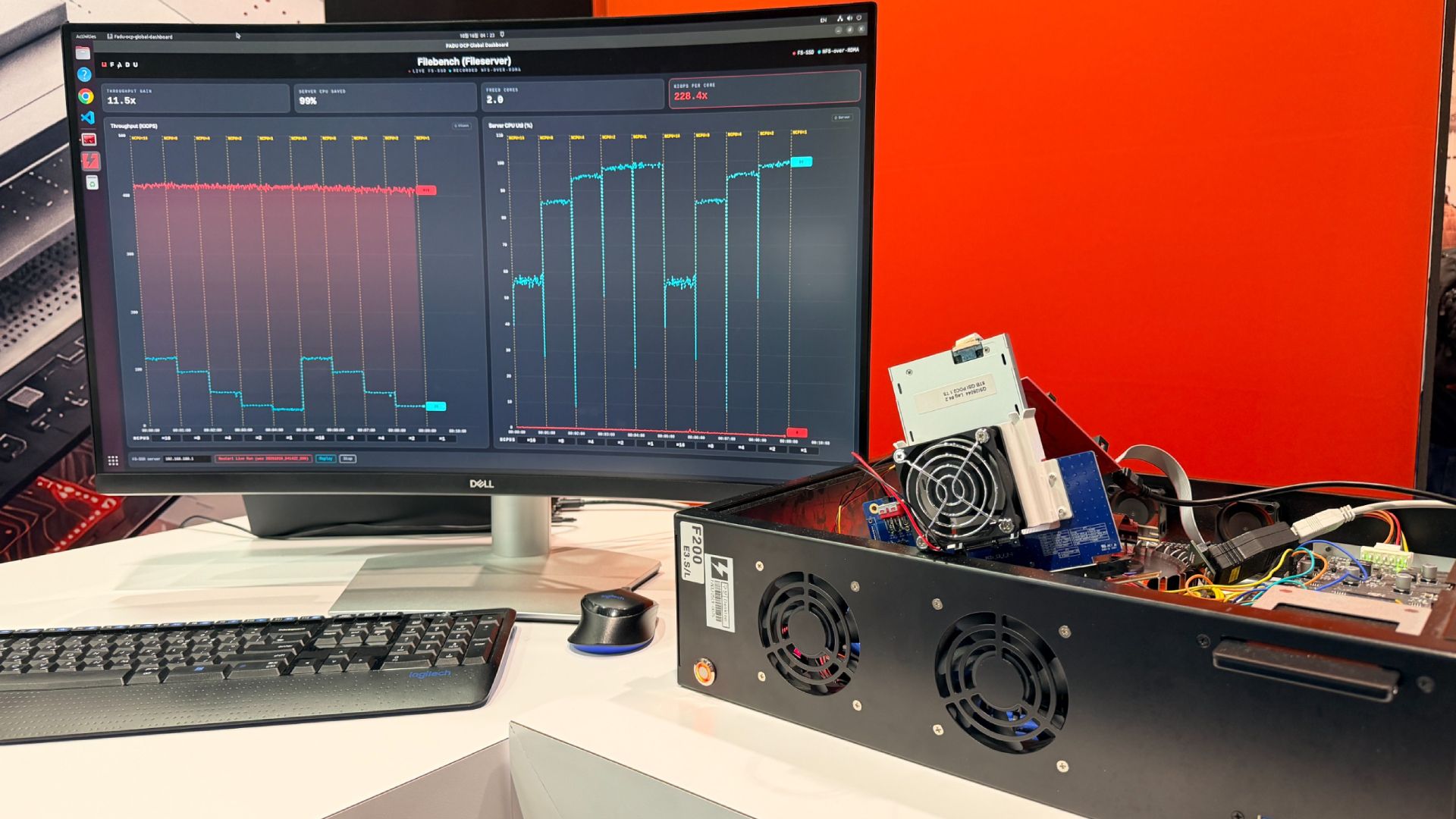
FADU's preliminary testing, while on a prototype built on a Gen6 controller in a PCIe 5.0 host, shows compelling results. In an NFS-over-NVMe test, the FS-SSD maintained a remarkable 460,000 operations per second (ops/s), even as the server's CPU core count was reduced from 16 to just one. This stands in stark contrast to a traditional Linux NFS-over-RDMA setup, which delivered only about 150,000 ops/s with 16 cores and a mere 40,000 ops/s with a single core. This demonstrates the FS-SSD's ability to offload significant processing burden from the host CPU.
For direct I/O workloads, FADU provided synthetic fio results comparing FS-SSD with traditional F2FS and Ext4 on block firmware, and a raw block device using SPDK. The FS-SSD (SPDK client) achieved 13,000 MB/s for 4KB random reads, retaining about 93% of the raw block device's performance. For 4KB random writes, it hit 7,030 MB/s, about 53% of the raw block's performance. The cost of the in-drive file layer was around 7% for random reads and 47% for random writes. Sequential read performance across F2FS, Ext4, and FS-SSD (kernel client) all topped out at approximately 14.1 GB/s, indicating the PCIe 5.0 link limit was hit. The Filebench test, characterized by metadata-heavy file server operations with 10,000 files and 50 client threads, highlighted the FS-SSD's significant advantage in offloading complex file system tasks.
Comparison to Alternatives
Let's put these numbers into perspective by comparing FADU's FS-SSD prototype with conventional approaches based on the provided data.
| Feature/Metric | FADU FS-SSD (Prototype) | Linux NFS-over-RDMA (16 cores) | Linux NFS-over-RDMA (1 core) | Raw Block (SPDK) |
|---|---|---|---|---|
| Filesystem Location | Inside SSD flash | Host CPU | Host CPU | N/A (block device) |
| CPU Overhead | Minimal (bypasses host CPU) | High (consumes ~30% of CPU cycles for file operations) | Very High (significant bottleneck) | Minimal (direct block access) |
| NFS Ops/s (Filebench) | ~460,000 | ~150,000 | ~40,000 | Not Applicable (no filesystem) |
| 4KB Random Read (MB/s) (FIO, SPDK Client) | 13,000 | Not Directly Comparable (NFS-over-RDMA is diff layer) | Not Directly Comparable | 13,990 |
| 4KB Random Write (MB/s) (FIO, SPDK Client) | 7,030 | Not Directly Comparable | Not Directly Comparable | 13,240 |
| DRAM Overhead | ~0.1% NAND capacity, 95% acts as hot-path node cache | Standard filesystem overhead | Standard filesystem overhead | Standard SSD controller mapping table overhead |
| Write Amplification | 63% lower vs. host F2FS | Higher (double GC possible) | Higher (double GC possible) | Standard SSD controller WA |
| Target Use Cases | GPU file reads/checkpoints, DPU HTTP content, JBoF FS | General purpose networked file access | General purpose networked file access | High-performance block storage, custom FS |
Note: The FIO comparisons for FS-SSD and Raw Block SPDK are on a Gen6 controller in a PCIe 5.0 host, with sequential reads topping out at the link limit. NFS-over-RDMA results are from a separate file server test.
User Experience and Practical Implications
For data center architects and engineers, the FS-SSD offers several compelling benefits. First, the host-free access model means GPUs, DPUs, and SmartNICs can directly interact with files, enabling extremely low-latency data access for AI/ML workloads, real-time analytics, and high-speed content delivery. This offloads compute resources from the host CPU, allowing them to focus on core application tasks rather than storage management.
The reduced DRAM overhead and improved write amplification are also significant for enterprise deployments, potentially leading to lower total cost of ownership (TCO) through more efficient resource utilization and extended flash endurance. Explicitly named use cases, such as GPU file reads and checkpoints, DPU-served HTTP content delivery, and JBoF (just a bunch of flash) file servers, highlight its potential for specialized, high-demand environments.
The Road Ahead: Q3 2027 and Beyond
While the technology is undeniably exciting, it's crucial to remember that FADU's FS-SSD is still "under active development." Partner samples aren't expected until Q3 2027, with Gen6-host results anticipated in Q1 2027. This indicates that widespread adoption is still several years away. Furthermore, while the performance claims are compelling, they are based on internal prototype testing and synthetic workloads, with some figures like the raw drive's random write performance potentially not representing a steady state. The long lead time also leaves room for competitors or alternative solutions to emerge.
Buying Recommendation
The FADU FS-SSD is not a product you can buy today, nor is it targeted at the average consumer or even small businesses. It’s a specialized solution for hyperscale data centers, AI/ML clusters, and environments where CPU overhead from storage I/O is a critical bottleneck. For these enterprise customers, the technology presents a very promising future direction. If you're designing next-generation data infrastructure and seeking ways to maximize the efficiency of your GPUs and DPUs by minimizing storage-related CPU cycles, keeping a close eye on FADU's progress is highly recommended. For everyone else, this is an exciting peek into how storage might evolve in the coming years.
FAQ
Q: Who is the FADU FS-SSD designed for?
A: The FADU FS-SSD is primarily designed for high-performance computing environments such as data centers, AI/ML clusters, and systems utilizing GPUs, DPUs, and SmartNICs. Its goal is to reduce host CPU involvement in file operations, thereby boosting overall system efficiency.
Q: When can we expect to see FADU FS-SSD products available?
A: FADU expects to have partner samples of the FS-SSD available by Q3 2027. This indicates that commercial products based on this technology will not be widely available for several years.
Q: What are the main benefits of FADU's approach compared to traditional SSDs?
A: The primary benefits include significantly reduced host CPU overhead for file operations, enabling faster data access for accelerators like GPUs, lower DRAM mapping metadata requirements (with more DRAM available for hot caching), and decreased write amplification due to a unified garbage collection process.
Related articles
UGREEN 25W MagFlow: Portable 2-in-1 Charger Hits Record Low
The UGREEN 25W MagFlow, a foldable 2-in-1 magnetic wireless charger for iPhones and earbuds, is back to its record-low Prime Day price. Offering Qi2 25W charging and a compact design, it's ideal for travelers and minimalists.

AI Model Lock-in? It's Not the Model, It's Everything Else
A recent survey reveals that while swapping AI models is becoming common, the real lock-in risk for enterprises lies in the surrounding infrastructure: integrations, agent workflows, and guardrails. Despite concerns about vendor lock-in, it often ranks lower than immediate priorities like security and cost in AI purchasing decisions. However, multi-model adopters are proactively building open, flexible architectures, demonstrating a path to mitigate future migration headaches.

OpenBSD 8.0: Unwavering Security, Specialized Performance
OpenBSD 8.0: Unwavering Security, Specialized Performance OpenBSD 8.0 has officially landed, marking the 61st release for this highly specialized operating system. True to its roots, OpenBSD 8.0 reinforces its

Xbox Game Pass Poised for Massive Overhaul: Farewell, All-You-Can-Eat
Well, gamers, if you thought Xbox Game Pass had settled into its groove, think again. Reports are swirling that Microsoft is preparing for a significant shake-up of its flagship subscription service, moving away from
Turn Your ESP32 into a Surveillance Detector for Enhanced Privacy
Turn Your ESP32 into a Surveillance Detector for Enhanced Privacy In an increasingly connected world, privacy concerns are more prevalent than ever. From ubiquitous street cameras to personal smart glasses, it can feel

Open-Source's Hidden Crisis: A Critical Security Vulnerability
The Unseen Pillars of Software: A Critical System Under Threat Quick Verdict: The modern software ecosystem, from operating systems to mobile apps, rests on a precarious foundation of critical open-source projects, many