
Cloud in a Bottle: Reimagining Self-Hosting for the Modern Web
As software developers, we're all too familiar with the evolving landscape of digital tools. While cloud-based applications offer undeniable convenience – instant access, cross-device compatibility, and seamless
As software developers, we're all too familiar with the evolving landscape of digital tools. While cloud-based applications offer undeniable convenience – instant access, cross-device compatibility, and seamless collaboration – they often come at a hidden cost: our data privacy, attention, and control. The financial incentives driving these services frequently diverge from user benefits, leading to experiences riddled with ads, tracking, and intentional engagement tactics. This shift has also created a dilemma for open-source software; developers who offer their work freely rarely have the resources to bear the significant hosting costs of a centralized cloud service.
In the pre-cloud era, open source thrived because users ran software locally. Today, that model struggles with the 'software-as-a-service' paradigm, primarily because individuals lack an accessible and straightforward way to self-host web applications in a manner comparable to commercial cloud offerings. Existing self-hosting solutions, while valuable, often fall short in terms of user experience, security, or ease of use for the broader public.
The Hurdles of Traditional Self-Hosting
Many developers who have explored self-hosting quickly encounter limitations with current options:
- Sandstorm.io: An early pioneer with a similar vision for federated hosting, Sandstorm unfortunately became unmaintained. Its approach also necessitated significant modifications for applications to run on its platform.
- Nextcloud: While popular, it can be resource-intensive, often facing reliability issues, and has increasingly adopted an enterprise-centric focus.
- Yunohost: This platform places applications directly on the host system without adequate sandboxing. This architecture poses a significant security risk, as a compromise in one application could potentially jeopardize the entire server.
- Coolify: While it supports containerized applications, each application functions as an isolated entity, typically requiring separate authentication and offering minimal integration with the host system or other applications.
These challenges highlight a gap in the ecosystem: a self-hosting solution that combines the ease of a commercial cloud service with the security and integration expected by modern users and developers.
Cloud in a Bottle: A New Approach
Cloud in a Bottle emerges as an open-source initiative designed to address these limitations. At its core, it's a foundational Ubuntu server equipped with a web server that manages a user dashboard and intelligently routes HTTP(s) requests to containerized applications. The platform emphasizes:
- Containerization: Applications run as rootless, hardened containers. This design allows existing software to be adapted with minimal changes while operating within a reasonably secure sandbox, mitigating the risks seen in less isolated environments.
- Unified Experience: Beyond merely hosting containers, Cloud in a Bottle introduces opt-in platform features to enhance the user experience. A key example is unified authentication: once logged into your instance, you're automatically logged into all integrated applications, eliminating the need for separate accounts.
- Inter-App Communication: The platform provides an interface for permissioned access to data and capabilities across different applications within the same instance. This parallels the robust API ecosystems of mobile operating systems like Android and iOS, which enable rich, integrated experiences through features such as sensor access, notifications, or health data sharing.
- Simplicity and Transparency: Developed with a philosophy of being 'magic-free,' Cloud in a Bottle is open source, entirely self-hostable, and incorporates zero telemetry. This commitment ensures developers and users retain full control and visibility over their digital infrastructure.
Developed by Imbue, Cloud in a Bottle is supported by a straightforward business model that includes a managed version. Crucially, the open-source, self-hosted version runs identical code and is a first-class citizen in the project's development, ensuring parity and community focus.
Catalyzing the Open-Source Web
Cloud in a Bottle aims to solve a classic 'chicken and egg' problem: without an accessible way to self-host open-source web applications, the audience for such software remains small, limiting its creation. By providing an easy-to-use platform, the project hopes to catalyze the development of more high-quality open-source web software that can compete with proprietary alternatives in terms of user experience and features. Its curated app catalog, though currently small, is growing, focusing on applications that deliver exceptional user experiences.
For developers, adapting or creating new applications for Cloud in a Bottle is designed to be straightforward. While early adopters might need some technical familiarity to customize their instances, the long-term vision is to make the platform accessible to everyone, regardless of their technical background, as the app catalog deepens and the user experience is further refined.
Getting Started
Developers interested in exploring Cloud in a Bottle have several avenues:
- Managed Instance: Try a managed instance to quickly experience the platform without setup overhead.
- Self-Hosting: Deploy it on a cloud VPS, a virtual machine on your local hardware, or directly on bare metal.
- Community and Code: Engage with the project on GitHub, review its AGPL-3.0 licensed source code, and join discussions on Matrix.
Cloud in a Bottle represents a compelling vision for reclaiming digital autonomy, offering a robust, integrated, and accessible path for self-hosting modern web applications. It empowers developers to build the next generation of open-source web software that truly aligns with user interests.
FAQ
Q: What is the fundamental architecture of a Cloud in a Bottle instance?
A: At its core, a Cloud in a Bottle instance is an Ubuntu machine featuring a web server. This server manages a central dashboard and intelligently routes incoming HTTP(s) requests to various applications, which are run as isolated, rootless, and hardened containers.
Q: How does Cloud in a Bottle enhance security and application integration compared to other self-hosting platforms?
A: Cloud in a Bottle significantly improves security by running applications in sandboxed, rootless containers, limiting potential attack surfaces. For integration, it offers features like unified authentication, where a single login grants access to all installed applications, and an interface for permissioned data and capability sharing between different applications, akin to modern mobile OS APIs.
Q: What kind of modifications are typically required to adapt existing open-source web software for Cloud in a Bottle?
A: Cloud in a Bottle is designed to run existing software with minimal changes, thanks to its containerized approach. Applications are packaged into hardened containers, and the platform provides mechanisms for integration, such as unified authentication and inter-app data access, which can be opted into. The documentation suggests that creating new apps or adapting existing ones is a relatively easy process for developers.
Related articles
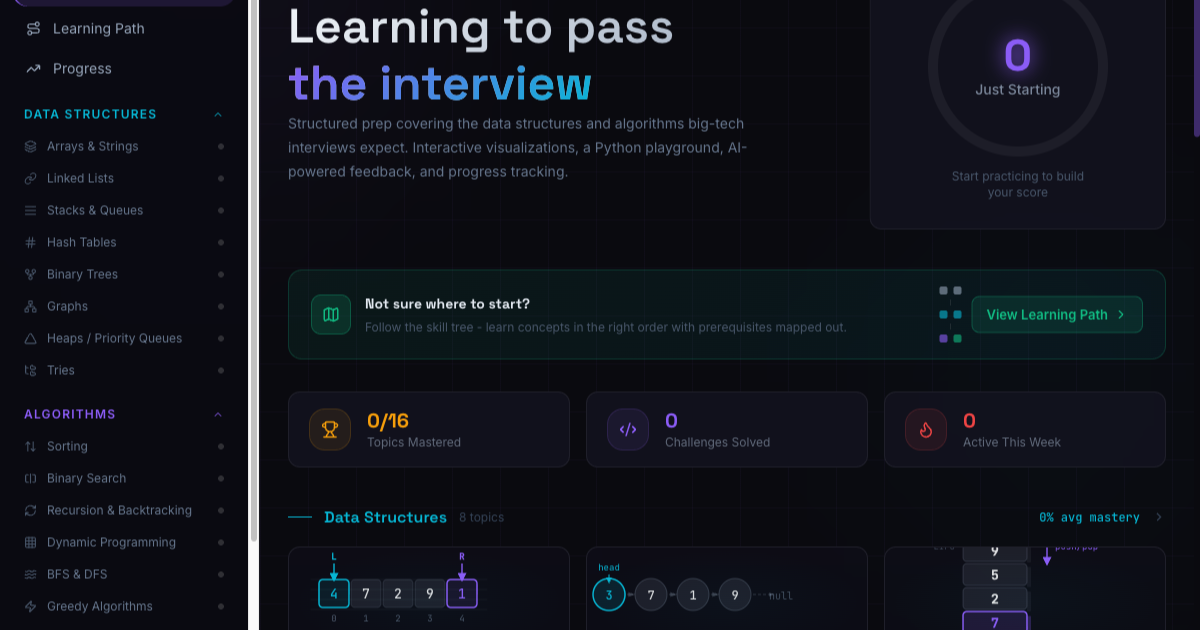
Learningto/Pass: Free, AI-Powered Interview Prep for Developers
Landing a role at a top-tier tech company often hinges on mastering complex data structures and algorithms, coupled with a solid grasp of system design. The problem for many aspiring software developers is that quality

The Composite Design Pattern: Unifying Individual Objects and Groups
As software engineers, we frequently encounter scenarios where we need to manage collections of objects that can be either individual entities or groups containing other entities. Think of a file system with files and

Java's Secret Weapon: How Age Powers Its AI Future
Java's extensive history is a key AI superpower, offering a stable foundation for agent-generated code and an unparalleled dataset for training AI models. Its mature ecosystem of libraries and agentic harnesses further enable developers to build robust, integrated AI applications. This positions Java as a powerful, reliable choice for future AI-driven software development.

Hyrule Reimagined: Ocarina of Time's Bold New Look Revealed
The Legend of Zelda: Ocarina of Time remake embraces a hyper-realistic HD overhaul, sparking widespread debate among fans. While stunning new screenshots showcase a meticulously detailed Hyrule, changes to Link's appearance, Navi's sound, and potential mobile phone integration for quests have generated mixed reactions. Nintendo's ambitious vision aims to balance modern graphics with the essence of the N64 classic.
Scaling FinTech Operations: AI's Role in Code, SDLC, & UX
In the rapidly evolving landscape of financial technology, ensuring both security and efficiency at scale is paramount. As AI increasingly permeates critical infrastructure, developers working in FinTech face unique
Nitter Project Continues Development Following Legal Challenge
Nitter Lives: Navigating Legal Challenges and Enhancing X/Twitter Privacy For many developers and privacy-conscious users, interacting with modern web platforms, particularly social media giants, presents a significant