
Article Review: Cosmic Bombardment Reshaped Early Earth - Insightful
Ars Technica's article, "The missing 500 million," offers an insightful and well-articulated review of a new geological theory suggesting cosmic bombardment melted Earth's first crust, enabling continent formation.
Ars Technica's "The missing 500 million": A Fresh Look at Earth's Origins
Verdict: Ars Technica's article, "The missing 500 million: Cosmic bombardment melted Earth’s first crust," offers an incredibly insightful and well-articulated dive into a groundbreaking new hypothesis about our planet’s earliest geological history. For anyone with a curiosity about Earth science, this piece is an engaging and highly recommended read that distills complex research into digestible information.
The Core Hypothesis: Cosmic Impacts as Earth's Sculptors
This article by Jacek Krywko explores a compelling new theory proposed by geologist Tim Johnson and his team at Curtin University. It addresses a long-standing enigma: the formation of Earth's continents. The prevailing models often struggled to account for the necessary heat budget during the Hadean eon (Earth's first 500 million years), leaving scientists puzzled about why continental crust only began to appear around 4 billion years ago. Johnson's team argues that an intense and sustained cosmic bombardment from asteroids and meteorites was the primary heat source during this tumultuous period, profoundly influencing the planet's nascent crust.
Traditionally, geological thought has leaned on internal heat sources like accretion remnants, core formation, and radioactive decay as dominant. However, the new modeling presented here suggests that external impacts delivered an immense amount of energy, heating the upper mantle by an order of magnitude greater than internal sources for much of the Hadean. This radical shift in understanding the early Earth's heat budget is the article's central revelation and is meticulously explained.
Methodology: Looking to the Moon for Earth's Past
One of the most fascinating aspects detailed in the article is the clever workaround for Earth's lack of ancient geological records. Since plate tectonics continuously recycles our planet's surface, direct evidence from the Hadean is incredibly scarce. Johnson's team, as explained, turned to the Moon. By calibrating crater counts on the Moon with dated lunar samples, they estimated the frequency and size of impacts on our celestial neighbor. This data was then scaled up to Earth, accounting for its larger size and stronger gravitational pull, to quantify the energy delivered by cosmic bombardments.
The article clarifies how this kinetic energy was converted into heat, impacting the upper mantle and driving extensive melting and basaltic volcanism, processes that continued for tens to hundreds of millions of years post-impact. These calculations, fed into geodynamic simulations, painted a vivid picture of a Hadean Earth with a thin, largely molten crust, potentially less than 5 kilometers thick, with significant melt fractions starting just 2-3 kilometers below the surface. Such conditions, the research indicates, would have made plate tectonics – which requires a rigid lithosphere – impossible.
Article's User Experience and Presentation
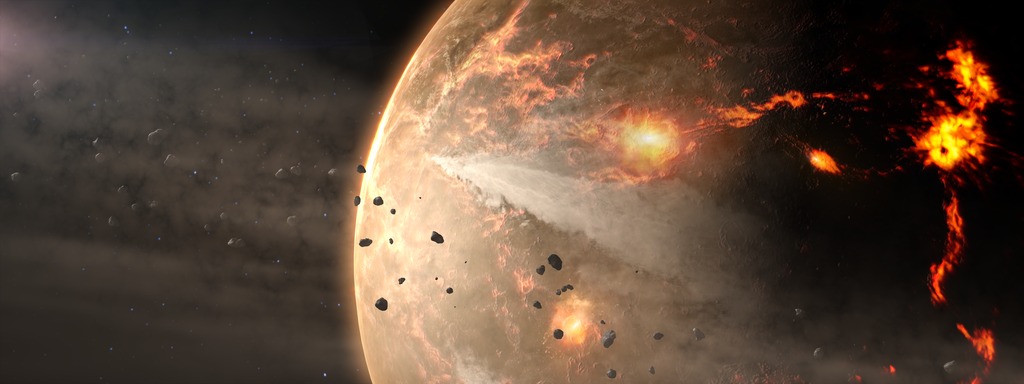
Jacek Krywko's writing is exemplary for science journalism. The article takes a complex geological hypothesis and makes it accessible without sacrificing detail. Krywko effectively uses direct quotes from Tim Johnson, lending authority and a human voice to the research. The analogy of mantle plumes to a lava lamp is a simple yet effective way to illustrate a complex geological process for a general audience. The flow of information is logical, moving from the problem statement to the proposed solution, the methodology, the findings, and finally, the implications for Earth's evolution. The single accompanying image, depicting a rocky planet surface under bombardment, visually anchors the abstract concepts. While the article is text-heavy, its clear structure, subheadings, and engaging prose ensure it remains an enjoyable and informative read.
Pros and Cons
Pros:
- Exceptional Clarity: Complex scientific concepts are broken down into understandable language.
- Strong Narrative: The article presents a compelling scientific puzzle and its elegant solution.
- Credible Sourcing: Features direct quotes from the lead researcher and cites the Science journal DOI, highlighting the robustness of the underlying research.
- Addresses a Fundamental Question: Offers a novel explanation for a major gap in our understanding of Earth's early history and continental formation.
- Engaging Analogies: Aids comprehension of difficult geological phenomena.
Cons:
- Limited Visuals: Only one image, though relevant. More diagrams or illustrations could further enhance understanding of the geological processes discussed.
- Reliance on Modeling: As the article itself notes, the hypothesis heavily relies on physics-based modeling due to a scarcity of direct rock samples from the Hadean. While acknowledged and justified, readers might wish for more empirical evidence (though this is a limitation of the science, not the article's reporting).
Comparing Alternative Theories
The article adeptly contrasts Johnson's new model with existing hypotheses regarding early Earth's geological activity. It mentions two dominant ideas: the presence of plate tectonics similar to today's, forming crust above subduction zones, or crust formation above mantle plumes rising from deep within the planet. The critical flaw in these prior ideas, as the article explains, was their inability to account for sufficient heat to drive such processes, based on models that only considered internal heat sources. Johnson's bombardment model effectively resolves this 'cold Earth' problem, providing the missing energy budget that makes the formation of early continents plausible, albeit through a different mechanism than previously thought. The article clearly demonstrates how the impact-driven heat would have rendered a rigid lithosphere (necessary for plate tectonics) impossible, leading to a period of extensive crustal recycling before the modern tectonic regime could establish itself as impacts waned.
Recommendation
For anyone interested in astrophysics, geology, or simply the dramatic origins of our home planet, this Ars Technica article is a must-read. It’s an accessible gateway to understanding cutting-edge research that challenges long-held beliefs about early Earth. The clear explanation of the scientific process, the logical presentation of evidence, and the engaging narrative make it an excellent piece of science journalism. It's especially valuable for those seeking to understand the ongoing debates and new discoveries in planetary science.
FAQ
Q: Is this article suitable for readers without a strong scientific background?
A: Yes, absolutely. Jacek Krywko excels at making complex geological concepts understandable through clear explanations and relatable analogies, making it very accessible to a general audience with an interest in science.
Q: Does the article offer a definitive answer to how continents formed?
A: The article presents a strong, physics-based modeling argument for a new hypothesis that explains continental formation and the conditions of the Hadean Earth. While the lead researcher acknowledges the ongoing search for more direct geological evidence, the model provides a compelling and well-supported explanation, challenging previous assumptions.
Q: Where can I find the original scientific paper mentioned in the article?
A: The article provides a DOI (Digital Object Identifier): 10.1126/science.aeb5402. You can use this to locate the peer-reviewed research paper published in the journal Science for a deeper dive into the technical details.
Related articles
Android 17 QPR2 Beta 7.1: The Performance Relief You've Been Waiting
Android 17 QPR2 Beta 7.1: Finally Fixing the QPR1 Performance Woes Verdict: Android 17 QPR2 Beta 7.1 is a crucial and highly anticipated software update for Google Pixel users, specifically targeting and resolving the

DJI Solo Video Setups: Smart Choices for Lone Creators
This review delves into DJI's recommended solo video setups, highlighting the Osmo Pocket 3 Creator Combo as a top pick for its integrated camera, gimbal, and mic. It also covers stabilizers like the Osmo Mobile 8 and RS 4, and the DJI Mic Mini series for enhanced audio, providing honest pros, cons, and clear buying advice.

Ars Technica's Rocket Report: Your Essential Space Industry Briefing
Quick Verdict Ars Technica's Rocket Report, presented by veteran space reporter Stephen Clark, offers an invaluable and meticulously organized weekly (or similar frequency, implied by "Edition 9.15") digest of the most

Apple iPhone Duo: A Daring Debut with Notable Compromises
Apple's highly anticipated iPhone Duo, priced at $2,000, has gone on pre-order. While hailed as "Apple's most exciting device in a decade" for its innovative foldable design and immersive display, it comes with significant drawbacks like the absence of FaceID and a premium camera.
KDE Plasma 6.8: A Future-Focused 30th Anniversary Update
Quick Verdict KDE Plasma 6.8, arriving as the "30th Anniversary Edition," is a pivotal release that decisively pushes the desktop environment into the future. With a definitive farewell to native X11 sessions and a

Ephemeral PR Preview Environments on GKE: A Deep Dive
Every development team eventually grapples with the limitations of shared staging environments. The familiar scenario: multiple features deployed simultaneously, database migrations clashing, and the phrase "it works on