
AI2 CEO Ali Farhadi Steps Down Amid Shifting AI Landscape
Ali Farhadi is stepping down as CEO of the Allen Institute for AI (Ai2) after two and a half years, citing the financial realities of competing in large-scale AI research as a nonprofit. Peter Clark will serve as interim CEO as the board seeks a permanent successor. Farhadi leaves a legacy of expanded open-source AI recognition and numerous impactful projects.

Ali Farhadi is stepping down as CEO of the Allen Institute for AI (Ai2), effective Friday, March 14, 2026, marking the end of a two-and-a-half-year tenure that significantly raised the Seattle-based nonprofit's profile in the open-source artificial intelligence community. His departure comes as Ai2 confronts the escalating demands and financial realities of competing with well-funded private sector entities in the rapidly evolving landscape of large-scale AI model development. Peter Clark, a founding member of Ai2, will serve as interim CEO, a role he previously held, as the board commences a search for a permanent leader.
Strategic Shift in AI Research
Board chair Bill Hilf revealed that discussions with Farhadi about this transition had been ongoing for approximately six months. Farhadi's motivation stems from a desire to pursue his research ambitions at the cutting edge of large-scale AI, an arena increasingly dominated by for-profit companies pouring billions into computational resources. Hilf articulated the strategic dilemma faced by Ai2: determining how philanthropic dollars can be most effectively utilized given the "extraordinary" cost of extreme-scale open model research and the difficulty for a nonprofit to keep pace with industry giants.
Interim Leadership and Departures
This marks the second instance of Peter Clark stepping into the interim CEO role for Ai2, having previously guided the institute after the departure of its founding CEO, Oren Etzioni, in 2022. The transition also includes the departure of Chief Operating Officer Sophie Lebrecht. Lebrecht shared a professional history with Farhadi, having worked alongside him at Xnor.ai, an Ai2 spinout, and subsequently at Apple, before joining him again at the nonprofit research institute.
Farhadi's Legacy at Ai2
A distinguished computer vision specialist, Farhadi first joined Ai2 in 2015 and was instrumental in co-founding Xnor.ai, a venture that Apple later acquired in 2020 for an estimated $200 million. He returned to lead Ai2 as CEO in July 2023 after a period heading machine learning initiatives at Apple. Under his leadership, Ai2 garnered widespread recognition as a pivotal force in open-source AI, releasing more than 300 AI models and artifacts that collectively achieved over 33 million downloads. Farhadi's tenure also saw significant advances in applying AI to critical areas such as health, science, and environmental research, attracting substantial investments from entities like the National Science Foundation and Nvidia, and establishing key partnerships such as the Cancer AI Alliance.
Ensuring Continuity and Future Direction
Bill Hilf emphasized that Farhadi prioritized ensuring the institute's stability before stepping down, confirming that all programs planned for 2026 are fully funded. Critical existing commitments, including a substantial $152 million, five-year initiative supported by the National Science Foundation and Nvidia for building open AI models for scientific research, and Ai2's involvement in the Cancer AI Alliance led by Seattle's Fred Hutch Cancer Center, will proceed without interruption. Founded in 2014 by the late Microsoft co-founder Paul Allen and receiving primary funding from the Foundation for Science and Technology, Ai2 remains committed to its core mission. It will continue to advance open-source AI models like OLMo and focus on leveraging AI to address real-world problems in areas such as climate, conservation, and public health.
The Search for a New Leader
Interim CEO Peter Clark reiterated the institute's unwavering dedication to "advancing AI research and engineering for the common good, and turning our open breakthroughs into lasting, real-world impact." The board's search for a permanent CEO will prioritize candidates who possess a unique combination of profound scientific expertise, proven experience in nonprofit management, and a deep-seated passion for open science—a profile Hilf described as challenging to find. While Ali Farhadi's next professional move remains unannounced, he is expected to retain his professorship at the University of Washington’s Allen School of Computer Science and Engineering and will also depart from the Ai2 board.
FAQ
Q: Why is Ali Farhadi stepping down as CEO of Ai2?
A: Ali Farhadi is stepping down to pursue his research ambitions in large-scale AI, an area where the computational and financial demands are exceptionally high, making it challenging for a nonprofit like Ai2 to compete with well-resourced for-profit companies.
Q: Who will lead the Allen Institute for AI in the interim?
A: Peter Clark, a founding member of Ai2, will serve as interim CEO. He previously held this role in 2022 after the departure of founding CEO Oren Etzioni.
Q: Will Ai2's major projects and funding be affected by this change?
A: No, Ai2's board chair Bill Hilf confirmed that all programs planned for 2026 are fully funded, and existing commitments, including the $152 million NSF/Nvidia initiative and the Cancer AI Alliance, remain unaffected. The institute's mission to advance open AI for the common good continues.
Related articles
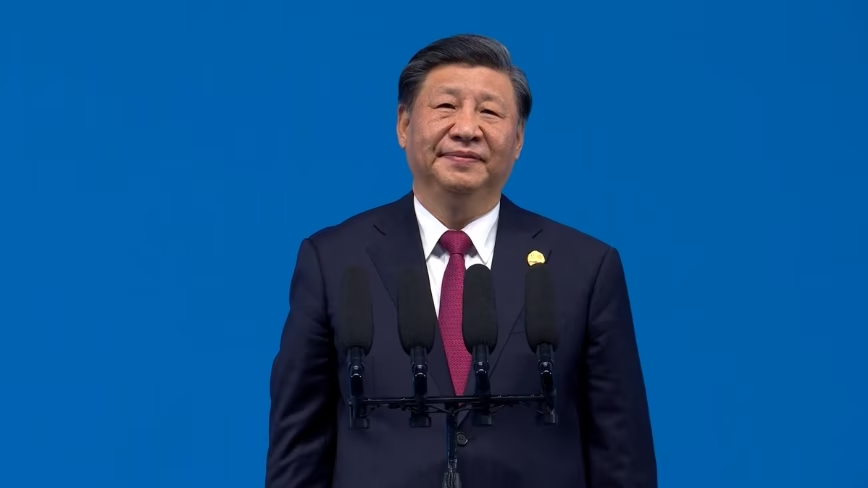
Xi pitches open-source AI to BRICS amid domestic curb debates
Chinese President Xi Jinping proposed a China-led open-source AI community and invited BRICS nations to join the World AI Cooperation Organization (WAICO) at the recent BRICS summit. This push for global collaboration contrasts sharply with Beijing's ongoing internal debates about restricting its own advanced AI models. Meanwhile, the EU's comprehensive AI Act, with its clear, enforceable rules for open-source AI, highlights a significant divergence in global AI governance approaches.

Tesla Set to Finally Unveil Second-Generation Roadster on October 1
The much-anticipated second generation of the Tesla Roadster, a halo vehicle promising revolutionary performance, is finally slated for a public unveiling on October 1. After years of delays and a protracted development

Seattle Warned on Big Tech Reliance; Microsoft/OpenAI Sued; Apple's
A new City of Seattle study warns of the city's risky economic over-reliance on a few dominant tech companies. Simultaneously, the Seattle Times and Newsday are suing Microsoft and OpenAI for alleged AI training data theft, while Apple's new foldable iPhone Duo evokes memories of Microsoft's defunct Surface Duo.

in-depth: The Best 3-in-1 Apple Charging Stations After Testing 30
Wired has released its top picks for 3-in-1 Apple charging stations, extensively tested for iPhone, Apple Watch, and AirPods. The guide highlights six leading models, from premium speedy options to budget-friendly and compact designs, all focused on decluttering and optimizing charging for Apple users.

Nscale Adds Former OpenAI Exec Fidji Simo to Board Ahead of IPO
Nscale, the U.K.-based AI data center startup, has appointed former OpenAI, Meta, and Instacart executive Fidji Simo to its board of directors. This high-profile addition comes as Nscale prepares for a potential IPO this fall, leveraging Simo's extensive experience in scaling major tech platforms and guiding a company through a successful public offering.

Microsoft comms chief Frank Shaw to exit after nearly three decades
Frank X. Shaw, Microsoft's long-serving chief communications officer, will exit at year-end after nearly three decades shaping the company's message through pivotal periods. Shaw, 64, is not retiring but plans a break before his next move, leaving behind a legacy of adapting communications for a digital age and embracing AI tools. Microsoft is now searching for his successor.