24 results found
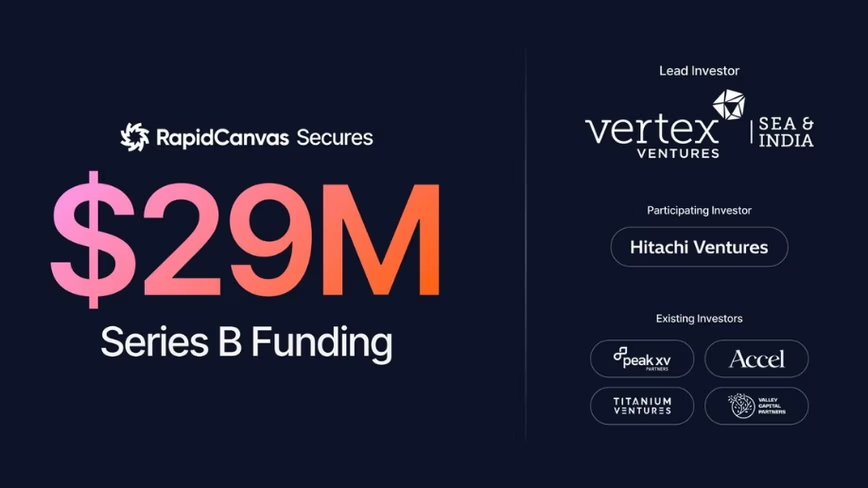
Austin, Texas – RapidCanvas, a burgeoning startup specializing in building and running custom AI applications for enterprises, has announced a successful close of its Series B funding round, raising $29 million. Led by

Quick Verdict: Redefining Enterprise AI's Potential TechRadar Pro's opinion piece, "What it takes to move enterprise AI beyond the chatbot," delivers a refreshingly honest and vital perspective on the current state and

OpenAI has launched Dots, a new AI agent platform aimed at enterprise users, accessible via a $100/month Pro account. While it struggled with some personal tasks due to security checks, Dot excelled in complex operations like website redesign and video editing when given direct computer access. This paid model positions Dot as a professional tool for the future of work, contrasting with free, consumer-focused competitors.

ChatGPT Space, Pages, and Slides: A New Chapter for AI in the Workspace Verdict: OpenAI's new Space, Pages, and Slides, coupled with the agentic Dots feature and Private Intelligence, mark a significant step towards a

Meta has launched its new "Meta Enterprise Platform" to sell its AI tools, including the Muse agent, to businesses, hiring MongoDB CEO Chirantan "CJ" Desai to lead the initiative. Desai's appointment as Chief Enterprise Platform Officer, reporting directly to Mark Zuckerberg, signals a major strategic push into the enterprise AI market. The news caused MongoDB's shares to drop by up to 27%, highlighting the significance of Desai's departure and Meta's ambitious new venture.

Meta Platforms has launched the "Meta Enterprise Platform," a new initiative to bring its AI technologies to businesses, leveraging its full tech stack including Muse. The company has hired MongoDB CEO Chirantan "CJ" Desai to lead this strategic push. Desai's appointment and Meta's enterprise pivot aim to monetize significant AI investments, while MongoDB's shares dropped over 17% following Desai's sudden departure.
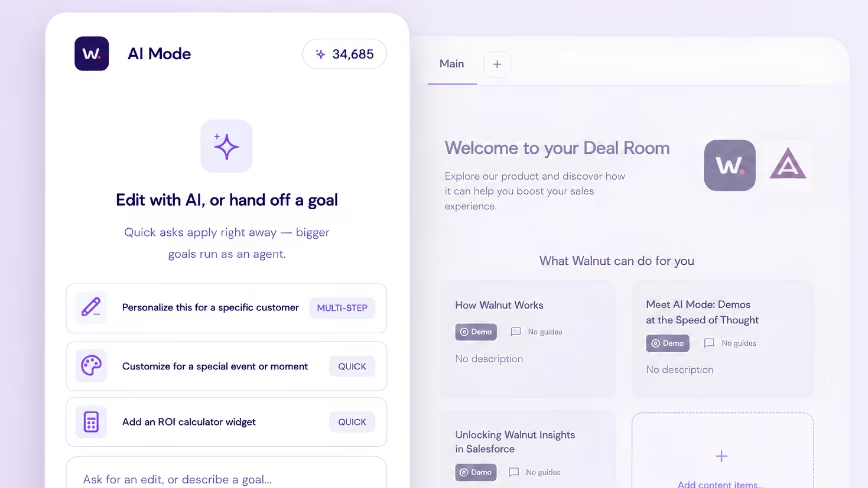
Walnut has launched an enterprise AI agent platform, including AI Mode for Playlists and Deal Rooms and Walnut Xpert, to personalize B2B buyer experiences. The platform leverages product capture technology to create interactive demos and deal rooms, drastically reducing seller effort and providing deeper buyer insights. This move aims to make personalized B2B engagements scalable and buyer-centric.
VentureBeat has appointed Rob Strechay as its first Lead Analyst, spearheading a significant expansion into specialized enterprise AI research. This strategic move aims to provide technical decision-makers with objective, data-driven insights into the complex challenges of evaluating and deploying AI solutions. Strechay, with nearly three decades of experience, will cover critical areas like cloud infrastructure, advanced data, DevOps, and AI security, while also hosting a revitalized "VB In Conversation" series.

Snowflake's Cortex AI Gateway now features dynamic model routing, automatically selecting the most cost-effective AI model for each query. This innovation aims to reduce enterprise AI token costs by up to 3x by preventing simple tasks from being processed by expensive, high-capacity models. The system integrates deeply with Snowflake's existing data governance and access controls.

xpander.ai, founded by former AWS principal engineers, has launched its enterprise AI agent platform and secured $7.5M in seed funding. The platform offers a vendor-neutral control plane, featuring a 'Universal Harness,' to help companies manage, govern, and orchestrate the growing sprawl of AI agents, addressing challenges like isolated workflows and vendor lock-in.

An in-depth review of the AI Evaluation Harness methodology reveals its critical importance for enterprise LLMs. Unlike qualitative reviews, it objectively measures correctness, unmasking models' dangerous tendency to be most confident when wrong.

OpenAI-backed Thrive Holdings secured $2 billion at a $12 billion valuation to expand its enterprise AI integration strategy. The firm acquires traditional businesses, infusing AI into their operations, and plans to extend its proven model beyond accounting and IT into regulatory services for physical assets. This major funding round highlights a growing trend of hands-on AI deployment in the enterprise.

Onyx Security, an Israeli startup, has secured a $113 million Series B funding round, valuing it at $640 million. The company's "secure AI control plane" sits between enterprise AI agents and critical systems, inspecting and blocking unauthorized actions to keep humans in control. This investment addresses the growing need for AI agent accountability as autonomous AI rapidly takes over enterprise operations, a market already seeing significant investment and activity.

TechCrunch Disrupt 2026, held Oct 13-15 in San Francisco, features an AI Stage presented by Google for Startups. It will explore how AI is reshaping business models, creating security gaps like the 'agent security gap,' and pioneering new job categories like the 'GTM Engineer.' Industry leaders will share insights on topics from enterprise AI security to the future of video intelligence.

OpenAI has officially introduced Presence, a new enterprise product designed to empower businesses to deploy and manage AI agents for critical customer-facing and internal workflows. Announced on July 22, 2026, the

Kai-Fu Lee's 01.ai is targeting a Hong Kong IPO in 2027. It pivoted from building AI models to enterprise data infrastructure, with its 'Boss AI' fine-tuning open-weight models for business data. Half its business is now international.
OpenClaw Machines offers an open-source, self-hosted platform for running AI agents with enterprise-grade security and cost efficiency. It utilizes Firecracker microVMs for hardware isolation on your own Linux servers, providing full data sovereignty and predictable costs, especially at scale. The platform includes a control plane for orchestration, a Cloudflare data plane for secure access, and integrated LLM proxying.

DeepSeek's recent 75% price reduction for its V4-Pro model, a move that should have been unequivocally celebrated by the enterprise AI sector, is instead revealing a critical flaw in the economic model of AI agent

A Box survey of 1,640 IT decision-makers reveals a rapid surge in enterprise AI maturity, with leading-edge companies achieving significantly higher ROI. Key factors driving this success include robust content access, formal governance frameworks, and flexible multi-model platforms, distinguishing high performers from those with ad hoc AI approaches.

Tencent has released its Hy3 MoE model under an Apache 2.0 license, removing previous regional restrictions and making it widely accessible. At half the size of GLM-5.2, Hy3 offers significant efficiency gains, excelling in search and tool orchestration, though it trails in coding. This move positions Hy3 as a strong contender for enterprise AI solutions seeking reliability and cost-effective deployment.

A critical flaw dubbed "AI tool poisoning" has been uncovered in enterprise AI agent security. The vulnerability exploits AI agents' reliance on unverified tool descriptions, rendering traditional software supply chain controls insufficient for ensuring behavioral integrity. A new runtime verification layer, using behavioral specifications and a proxy, is proposed to validate tool actions and prevent sophisticated attacks like prompt injection and behavioral drift.

Elon Musk's lawsuit against OpenAI heated up as he testified for three days, accusing the company of betraying its nonprofit mission by going for-profit. He repeatedly asserted, "You can't steal a charity," as emails and tweets surfaced. This comes amidst strong cloud earnings driven by enterprise AI spending and other tech developments.

Nvidia CEO Jensen Huang took the stage at GTC 2026 on Monday to unveil the Agent Toolkit, an open-source platform for building autonomous AI agents, announcing a significant industry alignment with 17 major enterprise

DeveloperWeek 2026 highlighted that for AI tools to be truly valuable, they need improved usability, deep contextual understanding, and robust interoperability. Key discussions centered on giving human developers more agency over AI outputs, integrating proprietary company knowledge into models, and designing agentic systems that can collaborate seamlessly across workflows.
