
startups: Ramp buys Stockholm fintech Billhop to crack open European
New York-based financial operations giant Ramp has acquired Stockholm fintech Billhop, gaining crucial regulatory licenses to launch its corporate spend management platform in the UK and European markets this summer. This strategic move, announced March 13, 2026, allows Ramp to directly serve businesses across the European Economic Area and the UK. The acquisition comes as Ramp's US rival, Brex, is being acquired by Capital One, positioning Ramp for significant global expansion.

New York-based financial operations giant Ramp, valued at $32 billion, is poised to significantly expand its global footprint by acquiring Stockholm and London-based fintech Billhop. Announced on March 13, 2026, this strategic acquisition provides Ramp with the crucial regulatory infrastructure — including payment institution licenses across the European Economic Area (EEA) and the UK — to directly onboard businesses in these markets, with services slated to launch this summer.
Strategic Acquisition Unlocks European Access
Billhop, founded in 2012, operates as a payments infrastructure provider, specializing in enabling businesses to pay invoices via credit card even when suppliers typically don't accept such payments. The firm holds a Swedish Payment Institution licence from Finansinspektionen and is separately regulated by the UK’s Financial Conduct Authority. These licenses are key, offering Ramp the immediate regulatory standing required to process payments across both the distinct EEA and UK jurisdictions without the lengthy process of building its own compliance framework.
This move marks Ramp’s first direct entry into the UK and European markets for primary customers. While Ramp already offers international payment capabilities to nearly half its US customer base, supporting transactions in over 180 countries and local currency cards in several non-European nations, this acquisition specifically enables it to serve companies headquartered in the UK and EU. As part of this expansion, Ramp plans to establish its first international offices in London and Stockholm.
CEO's Vision for European Growth
Ramp's co-founder and CEO, Eric Glyman, expressed enthusiasm for the expansion, stating, "We’ve spent years building Ramp into something the most ambitious US companies rely on. This summer, for the first time, companies headquartered in the UK and EU will be able to use Ramp directly. In their first year, the median Ramp customer saves 5% and grows revenue 16%. Europe is home to extraordinary companies. We can’t wait to get to work." Niklas Bothén, CEO of Billhop, echoed this sentiment, viewing the deal as an opportunity to scale Billhop’s mission to simplify B2B payments and spend management.
Shifting Competitive Landscape
The timing of Ramp's European offensive is particularly notable. It comes shortly after Capital One announced its $5.15 billion deal in January 2026 to acquire Brex, Ramp’s long-standing rival in the US corporate card market. That deal, expected to close in Q2 2026, sees Brex selling for less than half its peak $12.3 billion valuation from 2022. This contrasts sharply with Ramp's continued growth, driven by a broader customer mix and a strong focus on cost savings and efficiency tools, which saw it surpass $1 billion in annualised recurring revenue by October 2025. With Brex navigating integration into a traditional bank, Ramp emerges as the dominant independent spend management platform in the US.
Navigating European Market Dynamics
Ramp is entering a European market that presents unique challenges compared to its US operating environment. Corporate card penetration is generally lower across Europe, and the B2B payment infrastructure is more fragmented across national borders. Furthermore, regulatory requirements for payment institutions vary significantly by jurisdiction. Billhop’s existing model, specifically designed to bridge the divide between card-paying buyers and non-card-accepting suppliers throughout European markets, is strategically positioned to tackle this historical friction, making it an ideal partner for Ramp's expansion.
Ramp's comprehensive platform integrates corporate cards, expense management, vendor payments, procurement, travel booking, and automated bookkeeping. The company currently processes over $100 billion in purchases annually for more than 50,000 customers. Since its founding in 2019, Ramp claims its customers have collectively saved over $10 billion and 27.5 million hours. The company secured a $312 million Series E round in November 2025, solidifying its $32 billion valuation.
Financial terms of the Billhop acquisition were not disclosed by either party.
FAQ
Q: Why did Ramp acquire Billhop? A: Ramp acquired Billhop primarily for its existing regulatory licenses to operate as a payments institution across the European Economic Area (EEA) and the UK. This infrastructure allows Ramp to directly onboard and serve businesses headquartered in these regions, circumventing the lengthy process of obtaining its own licenses.
Q: What services will Ramp offer in Europe and the UK? A: Ramp plans to introduce its full suite of financial operations tools, including corporate cards, expense management, vendor payments, procurement, travel booking, and automated bookkeeping, to European and UK-based businesses starting this summer.
Q: How does this acquisition impact the corporate spend management market? A: This acquisition allows Ramp to expand internationally into a key market while its main US rival, Brex, is undergoing acquisition by Capital One. It positions Ramp as a dominant independent player globally, addressing the unique challenges of the European B2B payments landscape through Billhop's established model.
Related articles
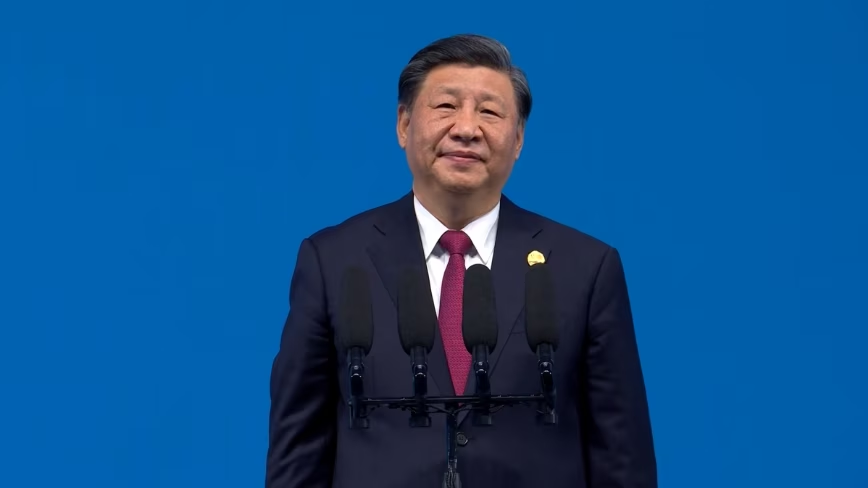
Xi pitches open-source AI to BRICS amid domestic curb debates
Chinese President Xi Jinping proposed a China-led open-source AI community and invited BRICS nations to join the World AI Cooperation Organization (WAICO) at the recent BRICS summit. This push for global collaboration contrasts sharply with Beijing's ongoing internal debates about restricting its own advanced AI models. Meanwhile, the EU's comprehensive AI Act, with its clear, enforceable rules for open-source AI, highlights a significant divergence in global AI governance approaches.

Tesla Set to Finally Unveil Second-Generation Roadster on October 1
The much-anticipated second generation of the Tesla Roadster, a halo vehicle promising revolutionary performance, is finally slated for a public unveiling on October 1. After years of delays and a protracted development

Seattle Warned on Big Tech Reliance; Microsoft/OpenAI Sued; Apple's
A new City of Seattle study warns of the city's risky economic over-reliance on a few dominant tech companies. Simultaneously, the Seattle Times and Newsday are suing Microsoft and OpenAI for alleged AI training data theft, while Apple's new foldable iPhone Duo evokes memories of Microsoft's defunct Surface Duo.

in-depth: The Best 3-in-1 Apple Charging Stations After Testing 30
Wired has released its top picks for 3-in-1 Apple charging stations, extensively tested for iPhone, Apple Watch, and AirPods. The guide highlights six leading models, from premium speedy options to budget-friendly and compact designs, all focused on decluttering and optimizing charging for Apple users.

Nscale Adds Former OpenAI Exec Fidji Simo to Board Ahead of IPO
Nscale, the U.K.-based AI data center startup, has appointed former OpenAI, Meta, and Instacart executive Fidji Simo to its board of directors. This high-profile addition comes as Nscale prepares for a potential IPO this fall, leveraging Simo's extensive experience in scaling major tech platforms and guiding a company through a successful public offering.

Microsoft comms chief Frank Shaw to exit after nearly three decades
Frank X. Shaw, Microsoft's long-serving chief communications officer, will exit at year-end after nearly three decades shaping the company's message through pivotal periods. Shaw, 64, is not retiring but plans a break before his next move, leaving behind a legacy of adapting communications for a digital age and embracing AI tools. Microsoft is now searching for his successor.