
startups: Grassroots opposition blocked $130 billion in US data
Grassroots opposition groups successfully blocked or delayed 75 data center projects worth $130 billion across the US in Q1 2026, matching the total disruptions for all of 2025. Driven by concerns over electricity, water, and noise, the number of anti-data center groups has doubled to 833 nationwide, profoundly impacting the AI industry's expansion plans amid shifting public opinion and legislative action.
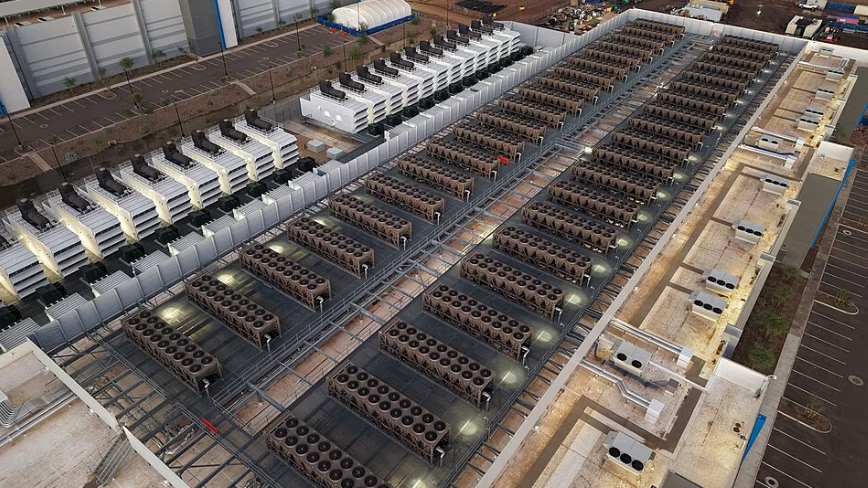
Grassroots opposition has surged across the United States, successfully blocking or delaying 75 data center projects totaling $130 billion in the first quarter of 2026 alone. This unprecedented wave of resistance, driven by local community concerns over electricity, water, and noise, has doubled the number of anti-data center groups to 833 nationwide, profoundly impacting the AI industry's expansion plans.
A new report from Data Center Watch, a tracker maintained by AI research firm 10a Labs, highlights this significant shift. According to NBC News, the number of disruptions recorded in Q1 2026 marks the highest in any three-month period since tracking began in 2023. The scale of projects halted or postponed in just these three months roughly equals the entire sum for all of 2025.
A Growing Movement
By March 2026, the number of active anti-data center groups had more than doubled, soaring from 396 at the close of 2025 to 833. These groups are now spread across 49 US states, with Maryland, Ohio, and Texas experiencing the most concentrated opposition. This movement is characterized by its bipartisan nature and strong local roots, transcending traditional political divides.
The core issues fueling this resistance—namely electricity costs, water consumption, and noise pollution—mirror concerns seen internationally. Denmark, for instance, has already paused new grid connections for data centers due to energy strain, and the EU has urged households to reduce peak electricity use, attributing part of the demand to AI data centers.
Legislative Battles Emerge
Alongside grassroots efforts, legislative momentum is also building. Data Center Watch identified 14 statewide measures introduced in Q1 2026 aimed at regulating data center construction. A separate analysis by MultiState found moratorium bills in 11 states, proposing pauses ranging from three months to four years. Over 300 data-center-related bills were introduced in state legislatures within the first six weeks of the year, signaling widespread governmental attention to the issue.
While none of these statewide moratoriums have fully passed yet, they are gaining traction. Maine's legislature approved a bill in April that would have halted permitting for facilities drawing 20 megawatts or more—a first in the country. Governor Janet Mills ultimately vetoed the bill, though she indicated she would have signed it if it had exempted a specific, locally supported project in Jay, Maine. Separately, she signed a law preventing data centers from receiving state tax incentives.
Shifting Public Opinion
Public sentiment is rapidly turning against data center proximity. A Heatmap Pro poll revealed that a majority of Americans would “strongly” oppose a data center near their home. This marks a significant shift from just nine months prior, when public opinion was roughly evenly split. Gallup data further supports this trend, indicating that 70% of the public now opposes nearby data center construction.
The swiftness of this shift suggests that the issue is evolving beyond localized planning disputes into a broader political concern, prompting public officials to take notice.
Industry's Dilemma
Despite the mounting public and legislative resistance, the data center industry is planning for massive expansion. US utilities anticipate spending $1.4 trillion on grid infrastructure by 2030, largely driven by data center demand. Hyperscaler capital expenditure is projected to exceed $690 billion in 2026 alone. This growing disparity between industry ambitions and community acceptance is widening faster than expected.
Resistance is now so organized that opposition groups are mobilizing even before projects are officially filed. The mere rumor of a new data center can trigger organized protest, making siting decisions incredibly challenging even in states without formal moratoriums. Local permitting bodies are increasingly facing political pressure before any formal application is submitted.
An essay in The Atlantic recently argued that the backlash is exaggerated and that data centers can offer real economic benefits. While acknowledging the political appeal of opposing such projects, the piece questioned if it was always sound policy. The industry's ability to demonstrate tangible local benefits beyond tax revenue will likely determine if this counter-argument gains widespread acceptance.
The report paints a clear picture of an industry that once believed it could overcome local opposition through sheer financial power and rapid development, now confronting a nation that is, one zoning board at a time, deciding otherwise.
FAQ
Q: What are the primary concerns driving opposition to data centers?
A: Local communities are primarily concerned about the immense electricity consumption, significant water usage, and constant operational noise associated with large-scale data center facilities.
Q: How has the scale of data center opposition changed recently?
A: The first quarter of 2026 saw a dramatic surge, with 75 projects valued at $130 billion blocked or delayed, matching the total disruptions for all of 2025. The number of active opposition groups also doubled to 833 across 49 states.
Q: What is the industry's response to this growing resistance?
A: Despite the mounting opposition, the industry continues to plan massive investments. US utilities project $1.4 trillion in grid infrastructure spending by 2030 due to data center demand, and hyperscalers anticipate over $690 billion in capital expenditure for 2026. This indicates a widening gap between industry plans and community acceptance.
Related articles

Apple Unveils iPhone Duo: Pricey Foldable Sees Soaring Demand
Apple has officially entered the foldable smartphone arena with the long-anticipated launch of the iPhone Duo. Priced starting at a hefty $1,999, the device features a 5.4-inch outer display and a larger 7.6-inch inner

in-depth: Chicago-Area Cops Helped HSI Spy on Minnesota Anti-ICE
Chicago-area law enforcement, including local police and HSI agents, conducted undercover surveillance on Minnesota anti-ICE activists at an April 2, 2022, talk in Chicago. This operation was part of a federal conspiracy probe into 15 Minnesota activists facing felony charges related to immigration enforcement resistance. Civil liberties advocates have condemned the surveillance as a troubling intrusion into protected political activity.
Ditch Merge & Center: The Better Way to Align Text in Excel
Learn to use Excel's "Center Across Selection" to align text across cells without merging, avoiding common data manipulation issues. This guide provides steps to utilize this newly accessible feature and add it to your Quick Access Toolbar.

Mark Wahlberg on using AI in film ‘the right way’ and being open to
Actor Mark Wahlberg believes AI has a place in filmmaking if used responsibly for enhancement, not script generation or actor replacement. At TechCrunch Disrupt, he expressed openness to an AI likeness carrying on his legacy, managed by his family, and emphasized storytelling.

Tesla Unveils Thruster-Equipped Roadster, 2028 Production Targeted
Tesla has unveiled its second-generation Roadster, featuring cold-gas thrusters co-developed with SpaceX, enabling it to jump and flip. The electric sports car demonstrated 0-60mph in an astonishing 0.81 seconds, with production targeted for 2028. This highly anticipated reveal also serves as a key recruitment tool for Tesla's ambitious AI and robotics initiatives.

AI's Confidence vs. Formal Methods' Rigor: Design Flaws & Verification
While AI accelerates code generation, formal methods remain critical for ensuring system correctness. Languages like TLA+ and tools like Quint enable developers to model and verify system designs before coding, catching subtle flaws. Quint makes formal methods more accessible with developer-friendly syntax and executability. This approach is vital for verifying AI-generated code through trace validation and model-based testing, ensuring reliability against real-world data.