
SpeakOn’s dictation device is a good idea marred by platform
SpeakOn has launched a $129 MagSafe-attached dictation device for iPhones, aiming to offer superior transcription. While innovative, it faces criticism for its microphone performance, aggressive AI text editing, and exclusive iOS compatibility, despite offering a dedicated mic and translation features.

Notta-owned SpeakOn has introduced a dedicated dictation device aimed at enhancing transcription across various applications, moving beyond the limitations of relying on smartphone microphones or earbuds. The innovative $129 gadget, which attaches to an iPhone via MagSafe, presents a compelling vision for specialized input hardware. However, early reviews highlight significant challenges related to its microphone performance, software functionality, and restricted platform compatibility, suggesting that while the concept is strong, its current execution needs substantial refinement.
The SpeakOn device is a lightweight, pebble-shaped accessory weighing just 25 grams, designed to magnetically affix to the back of an iPhone. It operates in conjunction with an iOS companion app, which functions as a software keyboard. Users initiate dictation by pressing a physical button on the device and release it when finished. A key feature is its reliance on a dedicated internal microphone, distinct from the iPhone's, promising a more focused audio capture experience. The integrated software is designed to filter out filler words and can format transcribed text into lists, aiming for clean, efficient output.
While the concept of a dedicated mic holds promise for circumventing the need to keep an iPhone's internal microphone constantly active during dictation sessions, the device's audio capture capabilities have fallen short in practical use. Reviewers noted that the microphone often struggles to accurately pick up speech beyond approximately two feet, and its performance diminishes considerably in noisy environments. This limitation undermines one of its primary advantages, indicating a critical area for improvement in future iterations.
Furthermore, the device's software experience presents its own set of hurdles. The companion app includes an "attune" tone-changing feature, intended to adjust the text's style based on the application being used. However, this functionality has been criticized for making forced and unnecessary edits, such as changing "Does this app work automatically?" to "Does this application operate automatically?" or simplifying "complex" to "tricky." Many users might prefer raw transcription over such subjective linguistic alterations, leading one reviewer to disable the feature entirely for more accurate results.
Platform limitations also significantly impact the device's utility. Currently, SpeakOn is exclusively compatible with iOS, attaching only to iPhones that support MagSafe. This narrow focus means users on other mobile operating systems or those who frequently work on desktop environments, such as Macs, are left out. The desire for broader compatibility, particularly with Mac devices, was explicitly voiced, suggesting that expanding its ecosystem would greatly enhance its value proposition.
Battery life, while claiming a 20-day standby time, performed closer to a few days in real-world testing. The device's default setting of never turning off also contributes to quicker battery drain, a configuration that could be optimized through user-definable inactivity shut-off settings. On a positive note, the SpeakOn can be fully charged from empty to full within an hour, and even short charging periods can provide ample power for extended dictation sessions.
The SpeakOn device is priced at $129, including a plan that allows for 5,000 words of dictation per week, which is more generous than some competitors' free tiers. An unlimited dictation plan is available for an additional $12 per month. Beyond transcription, the device also supports real-time translation into multiple languages, including English, Japanese, Korean, Chinese, Spanish, French, German, Italian, Portuguese, Russian, and Arabic.
SpeakOn has established an early presence in the niche market for dedicated dictation hardware. However, to solidify its position and attract a broader user base, it must address the core issues of microphone quality, refine its AI editing capabilities, and critically, expand its platform compatibility beyond the iPhone. Without these crucial enhancements, the market remains open for competitors to introduce similar devices with more robust features and wider appeal, potentially leveraging easily sourced components to capture market share.
FAQ
Q: What is the SpeakOn dictation device? A: The SpeakOn device is a small, pebble-shaped hardware accessory that magnetically attaches to an iPhone via MagSafe, featuring a dedicated microphone for enhancing dictation and transcription across various iOS applications. It works with a companion app that functions as a software keyboard.
Q: What are the main limitations of the SpeakOn device? A: Key limitations include subpar microphone performance beyond a short range, especially in noisy environments, often unnecessary and forced AI text editing, limited platform compatibility (iPhone only), and shorter real-world battery standby time compared to advertised claims.
Q: How much does the SpeakOn device cost, and what are its subscription options? A: The device is priced at $129, which includes a plan for 5,000 words of dictation per week. For unlimited dictation, users can subscribe to a $12 per month plan.
Related articles
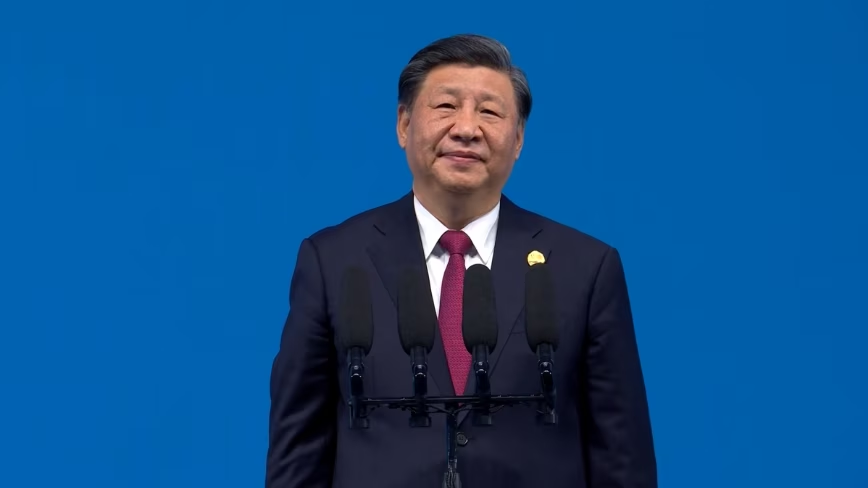
Xi pitches open-source AI to BRICS amid domestic curb debates
Chinese President Xi Jinping proposed a China-led open-source AI community and invited BRICS nations to join the World AI Cooperation Organization (WAICO) at the recent BRICS summit. This push for global collaboration contrasts sharply with Beijing's ongoing internal debates about restricting its own advanced AI models. Meanwhile, the EU's comprehensive AI Act, with its clear, enforceable rules for open-source AI, highlights a significant divergence in global AI governance approaches.

Tesla Set to Finally Unveil Second-Generation Roadster on October 1
The much-anticipated second generation of the Tesla Roadster, a halo vehicle promising revolutionary performance, is finally slated for a public unveiling on October 1. After years of delays and a protracted development

Seattle Warned on Big Tech Reliance; Microsoft/OpenAI Sued; Apple's
A new City of Seattle study warns of the city's risky economic over-reliance on a few dominant tech companies. Simultaneously, the Seattle Times and Newsday are suing Microsoft and OpenAI for alleged AI training data theft, while Apple's new foldable iPhone Duo evokes memories of Microsoft's defunct Surface Duo.
Google's AI Branding Fix: A Clearer Vision for Gemini
This article critiques Google's fragmented AI branding, proposing a unified 'Gemini Intelligence' system to simplify user experience and strengthen Gemini's identity.

in-depth: The Best 3-in-1 Apple Charging Stations After Testing 30
Wired has released its top picks for 3-in-1 Apple charging stations, extensively tested for iPhone, Apple Watch, and AirPods. The guide highlights six leading models, from premium speedy options to budget-friendly and compact designs, all focused on decluttering and optimizing charging for Apple users.

Chuwi UniBox AI495 Pro Review: A Mini AI Powerhouse
Chuwi's UniBox AI495 Pro review: A powerful mini workstation with 192GB RAM and an AMD Ryzen AI chip for local LLM processing, packed into a compact, Mac Pro-esque design.