
Nyne, founded by a father-son duo, gives AI agents the human context
Nyne, a father-son startup, raised $5.3 million in seed funding. It aims to empower AI agents with crucial human context by analyzing public digital footprints, bridging a key gap for autonomous decisions and personalized customer engagement.

Nyne, a new startup co-founded by computer science graduate Michael Fanous and veteran CTO Emad Fanous, announced Friday it has secured $5.3 million in seed funding. The round was led by Wischoff Ventures and South Park Commons, with notable participation from angel investors including Gil Elbaz, co-founder of Applied Semantics and a pioneer of Google AdSense. This capital infusion will power Nyne’s mission to become the essential intelligence layer that provides AI agents with a comprehensive understanding of humans across their entire digital footprint, addressing a critical gap in autonomous decision-making.
Bridging the AI Context Gap
As AI agents increasingly move towards making independent purchasing and scheduling decisions on behalf of users, a significant hurdle remains: their inability to fully grasp the intricate context of the people they serve. Michael Fanous, Nyne’s CEO, highlights this challenge, noting that current machines struggle to reconcile disparate online identities—such as a professional LinkedIn profile, personal Instagram activity, and public government records—as belonging to a single individual. This fragmented view prevents AI from developing a truly holistic understanding of human users.
Nyne's Approach to Human Understanding
To overcome this, Nyne deploys millions of specialized agents across the internet. These agents meticulously analyze public digital footprints, gathering vast amounts of data. Subsequently, the startup applies advanced machine learning techniques to this aggregated information, allowing it to triangulate and connect details about a person from a wide array of sources. This includes major social networks like Instagram, Facebook, and X, as well as more niche platforms such as SoundCloud and Strava, creating a rich, unified profile of an individual.
The Challenge of Public Data
While the concept of identifying users across various platforms might seem like an issue already addressed by sophisticated machine learning, particularly given the effectiveness of Google's ad targeting, Fanous emphasizes a crucial distinction. He explains that Google's "secret sauce" lies in its exclusive access to users' search histories and extensive cross-platform activity—a proprietary data advantage that the tech giant does not share with external AI agents. For companies operating outside of this walled garden, resolving this identity puzzle presents an "oddly hard problem to solve," as noted by Nichole Wischoff, founder of Wischoff Ventures, which backed the deal.
A Massive Market Opportunity
According to Wischoff, the market for this enhanced contextual data is both massive and invaluable. As more consumer-facing companies integrate AI agents into their operations, they will seek solutions like Nyne to equip these agents with a deeper, real-world understanding of both their existing and prospective customers. Fanous states that Nyne can provide any useful piece of information about a person needed "to make the right next action."
By connecting these diverse data points, Nyne enables AI agents to develop a profound comprehension of an individual’s interests, hobbies, and even specific ways of thinking. This precision allows businesses to engage customers more effectively, for instance, by identifying a pregnant individual "as early as possible" to recommend relevant products. This capability, Fanous and Wischoff suggest, surpasses the less precise data gathering of previous adtech generations.
A Unique Father-Son Partnership
Beyond its technological innovation, Nyne also stands out for its unique founding team: a father-son duo. Michael Fanous, the CEO, describes his partnership with his father, Emad Fanous, the CTO, as ideal. This close relationship appears to foster a strong commitment, with Michael humorously noting the inherent stability. "I think with co-founders, it becomes easy to walk away when things don’t work," Fanous observed. "If I have to ping him at three in the morning to finish a launch, I know he’s going to still love me the next day." This personal dynamic underscores the dedication driving Nyne’s ambitious goal.
The Future of Human-AI Interaction
Nyne’s successful seed funding round marks a significant step towards bridging the contextual gap in AI agent capabilities. By aggregating and analyzing public digital footprints, the company aims to empower AI systems with a more human-like understanding of individuals, enabling more informed and relevant autonomous interactions. This innovation could fundamentally reshape how businesses engage with customers through AI, ushering in an era of more personalized and effective digital experiences, powered by a deeper grasp of human context.
FAQ
Q: What problem is Nyne trying to solve?
A: Nyne aims to solve the problem of AI agents lacking full human context. Current AI agents struggle to connect a person's various digital profiles (e.g., LinkedIn, Instagram, public records) to a single individual, preventing them from truly understanding the people they are meant to serve.
Q: How does Nyne gather information about people?
A: Nyne deploys millions of agents across the internet to analyze public digital footprints. It then applies machine learning techniques to this data, triangulating information about individuals from major social networks (like Instagram, Facebook, X) and other apps (like SoundCloud, Strava).
Q: Who led Nyne's seed funding round?
A: Nyne's $5.3 million seed funding round was led by Wischoff Ventures and South Park Commons. It also included participation from several angel investors, notably Gil Elbaz, co-founder of Applied Semantics and a pioneer of Google AdSense.
Related articles
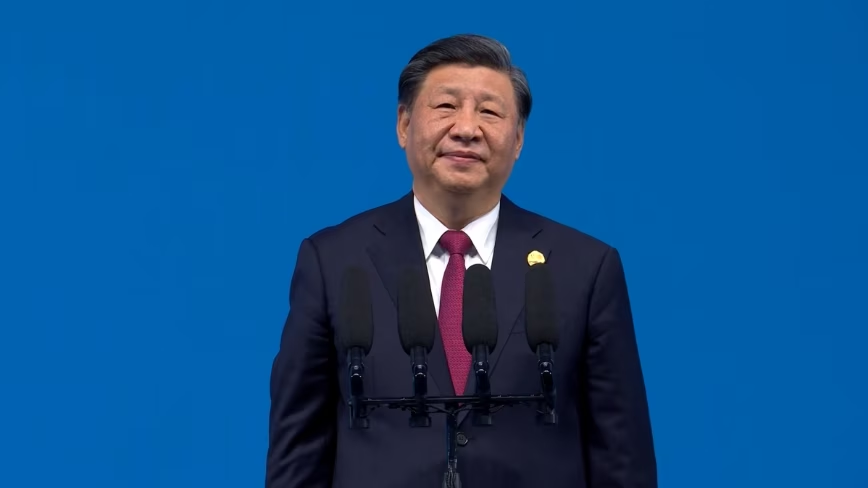
Xi pitches open-source AI to BRICS amid domestic curb debates
Chinese President Xi Jinping proposed a China-led open-source AI community and invited BRICS nations to join the World AI Cooperation Organization (WAICO) at the recent BRICS summit. This push for global collaboration contrasts sharply with Beijing's ongoing internal debates about restricting its own advanced AI models. Meanwhile, the EU's comprehensive AI Act, with its clear, enforceable rules for open-source AI, highlights a significant divergence in global AI governance approaches.

StarCraft Returns in 2030 as Open-World Shooter
Blizzard Entertainment announced a new StarCraft game, an open-world shooter, set to release in 2030. Unveiled at BlizzCon by VP Dan Hay, this marks the series' return after over a decade and a significant genre shift from its real-time strategy roots. The cinematic trailer showcased a gritty human-Zerg conflict, with many fans hoping for a traditional RTS follow-up.

Tesla Set to Finally Unveil Second-Generation Roadster on October 1
The much-anticipated second generation of the Tesla Roadster, a halo vehicle promising revolutionary performance, is finally slated for a public unveiling on October 1. After years of delays and a protracted development

Seattle Warned on Big Tech Reliance; Microsoft/OpenAI Sued; Apple's
A new City of Seattle study warns of the city's risky economic over-reliance on a few dominant tech companies. Simultaneously, the Seattle Times and Newsday are suing Microsoft and OpenAI for alleged AI training data theft, while Apple's new foldable iPhone Duo evokes memories of Microsoft's defunct Surface Duo.

in-depth: The Best 3-in-1 Apple Charging Stations After Testing 30
Wired has released its top picks for 3-in-1 Apple charging stations, extensively tested for iPhone, Apple Watch, and AirPods. The guide highlights six leading models, from premium speedy options to budget-friendly and compact designs, all focused on decluttering and optimizing charging for Apple users.

Nscale Adds Former OpenAI Exec Fidji Simo to Board Ahead of IPO
Nscale, the U.K.-based AI data center startup, has appointed former OpenAI, Meta, and Instacart executive Fidji Simo to its board of directors. This high-profile addition comes as Nscale prepares for a potential IPO this fall, leveraging Simo's extensive experience in scaling major tech platforms and guiding a company through a successful public offering.