
Meta's AI Content Rules: Overdue Overhaul
An in-depth review of the Oversight Board's critical recommendations for Meta's AI-generated content policies, highlighting the urgent need for dedicated rules, improved detection, and greater transparency to combat misinformation.

Meta's AI Content Rules: Overdue Overhaul
Quick Verdict: Meta's current policies for AI-generated content are demonstrably insufficient, leading to widespread deception and a critical erosion of user trust, especially during sensitive times like armed conflicts. The Oversight Board's latest recommendations are not just a suggestion but an urgent, necessary blueprint for fundamental change that Meta must adopt to remain a responsible platform.
The Troubling Reality: Meta's Current AI Content Quandary
The digital landscape is rapidly evolving, and with the advent of sophisticated AI, the line between authentic and fabricated content has blurred to a dangerous degree. This critical issue is precisely why the Oversight Board has, once again, stepped in to pressure Meta to overhaul its rules concerning AI-generated content. Their latest call for action stems from a concerning incident last year involving an AI-generated video. This clip falsely depicted damaged buildings in the Israeli city of Haifa during a hypothetical 2025 Israel-Iran conflict, garnering over 700,000 views. What made this particularly egregious was that it was posted by an account masquerading as a news outlet, run by an individual in the Philippines.
Crucially, when this video was reported to Meta, the company initially declined to either remove it or apply a "high risk" AI label, which would have clearly indicated its AI origins. It was the Oversight Board that ultimately overturned Meta's decision, forcing the application of the label. This incident, according to the Board, starkly illuminates the profound shortcomings in Meta's existing AI content policies.
Throughout its analysis, the Board highlights several critical failures in Meta's current approach:
- Lack of a Dedicated AI Rule: Meta currently lacks a separate, specific rule for AI-generated content, instead attempting to shoehorn it under its broader misinformation policy. This approach is deemed inadequate given the unique challenges AI content presents.
- Ineffective "AI Info" Labels: The Board found Meta's current "AI Info" labeling system to be "neither robust nor comprehensive enough to contend with the scale and velocity of AI-generated content," a flaw particularly magnified during periods of conflict or crisis. The system's heavy reliance on users self-disclosing AI usage and infrequent escalated reviews renders it largely ineffective.
- Insufficient Detection Technology: There's a clear need for Meta to invest significantly more in sophisticated detection tools capable of reliably identifying AI-generated media, including audio and video content.
- Inconsistent Watermarking: The Board expressed concern over reports that Meta is "inconsistently implementing" digital watermarks on AI content created by its own AI tools. This inconsistency undermines a fundamental tool for transparency.
- Over-reliance on Third Parties: Meta continues to depend heavily on external fact-checking organizations and "trusted partners" to flag problematic content. The Board noted that these partners report Meta being "less responsive to outreach and concerns," partly due to a "significant reduction in capacities for Meta’s internal teams." The Board firmly stated that Meta "should be capable of conducting such assessments of harm itself, rather than rely solely on partners reaching out to them during an armed conflict."
This isn't an isolated criticism. The Oversight Board has previously described Meta's manipulated media rules as "incoherent" on at least two other occasions, consistently pointing to the company's reliance on external fact-checkers as a weakness.
A Blueprint for Better: The Oversight Board's Recommendations
To address these critical failings, the Oversight Board has put forth a series of clear, actionable recommendations aimed at creating a more transparent and trustworthy environment on Meta's platforms:
- Create a Dedicated AI Content Rule: Foremost among the recommendations is the establishment of a specific, standalone rule for AI-generated content, distinct from Meta's general misinformation policy. This new rule should precisely outline when and how users are required to label AI content, along with clear penalties for non-compliance.
- Enhance Labeling System: Move beyond the current ineffective "AI Info" labels to implement a system that is robust, comprehensive, and can effectively manage the sheer volume and speed of AI-generated content.
- Invest in Sophisticated Detection: Meta must commit to investing in and deploying advanced detection technologies capable of reliably identifying AI-generated media, including complex audio and video content, to augment or replace current manual review processes.
- Consistent Watermarking: Ensure consistent and reliable implementation of digital watermarks on all AI content, particularly that generated by Meta's own AI tools, to provide clear indicators of artificial origins.
- Strengthen Internal Capacity: Reduce reliance on third-party fact-checkers by bolstering its internal teams and capabilities to conduct harm assessments and content moderation, especially during critical events like armed conflicts.
- Industry-Wide Coherence: While directly addressing Meta, the Board also issued a broader call, stating that "The industry needs coherence in helping users distinguish deceptive AI-generated content and platforms should address abusive accounts and pages sharing such output." This emphasizes the need for a unified approach across the tech sector.
The Honest Take: Pros and Cons
Pros (of the Recommendations):
- Increased Transparency: A dedicated AI rule and robust labeling would empower users to better distinguish between genuine and AI-generated content, fostering greater trust in the information they encounter.
- Improved User Experience: Users would benefit from clearer guidelines and more reliable indicators, reducing the cognitive load of constantly discerning authenticity.
- Enhanced Accountability: The recommendations push Meta towards greater accountability for content shared on its platforms, rather than externalizing much of that responsibility.
- Proactive vs. Reactive: These changes move Meta from a primarily reactive stance (waiting for reports) to a more proactive one (investing in detection, mandating labeling).
- Urgent Necessity: Given the sharp rise in viral AI-generated misinformation during recent conflicts, these recommendations address a pressing and evolving threat to public discourse.
Cons (Challenges to Implementation / Current System Flaws):
- Meta's Track Record: The Board's repeated criticisms suggest a historical reluctance or slowness from Meta to adequately address these issues, raising questions about the pace and extent of future adoption.
- Scale and Velocity: The sheer volume and speed at which AI content can be generated and disseminated pose immense challenges for any detection or moderation system, even a sophisticated one.
- Technical Complexity: Developing and deploying truly reliable AI detection technology, particularly for audio and video, is technically complex and resource-intensive.
- Internal Capacity Gaps: The reported "significant reduction in capacities for Meta’s internal teams" indicates a potential internal barrier to fully implementing the recommendations regarding self-assessment and reducing reliance on external partners.
- Enforcement Challenges: Even with clear rules, consistent global enforcement across diverse languages and cultures remains a monumental task.
Comparison to Alternatives
The source content primarily focuses on Meta's specific policies and the Oversight Board's recommendations for that platform. While the Board hints at a need for industry-wide coherence, it does not provide specific details or comparative analyses of how other social media platforms are handling AI-generated content, nor does it name alternative platforms with superior systems. Therefore, a direct comparison table to specific alternatives is not possible based solely on the provided information.
Our Recommendation
For Meta, the message is unambiguous: swift, comprehensive, and transparent adoption of the Oversight Board's recommendations is not optional; it is essential. Failure to act decisively risks further erosion of trust, increased proliferation of harmful misinformation, and potentially severe reputational and regulatory consequences. This isn't just about compliance; it's about fulfilling a fundamental responsibility to the billions of users who rely on Meta's platforms for information.
For Users, the advice remains critical: maintain a healthy skepticism towards unverified content, especially during times of conflict or crisis. Demand greater transparency and more effective moderation tools from platforms like Meta. While these recommendations offer a path forward, users must remain vigilant and actively engage in discerning credible information.
FAQ
Q: Why is the Oversight Board making these recommendations now?
A: The recommendations are driven by the ongoing proliferation of deceptive AI-generated content, highlighted by incidents like the fake Haifa video, and the sharp rise in AI-generated misinformation observed during recent armed conflicts. These events underscore the urgent inadequacies of Meta's current policies.
Q: What's the biggest challenge for Meta in implementing these changes?
A: The primary challenges include the immense scale and velocity of AI-generated content, the technical complexity and significant investment required for sophisticated and reliable AI detection technology, and concerns about Meta's reportedly reduced internal capacities for content assessment and outreach.
Q: Will these recommendations make a real difference?
A: If Meta adopts and consistently implements these recommendations comprehensively, they have the potential to make a significant positive difference. A dedicated AI rule, robust labeling, and improved detection would empower users, increase transparency, and enhance Meta's ability to combat deceptive AI content, though ongoing vigilance and enforcement will remain crucial.
Related articles

Crystal Lake Series on Peacock: A Deep Dive into Horror's Past
Crystal Lake Series Review: A Deep Dive into Horror's Past Verdict: Is Crystal Lake Worth the Dive? The long-awaited Friday the 13th prequel, Crystal Lake, is finally arriving on Peacock, promising a fresh, in-depth
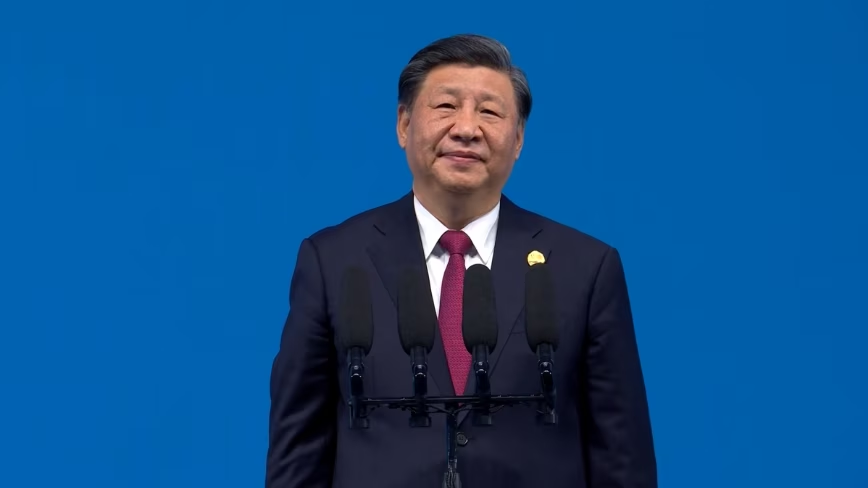
Xi pitches open-source AI to BRICS amid domestic curb debates
Chinese President Xi Jinping proposed a China-led open-source AI community and invited BRICS nations to join the World AI Cooperation Organization (WAICO) at the recent BRICS summit. This push for global collaboration contrasts sharply with Beijing's ongoing internal debates about restricting its own advanced AI models. Meanwhile, the EU's comprehensive AI Act, with its clear, enforceable rules for open-source AI, highlights a significant divergence in global AI governance approaches.
Google's AI Branding Fix: A Clearer Vision for Gemini
This article critiques Google's fragmented AI branding, proposing a unified 'Gemini Intelligence' system to simplify user experience and strengthen Gemini's identity.

Chuwi UniBox AI495 Pro Review: A Mini AI Powerhouse
Chuwi's UniBox AI495 Pro review: A powerful mini workstation with 192GB RAM and an AMD Ryzen AI chip for local LLM processing, packed into a compact, Mac Pro-esque design.

Nscale Adds Former OpenAI Exec Fidji Simo to Board Ahead of IPO
Nscale, the U.K.-based AI data center startup, has appointed former OpenAI, Meta, and Instacart executive Fidji Simo to its board of directors. This high-profile addition comes as Nscale prepares for a potential IPO this fall, leveraging Simo's extensive experience in scaling major tech platforms and guiding a company through a successful public offering.
Pixel Connectivity: Battery Drain, Not Data Speed, Is the Real
Google's Pixel series has consistently offered a compelling Android experience, often earning a spot on recommendation lists for its clean software and camera prowess. However, a recurring shadow has loomed over the