
industry: Google Workspace CLI brings Gmail, Docs, Sheets and more
Google has launched a new Command Line Interface (CLI) for its Workspace suite, unifying access to Gmail, Drive, Calendar, Sheets, and Docs for developers and AI agents. This open-source tool, introduced by Google Cloud director Addy Osmani, streamlines automation and agentic workflows by offering a direct, scriptable interface. It aims to reduce reliance on custom integrations and third-party connectors for enterprise productivity.

Google has unveiled a new Command Line Interface (CLI) for its Workspace suite, unifying access to popular applications like Gmail, Drive, Calendar, Sheets, and Docs for both human developers and, critically, AI agents. Introduced recently by Google Cloud director Addy Osmani via an X post, the googleworkspace/cli project aims to streamline automation and agentic workflows by providing a common, scriptable interface, reducing reliance on custom integrations and third-party connectors. Available as an open-source (Apache 2.0) tool on GitHub, this development marks a significant step towards treating Google Workspace as a programmable runtime.
The Rising Appeal of the CLI for AI Agents
The command line, once considered a legacy interface, has re-emerged as a vital component in agentic AI development. This shift is partly driven by coding-native tools that establish a model where AI agents execute tasks through a shared, scriptable interface familiar to developers. For those building automation, the CLI offers practical advantages: it is inspectable, composable, and provides more control compared to managing a disparate set of custom application integrations.
While Google Workspace APIs have long been available for programmatic access, this new CLI fundamentally changes the interface. Instead of requiring teams to build and maintain separate wrappers around individual APIs, the googleworkspace/cli offers a unified command surface with structured JSON output. Its dynamic command surface, built by reading Google's Discovery Service at runtime, ensures new API methods appear without requiring manual updates.
Enhanced Capabilities for Developers and Enterprises
Designed for both direct human use in the terminal and for agent-driven workflows, the CLI offers features like per-resource help, dry-run previews, schema inspection, and auto-pagination. For AI agents, the value is even more pronounced: structured JSON output, reusable commands, and over 100 built-in skills for Gmail, Drive, Docs, Calendar, and Sheets enable models to interact with Workspace data and actions without a custom integration layer.
This translates into immediate utility for internal enterprise workflows. Teams can now easily list Drive files, create spreadsheets, inspect request and response schemas, and send Chat messages directly from the terminal. By exposing these widely used productivity surfaces through a common, agent-friendly interface, the CLI simplifies the creation of AI assistants that retrieve information, trigger actions, and automate repetitive business processes within the core systems of record.
Important Caveats and Nuances
Despite the enthusiastic social media response, enterprises should approach googleworkspace/cli with a clear understanding of its current status. The project's README explicitly states: “This is not an officially supported Google product.” It is also under active development, warning users to expect breaking changes as it moves towards a v1.0 release. This means that while technically relevant, it is currently more of a promising developer tool than a production platform for immediate standardization by large organizations.
Crucially, the CLI does not bypass the underlying security and governance controls of Google Workspace. Users will still need a Google Cloud project for OAuth credentials and a Google account with the appropriate Workspace access. It supports various authentication patterns for local development, CI, and service accounts. The tool acts as a more usable abstraction over existing permissions, scopes, and admin controls, not a means to circumvent them.
A Broader Agent Interface Strategy
Initial commentary sometimes frames the CLI as an alternative to Model Context Protocol (MCP)-heavy setups. However, the googleworkspace/cli repo presents a more integrated approach. It includes a Gemini CLI extension, providing Gemini agents with direct access to gws commands, and also features an MCP server mode through gws mcp. This exposes Workspace APIs as structured tools for MCP-compatible clients such as Claude Desktop, Gemini CLI, and VS Code, indicating that the CLI is emerging as a foundational interface, with MCP available where strategically advantageous.
Strategic Evaluation for Enterprises
The recommended near-term action for enterprises is targeted evaluation rather than a broad rollout. Developer productivity, platform engineering, and IT automation teams should test the tool within a sandboxed Workspace environment. Focus should be placed on identifying high-friction use cases where a CLI-first approach could reduce integration work, such as file discovery, spreadsheet updates, document generation, calendar operations, and internal reporting.
Concurrently, security and identity teams must review authentication patterns and determine how tightly permissions, scopes, and service-account usage can be constrained and monitored. AI platform teams should also compare direct CLI execution against MCP-based approaches in real workflows, evaluating reliability, prompt overhead, and operational simplicity. This allows organizations to strategically leverage the command line as it solidifies its role as a common control plane for both human developers and maturing AI systems.
FAQ
Q: Is the Google Workspace CLI officially supported by Google?
A: No, the README for the googleworkspace/cli project explicitly states that it is not an officially supported Google product and is under active development, so users should expect breaking changes as it progresses toward v1.0.
Q: How does the new CLI improve automation for AI agents? A: The CLI provides a unified, scriptable interface with structured JSON output and over 100 built-in skills, allowing AI agents to directly interact with Gmail, Drive, Docs, Sheets, and Calendar without the need for custom integration layers or reliance on third-party connectors.
Q: Does the Workspace CLI bypass existing security or access controls? A: No, the CLI acts as a cleaner abstraction over existing permissions and controls. Users still need a Google Cloud project for OAuth credentials and a Google account with the necessary Workspace access, adhering to established security policies and administrative controls.
Related articles
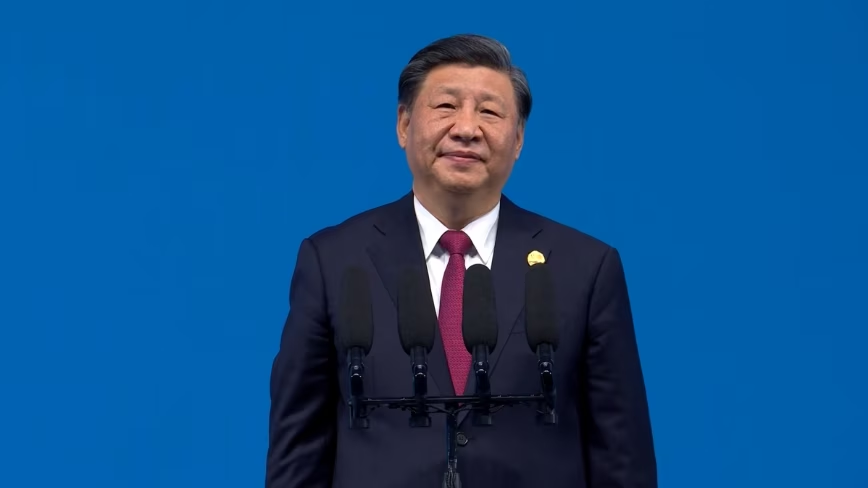
Xi pitches open-source AI to BRICS amid domestic curb debates
Chinese President Xi Jinping proposed a China-led open-source AI community and invited BRICS nations to join the World AI Cooperation Organization (WAICO) at the recent BRICS summit. This push for global collaboration contrasts sharply with Beijing's ongoing internal debates about restricting its own advanced AI models. Meanwhile, the EU's comprehensive AI Act, with its clear, enforceable rules for open-source AI, highlights a significant divergence in global AI governance approaches.

Tesla Set to Finally Unveil Second-Generation Roadster on October 1
The much-anticipated second generation of the Tesla Roadster, a halo vehicle promising revolutionary performance, is finally slated for a public unveiling on October 1. After years of delays and a protracted development

Seattle Warned on Big Tech Reliance; Microsoft/OpenAI Sued; Apple's
A new City of Seattle study warns of the city's risky economic over-reliance on a few dominant tech companies. Simultaneously, the Seattle Times and Newsday are suing Microsoft and OpenAI for alleged AI training data theft, while Apple's new foldable iPhone Duo evokes memories of Microsoft's defunct Surface Duo.
Google's AI Branding Fix: A Clearer Vision for Gemini
This article critiques Google's fragmented AI branding, proposing a unified 'Gemini Intelligence' system to simplify user experience and strengthen Gemini's identity.

in-depth: The Best 3-in-1 Apple Charging Stations After Testing 30
Wired has released its top picks for 3-in-1 Apple charging stations, extensively tested for iPhone, Apple Watch, and AirPods. The guide highlights six leading models, from premium speedy options to budget-friendly and compact designs, all focused on decluttering and optimizing charging for Apple users.

Nscale Adds Former OpenAI Exec Fidji Simo to Board Ahead of IPO
Nscale, the U.K.-based AI data center startup, has appointed former OpenAI, Meta, and Instacart executive Fidji Simo to its board of directors. This high-profile addition comes as Nscale prepares for a potential IPO this fall, leveraging Simo's extensive experience in scaling major tech platforms and guiding a company through a successful public offering.