
Empowering STEM Students: Essential Open Source Tools for Success
In today's rapidly evolving technological landscape, the methods through which STEM students learn, experiment, and collaborate have undergone a significant transformation. A mere decade ago, advanced learning resources

In today's rapidly evolving technological landscape, the methods through which STEM students learn, experiment, and collaborate have undergone a significant transformation. A mere decade ago, advanced learning resources often meant expensive licensed software, limiting access for many. Today, open source tools have democratized high-level educational and professional resources, making them available to anyone with an internet connection and a drive to learn.
These powerful open source solutions are not just cost-free alternatives; they are robust platforms used by professional researchers and software engineers worldwide. They span critical domains such as coding, data analysis, mathematics, technical writing, visualization, collaboration, and project management, equipping students with industry-ready skills long before they enter the workforce. For fellow developers, understanding how these tools empower the next generation of STEM professionals is crucial, as it impacts the talent pipeline and the broader tech ecosystem.
Why Open Source Tools are Pivotal for STEM Education
Open source software extends beyond simply being 'free.' It grants users access to the underlying code, fosters vibrant community support, and allows unrestricted experimentation. This transparency and flexibility are invaluable in STEM education, which increasingly emphasizes hands-on application over rote theory. Employers now expect graduates to possess practical workflow experience, and early exposure to modern open source tools significantly smooths the transition into internships and professional roles.
The open source ecosystem is dynamic and constantly innovating. By engaging with these tools, students gain insights into real-world technologies adopted by research labs, startups, and major engineering firms. Many professional environments leverage open-source automation to streamline development and enhance cross-team collaboration, making proficiency with such tools a vital asset.
Key Open Source Tools Every STEM Student Should Master
Let's delve into specific open source tools that provide a strong foundation for technical learning across various STEM disciplines:
Jupyter Notebook: Interactive Computing for Data and Science
Jupyter Notebook is an indispensable tool for interactive learning, particularly in data science, physics, statistics, and machine learning. It allows users to create and share documents that integrate live code, mathematical equations, visualizations, and narrative text within a single, interactive environment. This unified approach eliminates the need to switch between multiple applications, streamlining the workflow for experimentation and iterative learning. For instance, a physics student can simulate motion equations and instantly visualize the results, or a statistics student can analyze datasets directly within the notebook, making complex concepts tangible.
VS Code: The Versatile Development Hub
Visual Studio Code (VS Code) has emerged as one of the most popular development environments globally. Built on open source technologies by Microsoft, its extensive extension ecosystem supports nearly every major programming language—from Python and JavaScript to C++ and Rust. For STEM students, VS Code provides an integrated environment for debugging, syntax highlighting, terminal access, and Git integration. This versatility is crucial for engineering students who often work across disciplines, such as a robotics student who might write Python scripts, configure embedded systems, and document experiments all within the same editor.
GeoGebra: Dynamic Mathematics Visualization
GeoGebra is an open source mathematics platform that makes complex mathematical concepts accessible through interactive graphs and simulations. It supports exploration in algebra, geometry, calculus, and statistics. Students can dynamically manipulate equations and observe the real-time impact on graphs, fostering a deeper intuitive understanding of mathematical relationships. This interactive approach is particularly beneficial for students tackling advanced mathematics, helping them visualize abstract concepts like trigonometric functions, transformations, and polynomial behavior more effectively than static diagrams.
Git and GitHub: The Foundation of Collaborative Development
Version control is a fundamental skill in modern technical work. Git, an open source version control system, enables developers to track changes in code and collaborate efficiently. It prevents common issues like accidental file overwrites by maintaining a complete history of all modifications. When coupled with GitHub, students gain a platform for collaborating on projects, contributing to open source initiatives, and building a public portfolio—an increasingly vital asset for computer science students seeking internships or engineering roles. Even non-software fields, like research, benefit from Git's ability to ensure reproducible experiments and manage technical documentation.
Blender: Advanced Scientific and Engineering Visualization
While often associated with animation and game design, Blender is a powerful open source 3D modeling and rendering platform with significant applications in STEM. Engineering students can leverage Blender to create product prototypes, mechanical visualizations, and detailed simulation renders. Biology students can construct intricate anatomical models, and physics students can visualize complex systems in three dimensions. Effective 3D visualization can clarify concepts that are otherwise challenging to convey through text alone, while also developing valuable spatial reasoning and design skills pertinent to fields like robotics, manufacturing, and augmented reality.
OBS Studio: Content Creation for Technical Communication
Modern STEM learning increasingly involves creating and sharing technical content. OBS Studio is an open source tool that facilitates screen recording, live streaming, and the creation of technical demonstrations. This is highly useful for students developing portfolios, preparing project walkthroughs, or explaining complex coding concepts. A software engineering student might record a demo of their web application, or a mathematics student could create video explanations of problem-solving techniques, enhancing their communication and presentation skills in an increasingly content-driven world.
Fostering Career Skills and Shaping the Future of STEM
One of the most significant advantages of open source tools is their direct alignment with professional industry workflows. Students proficient in Git, VS Code, and Jupyter are not just learning academic theories; they are gaining hands-on experience with systems used daily in engineering environments. Similarly, using Blender or GeoGebra develops crucial visualization and analytical skills that are directly transferable to technical careers.
Open source communities also champion experimentation. Students can examine source code, propose fixes, engage in discussions, and learn from experienced developers globally. This participatory learning model is far more active and effective than passively consuming instructional content. As STEM education shifts towards project-based and interdisciplinary approaches, open source tools remove financial barriers, providing access to professional-grade software that enables students to solve real problems and adapt to rapidly evolving technologies. This independent exploration and project building are critical advantages in an era dominated by AI, data science, and remote collaboration.
Final Thoughts
The most successful STEM students are often those who creatively and consistently leverage accessible tools, rather than those with the most expensive hardware or software. The open source platforms discussed—Jupyter Notebook, VS Code, GeoGebra, Git, Blender, and OBS Studio—offer a robust foundation for technical learning across diverse disciplines. More importantly, they cultivate curiosity, encourage experimentation, and promote practical problem-solving skills that extend well beyond the academic setting. As STEM education continues its evolution, students who embrace and master open source technologies will be exceptionally well-prepared for the interdisciplinary challenges of future research, engineering, and software development roles.
FAQ
Q: What makes open source tools better for STEM students than proprietary software, beyond being free? A: Beyond the cost, open source tools provide unparalleled transparency (access to source code), foster community support for troubleshooting and learning, and allow for unrestricted experimentation. This environment closely mirrors professional development workflows, giving students practical skills and a platform to contribute to real-world projects, which is often not possible with closed-source alternatives.
Q: How does using Git and GitHub specifically prepare STEM students for industry roles outside of pure software development? A: Git and GitHub teach crucial version control and collaboration skills that are increasingly vital across all STEM fields. Researchers use them for reproducible experiments, ensuring data and code changes are tracked transparently. Engineering teams manage technical documentation, simulation code, and project assets through these platforms. The ability to manage changes, collaborate effectively, and maintain a historical record of work is a fundamental professional skill, regardless of the specific technical discipline.
Q: Can a student realistically build a professional portfolio using only the open source tools mentioned in this article? A: Absolutely. Tools like Jupyter Notebook enable comprehensive data analysis projects, VS Code is a professional-grade IDE for diverse coding tasks, and Git/GitHub provide the perfect platform to host and showcase all code and project work. Blender can be used for advanced visualizations and prototypes, while OBS Studio allows for creating high-quality project demos and presentations. Collectively, these tools offer a complete ecosystem for developing, documenting, and presenting complex STEM projects, making them highly effective for building a strong portfolio that demonstrates practical skills to potential employers.
Related articles

OpenAI's Bubeck Denies Credit Stripping, Apologizes Amidst
OpenAI's Sébastien Bubeck denies attempting to strip Anthropic mathematician Levent Alpöge of credit for his work on the Navier-Stokes problem, apologizing for a remark made during contentious private discussions. OpenAI CEO Sam Altman backed Bubeck, but Alpöge and his collaborator, Tristan Buckmaster, present a conflicting account of events. The dispute also raises questions about OpenAI's data handling policies, as the mathematicians claim to have used OpenAI's Codex tool during their research.
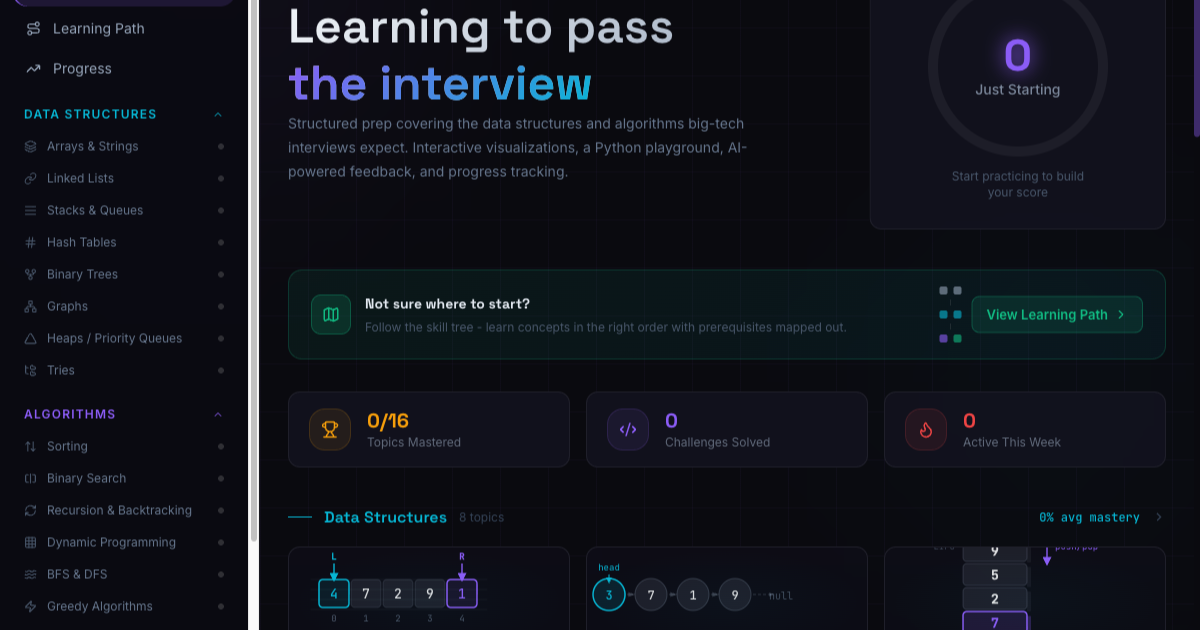
Learningto/Pass: Free, AI-Powered Interview Prep for Developers
Landing a role at a top-tier tech company often hinges on mastering complex data structures and algorithms, coupled with a solid grasp of system design. The problem for many aspiring software developers is that quality
The One Zero Company Achievement That Got Away From Me
Star Wars Zero Company is a stellar turn-based tactics game, but the author is playfully irked by one missing achievement: a reward for completing the game without losing any squad members to its brutal permadeath system. Despite this minor gripe, the game is lauded as one of the year's best, showcasing deep strategic gameplay.

The Composite Design Pattern: Unifying Individual Objects and Groups
As software engineers, we frequently encounter scenarios where we need to manage collections of objects that can be either individual entities or groups containing other entities. Think of a file system with files and

Uber Injects $10M into Indian Fleet Partner Carrum at $168M Valuation
Uber has significantly deepened its investment in India’s burgeoning ride-hailing ecosystem, announcing a $10 million Series B funding round into Carrum Mobility, an Indian fleet management startup. The move, disclosed

Windows 11 September Update: A Welcome Return to User Control
The Windows 11 September update brings back highly requested features like a movable taskbar and resizable Start menu, alongside crucial search improvements. It's a significant step toward enhanced user customization and system stability, making it a compelling upgrade despite phased rollouts.