
Blue Origin New Glenn: Reusable Booster Shines, Upper Stage Stumbles
Blue Origin's third New Glenn mission marked a successful first reflight of its orbital-class booster but was marred by a critical upper stage failure, stranding its AST SpaceMobile payload. This mixed outcome impacts Blue Origin's reliability standing and crucial future missions.
Quick Verdict
Blue Origin's third New Glenn mission delivered a significant milestone with its first successful reuse of an orbital-class booster, a commendable achievement for the company. However, this triumph was significantly overshadowed by a critical failure of the rocket's upper stage, which left its primary payload, an AST SpaceMobile satellite, stranded in an unusable, low-Earth orbit. While the reusability demonstration marks progress, the overall mission outcome is a stark reminder that consistent, end-to-end reliability is paramount for commercial launch services.
Introduction: A Mission of Mixed Fortunes
Blue Origin, Jeff Bezos's aerospace venture, recently completed the third flight of its heavy-lift New Glenn launcher, a mission eagerly watched by the industry and its customers. This flight was particularly significant as it marked the company's inaugural successful reflight of an orbital-class booster, a feat that has become a benchmark for efficiency in modern spaceflight. However, the celebratory mood quickly dissipated as it became apparent that the mission's upper stage had failed to deliver its precious cargo, an AST SpaceMobile cellular broadband satellite, to its intended orbit.
The Reusable First Stage: A Beacon of Progress
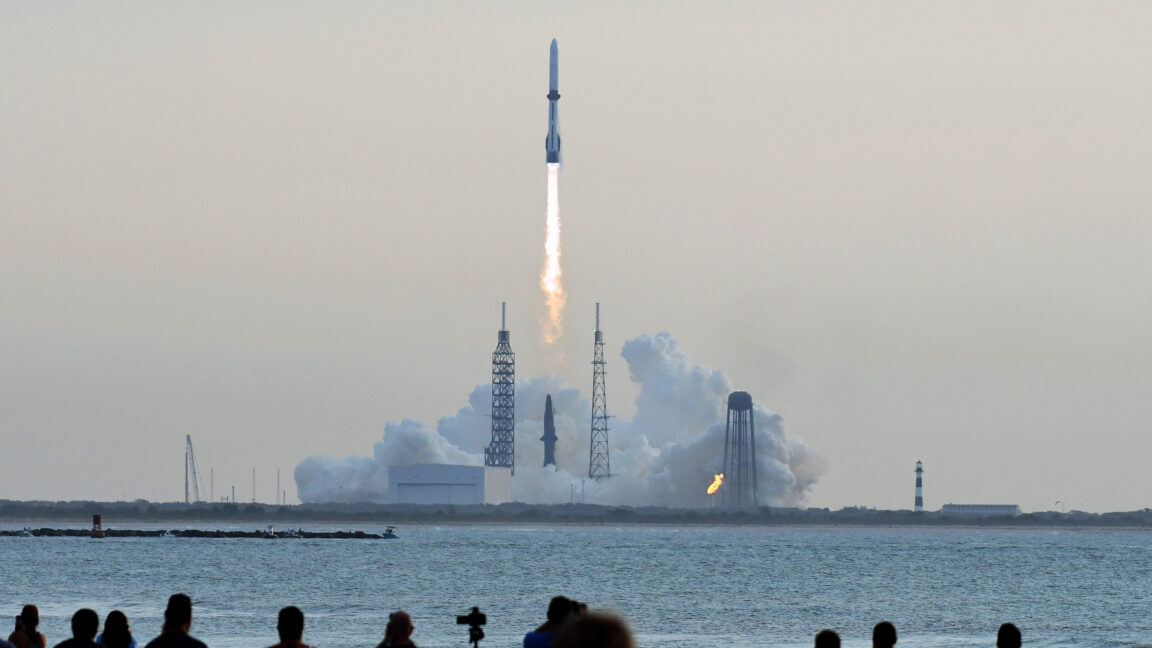
Named Never Tell Me The Odds, the 321-foot (98-meter) New Glenn rocket lifted off from Cape Canaveral Space Force Station with an impressive display of power from its seven methane-fueled BE-4 engines. The first stage performed flawlessly, accelerating the rocket beyond the speed of sound before detaching and beginning its carefully orchestrated return journey. In a testament to Blue Origin's engineering, the booster executed two precise braking burns, culminating in a smoky but accurate touchdown on the company’s landing platform in the Atlantic Ocean, nearly 400 miles southeast of the launch site. This marked the booster's second flight, following its successful debut and recovery in November. While new engines were installed for this specific reflight, Blue Origin has articulated its future goal to reuse the engines themselves, signaling a commitment to deep reusability. This milestone is a critical step for Blue Origin, as it seeks to emulate the rapid launch rates seen with competitors like SpaceX's Falcon 9, ultimately aiming for vastly faster turnaround times for New Glenn missions.
The Upper Stage Debacle: A Major Setback
Unfortunately, the success of the first stage was starkly contrasted by the failure of the New Glenn's upper stage. Powered by two BE-3U engines, this stage was tasked with two burns to place AST SpaceMobile’s BlueBird 7 satellite into a precise orbit approximately 285 miles (460 kilometers) above Earth, at a 49-degree inclination. The satellite, a roughly six-ton spacecraft designed to unfurl a 2,400-square-foot communications array, was a crucial component of AST’s burgeoning cellular broadband network.
Within hours of the launch, Blue Origin confirmed that the upper stage had missed its mark, placing the payload into an “off-nominal orbit.” AST SpaceMobile later clarified that the satellite’s orbit was “too low to sustain operations,” rendering it unusable and necessitating its de-orbiting. Preliminary tracking data from the US Space Force indicated an alarming closest approach altitude of just 95 miles (154 kilometers), which would lead to a destructive reentry within days. This failure is particularly frustrating as New Glenn’s upper stage had performed commendably on its two previous flights in 2025, achieving precise orbital insertions.
Implications for AST SpaceMobile and the Satellite Market
For AST SpaceMobile, a startup lacking the extensive resources of industry giants like Amazon and SpaceX, this failure is a significant blow. While the company expects to recover the satellite’s undisclosed cost through insurance, the loss of BlueBird 7 impacts its aggressive deployment schedule. AST aims to have 45 to 60 satellites in orbit by the end of 2026 to provide continuous coverage over key markets, a goal now slightly delayed. This incident occurs within a highly competitive landscape where SpaceX's Starlink already boasts an operational direct-to-cell offering with thousands of active satellites, and Amazon is actively building out its Project Kuiper network, recently acquiring Globalstar and partnering with Apple for mobile satellite services.
Broader Industry Context and NASA's Concerns
Upper stage failures are not uncommon for new rockets, as evidenced by SpaceX's Starship test flights and historical issues with its Falcon 9 second stage, or United Launch Alliance's Vulcan rocket grappling with persistent solid rocket booster problems. These incidents often trigger lengthy investigations, and a similar inquiry for New Glenn could delay Blue Origin’s subsequent missions, including launches for Amazon’s Project Kuiper constellation and, crucially, the company’s first prototype Blue Moon lander. Any delay to the Blue Moon program carries significant weight for NASA, which plans to use a human-rated version of the lander to ferry astronauts to the lunar surface as part of the Artemis program before 2028. NASA is closely monitoring the progress and reliability of its Moon lander contractors, with SpaceX also planning an upgraded Starship Version 3 test flight soon.
Pros and Cons
Pros:
- Successful Booster Reuse: Achieved its first orbital-class booster reflight, a major technological and operational milestone.
- Reliable First Stage: The New Glenn first stage demonstrated robust performance and precise landing capability.
- Pathway to Rapid Reusability: Blue Origin is actively working towards reducing engine replacement for future reflights, which is key for increased launch cadence.
Cons:
- Critical Upper Stage Failure: The complete failure of the upper stage to deliver its payload to the correct orbit is a severe drawback.
- Significant Customer Impact: Resulted in the total loss of a customer satellite (AST SpaceMobile BlueBird 7), incurring financial losses (albeit insured) and schedule delays for the customer.
- Reputation Risk: Undermines confidence in the rocket's overall reliability, particularly after prior upper stage successes.
- Artemis Program Implications: Potential delays for critical NASA Blue Moon lander missions, impacting national space exploration goals.
- Competitive Disadvantage: Puts Blue Origin further behind competitors like SpaceX in terms of consistent mission success and rapid reusability.
Buying Recommendation
For potential customers eyeing Blue Origin's New Glenn, this mission presents a mixed picture. While the successful booster reflight is a significant step forward and validates a core tenet of the New Glenn design, the upper stage failure introduces considerable uncertainty regarding mission reliability. Until Blue Origin successfully identifies and rectifies the root cause of the upper stage malfunction, and demonstrates consistent, end-to-end mission success across several flights, a cautious approach is warranted. Companies with critical, time-sensitive payloads should carefully weigh the risks against the demonstrated capabilities. For those prioritizing proven reliability and high launch cadences, established alternatives might currently offer a more compelling proposition. Blue Origin needs to prove its full stack reliability before it can be considered a top-tier choice for all orbital missions.
FAQ
Q: How significant is the New Glenn first stage reusability achievement? A: It's very significant. Successfully landing and reusing an orbital-class booster for the second time is a major technical and operational milestone for Blue Origin, demonstrating their capability to recover and potentially rapidly re-fly expensive rocket components. This puts them in an elite club of space companies achieving such feats.
Q: What are the main implications of the upper stage failure for Blue Origin and its customers? A: For Blue Origin, it means a setback in establishing New Glenn's reliability, likely triggering a lengthy investigation that could delay future launches, including those for Amazon's Kuiper constellation and NASA's crucial Blue Moon lunar lander. For customers like AST SpaceMobile, it resulted in the complete loss of their satellite, albeit insured, and a disruption to their network deployment schedule. This impacts confidence and market perception, especially in a competitive commercial launch sector.
Q: How does New Glenn compare to other reusable rockets in the market after this event? A: While New Glenn has now demonstrated first stage reusability, its overall mission reliability (especially the upper stage) lags behind market leader SpaceX's Falcon 9, which has an extensive track record of successful reflights and near-perfect orbital insertion reliability. New Glenn is still in its early flight phase, and while the booster reuse is positive, the upper stage failure highlights that the entire system needs to achieve consistent performance to compete effectively with more mature, highly reliable launch vehicles.
Related articles
Android 17 QPR2 Beta 7.1: The Performance Relief You've Been Waiting
Android 17 QPR2 Beta 7.1: Finally Fixing the QPR1 Performance Woes Verdict: Android 17 QPR2 Beta 7.1 is a crucial and highly anticipated software update for Google Pixel users, specifically targeting and resolving the

MapQuest's ALPR Feature: Navigating Surveillance with Intelligence
Quick Verdict MapQuest's latest "Surveillance" feature is a compelling and timely addition, offering users the ability to identify automated license plate reader (ALPR) cameras in their vicinity. While its data sourcing

"thegentlemanpervert": A Catastrophic Failure in Digital Ethics and
"thegentlemanpervert" review: An AI CSAM production and distribution operation, led by a NJ prosecutor, proved to be an absolute and catastrophic failure, resulting in felony charges and a stark warning about digital culpability.

DJI Solo Video Setups: Smart Choices for Lone Creators
This review delves into DJI's recommended solo video setups, highlighting the Osmo Pocket 3 Creator Combo as a top pick for its integrated camera, gimbal, and mic. It also covers stabilizers like the Osmo Mobile 8 and RS 4, and the DJI Mic Mini series for enhanced audio, providing honest pros, cons, and clear buying advice.

Ars Technica's Rocket Report: Your Essential Space Industry Briefing
Quick Verdict Ars Technica's Rocket Report, presented by veteran space reporter Stephen Clark, offers an invaluable and meticulously organized weekly (or similar frequency, implied by "Edition 9.15") digest of the most

Apple iPhone Duo: A Daring Debut with Notable Compromises
Apple's highly anticipated iPhone Duo, priced at $2,000, has gone on pre-order. While hailed as "Apple's most exciting device in a decade" for its innovative foldable design and immersive display, it comes with significant drawbacks like the absence of FaceID and a premium camera.