
Anthropic to challenge DOD’s supply chain label in court: AI Ethics
AI firm Anthropic plans to challenge the DOD's recent "supply chain risk" designation in court, calling it "legally unsound." This follows a dispute over AI control, with Anthropic refusing use for mass surveillance or autonomous weapons, while the Pentagon seeks unrestricted access for lawful purposes. The designation could bar Anthropic from military contracts.

AI firm Anthropic announced Thursday its intent to challenge the Department of Defense’s (DOD) recent decision to label the company a supply chain risk in federal court. CEO Dario Amodei stated the designation, which could bar the company from working with the Pentagon and its contractors, is "legally unsound" and stems from a weeks-long dispute over the military's control and use of artificial intelligence systems.
The designation follows a firm stance by Anthropic, led by Amodei, against the use of its AI models for mass surveillance of Americans or for fully autonomous weapons. In contrast, the Pentagon has expressed a desire for unrestricted access to the AI for "all lawful purposes." This fundamental disagreement has escalated into a direct legal confrontation between a leading AI developer and the nation's defense apparatus.
In his statement, Amodei clarified that the vast majority of Anthropic’s customer base remains unaffected by the DOD’s decision. He emphasized that the designation specifically applies to the use of their AI model, Claude, "as a direct part of" contracts with the Department of Defense, not to all uses of Claude by customers who may also hold such military contracts.
Amodei offered a preview of Anthropic's likely legal arguments, asserting that the DOD's letter outlining the supply chain risk is narrow in scope. "It exists to protect the government rather than to punish a supplier," Amodei said, adding that existing law mandates the Secretary of War to employ the "least restrictive means necessary" to safeguard the supply chain. He further contended that even for DOD contractors, the designation cannot limit unrelated uses of Claude or business relationships with Anthropic.
The legal challenge emerges amidst a contentious period, which Amodei acknowledged. He confirmed that productive discussions with the DOD over recent days were likely disrupted by the leak of an internal memo he had sent to staff. In that memo, Amodei reportedly characterized rival OpenAI’s engagement with the Department of Defense as "safety theater." OpenAI has since signed a deal to work with the DOD, effectively replacing Anthropic, a move that has reportedly sparked backlash among OpenAI's own employees.
Amodei publicly apologized for the memo's leak, stating that Anthropic did not intentionally share it or direct anyone to do so, emphasizing, "It is not in our interest to escalate the situation." He explained the memo was drafted under duress within hours of a series of rapid announcements: a presidential Truth Social post calling for Anthropic's removal from federal systems, Secretary Hegseth’s supply chain risk designation, and the Pentagon's subsequent deal with OpenAI. He described it as a "difficult day for the company" and clarified that the memo did not reflect his "careful or considered views," further noting it was an "out-of-date assessment" written six days prior.
Despite the impending legal battle, Amodei reaffirmed Anthropic’s commitment to national security, stating that the company's top priority is to ensure American soldiers and national security experts maintain access to critical tools amid ongoing major combat operations. Anthropic is currently supporting U.S. operations in Iran, and Amodei pledged to continue providing its models to the DOD at a "nominal cost" for "as long as necessary to make that transition."
Anthropic is expected to file its challenge in federal court, likely in Washington. However, legal experts caution that the path to overturning such a designation is steep. The underlying law behind the DOD's decision limits the typical avenues companies have to contest government procurement choices and grants the Pentagon broad discretion on matters concerning national security. Dean Ball, a former Trump-era White House advisor on AI, commented on the difficulty, noting, "Courts are pretty reluctant to second-guess the government on what is and is not a national security issue…There’s a very high bar that one needs to clear in order to do that. But it’s not impossible."
FAQ
Q: What does a "supply chain risk" designation entail for a company? A: A supply chain risk designation can effectively bar a company from securing contracts with the Pentagon and its numerous contractors, significantly impacting its ability to work with the U.S. military.
Q: What is the core disagreement between Anthropic and the DOD that led to this designation? A: The dispute centers on the control and ethical use of AI. Anthropic seeks to restrict its AI from being used for mass surveillance of Americans or for fully autonomous weapons, while the DOD desires unrestricted access for "all lawful purposes."
Q: How difficult will it be for Anthropic to successfully challenge the DOD's designation in court? A: It will be very difficult. The law governing such decisions limits a company's ability to challenge government procurement and grants the Pentagon broad discretion on national security matters, setting a very high legal bar for a successful appeal.
Related articles
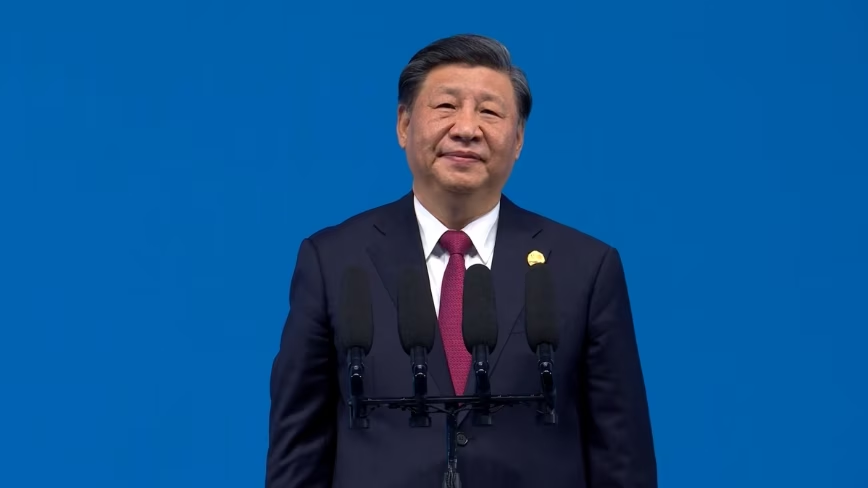
Xi pitches open-source AI to BRICS amid domestic curb debates
Chinese President Xi Jinping proposed a China-led open-source AI community and invited BRICS nations to join the World AI Cooperation Organization (WAICO) at the recent BRICS summit. This push for global collaboration contrasts sharply with Beijing's ongoing internal debates about restricting its own advanced AI models. Meanwhile, the EU's comprehensive AI Act, with its clear, enforceable rules for open-source AI, highlights a significant divergence in global AI governance approaches.

StarCraft Returns in 2030 as Open-World Shooter
Blizzard Entertainment announced a new StarCraft game, an open-world shooter, set to release in 2030. Unveiled at BlizzCon by VP Dan Hay, this marks the series' return after over a decade and a significant genre shift from its real-time strategy roots. The cinematic trailer showcased a gritty human-Zerg conflict, with many fans hoping for a traditional RTS follow-up.

Tesla Set to Finally Unveil Second-Generation Roadster on October 1
The much-anticipated second generation of the Tesla Roadster, a halo vehicle promising revolutionary performance, is finally slated for a public unveiling on October 1. After years of delays and a protracted development

Seattle Warned on Big Tech Reliance; Microsoft/OpenAI Sued; Apple's
A new City of Seattle study warns of the city's risky economic over-reliance on a few dominant tech companies. Simultaneously, the Seattle Times and Newsday are suing Microsoft and OpenAI for alleged AI training data theft, while Apple's new foldable iPhone Duo evokes memories of Microsoft's defunct Surface Duo.

Understanding the Anti-Woke Right's Challenge with Grand Theft Auto VI
Welcome to this guide on understanding the current cultural conversation surrounding the highly anticipated game, Grand Theft Auto VI. This resource is designed to help you navigate the specific challenges and

in-depth: The Best 3-in-1 Apple Charging Stations After Testing 30
Wired has released its top picks for 3-in-1 Apple charging stations, extensively tested for iPhone, Apple Watch, and AirPods. The guide highlights six leading models, from premium speedy options to budget-friendly and compact designs, all focused on decluttering and optimizing charging for Apple users.