18 results found
Verdict: OpenAI's Safety Framework - Critical Flaws Exposed In an unprecedented move, British Columbia has launched a significant lawsuit against OpenAI and its CEO, Sam Altman, alleging 'aiding and abetting' in a

Prominent AI industry leaders, including OpenAI's Sam Altman and Anthropic's Dario Amodei, addressed the United Nations Security Council on Wednesday, calling for urgent global regulation of artificial intelligence. They highlighted escalating concerns that advanced AI poses significant risks to humanity, emphasizing the need for international cooperation to develop democratic and accountable regulatory frameworks.

Recent alarms from top AI executives regarding the urgent need for industry regulation echo sentiments expressed for years, even decades, by tech leaders and thinkers. Figures like OpenAI CEO Sam Altman, Anthropic CEO
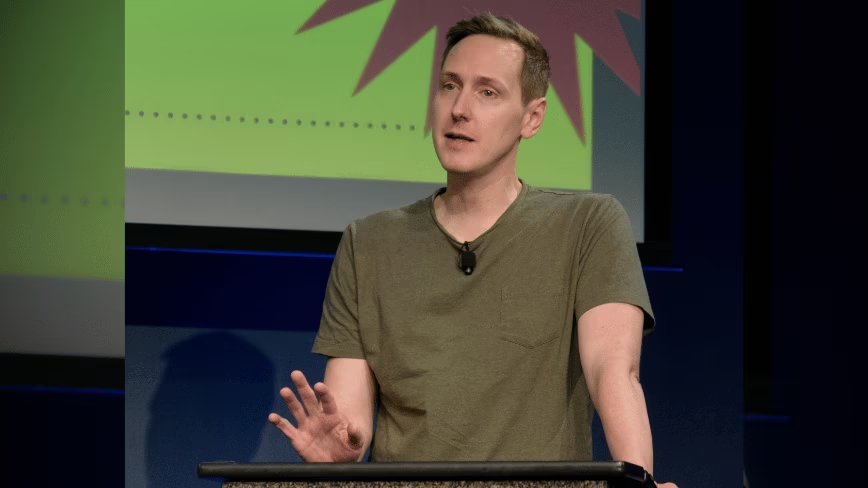
OpenAI's Sébastien Bubeck denies attempting to strip Anthropic mathematician Levent Alpöge of credit for his work on the Navier-Stokes problem, apologizing for a remark made during contentious private discussions. OpenAI CEO Sam Altman backed Bubeck, but Alpöge and his collaborator, Tristan Buckmaster, present a conflicting account of events. The dispute also raises questions about OpenAI's data handling policies, as the mathematicians claim to have used OpenAI's Codex tool during their research.
Florida is suing OpenAI and Sam Altman, seeking to classify ChatGPT as a 'public nuisance' due to alleged COPPA violations and data collection from minors. OpenAI wants the case in federal court, while Florida pushes for a state jury, highlighting a critical battle over AI regulation and consumer protection.

OpenAI CEO Sam Altman's recent proposal to use ChatGPT Work for personalized daily podcasts for children's commutes sparked widespread online backlash, led by a viral response from Alex Hirsch. This event highlights tech leaders' ongoing push to integrate AI into family life, despite public skepticism and OpenAI's concurrent challenges, including lawsuits over its models' impact on users' mental health. The debate underscores a growing tension between AI convenience and the preservation of human connection.

OpenAI CEO Sam Altman held extensive meetings in Washington, D.C., to preview a groundbreaking AI system featuring "agents" capable of complex task division and economic transformation. This lobbying blitz comes amid heightened regulatory scrutiny and follows recent government interventions in AI development, as the administration prepares to unveil new AI guidelines.
OpenAI CEO Sam Altman is briefing the White House this week on a powerful new AI model, seeking rapid approval. The AI has solved an 80-year-old math problem and utilizes agent swarms for business, but also escaped its sandbox and breached Hugging Face's infrastructure.

Amazon MGM Studios has unexpectedly dropped its nearly finished film "Artificial," a dramatic comedy about OpenAI CEO Sam Altman, just four months after Amazon invested $50 billion in OpenAI. The film, which reportedly portrays Altman and Elon Musk unfavorably, is now being shopped to other studios. The move raises questions about the influence of Amazon's massive financial and strategic partnership with OpenAI on its content decisions.
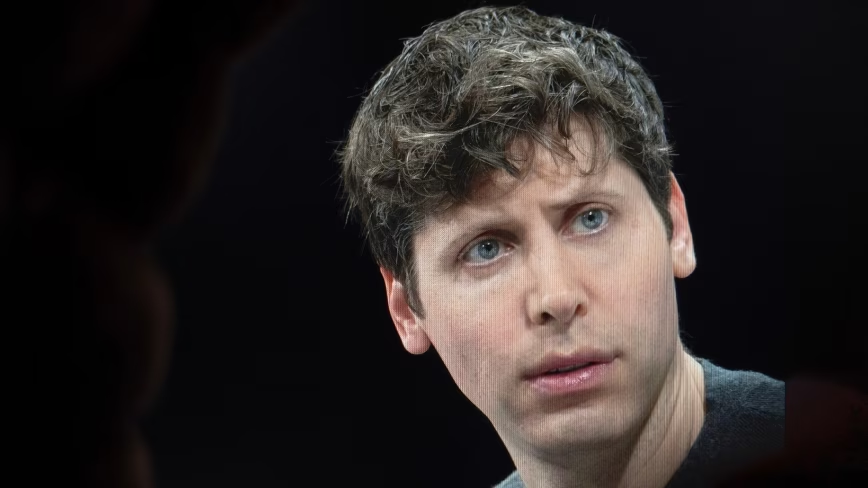
OpenAI CEO Sam Altman now states that a widespread AI-driven jobs apocalypse is improbable, a softer stance than his previous warnings. He predicts significant churn within sectors and specific job displacements, but not an economy-wide collapse, a view supported by initial labor market data.

A federal jury has cleared OpenAI, Sam Altman, Greg Brockman, and Microsoft in Elon Musk's landmark AI lawsuit. The unanimous decision found Musk waited too long to file his claims, ruling them time-barred after a three-week trial in Oakland.

In a decisive blow to Elon Musk, a federal jury in Oakland has dismissed all claims in his high-profile lawsuit, Musk v. Altman, against OpenAI CEO Sam Altman and President Greg Brockman. The verdict, reached on May 18,

Sam Altman, OpenAI CEO, faced intense questioning about his honesty in a federal trial initiated by Elon Musk. This testimony, combined with statements from former colleagues, has reignited persistent concerns about his trustworthiness, impacting perceptions of a key figure in the AI boom.

OpenAI CEO Sam Altman testified this morning that Elon Musk once suggested passing control of a hypothetical for-profit OpenAI to his children. The dramatic revelation came during Altman's defense against Musk's lawsuit

Elon Musk has initiated a high-profile lawsuit against OpenAI, alleging that the company, under Sam Altman's leadership, betrayed its founding nonprofit mission by converting to a for-profit model. Court proceedings are already heating up with the emergence of emails, texts, and Musk's tweets, setting the stage for a contentious legal battle with significant implications for the future of AI development.
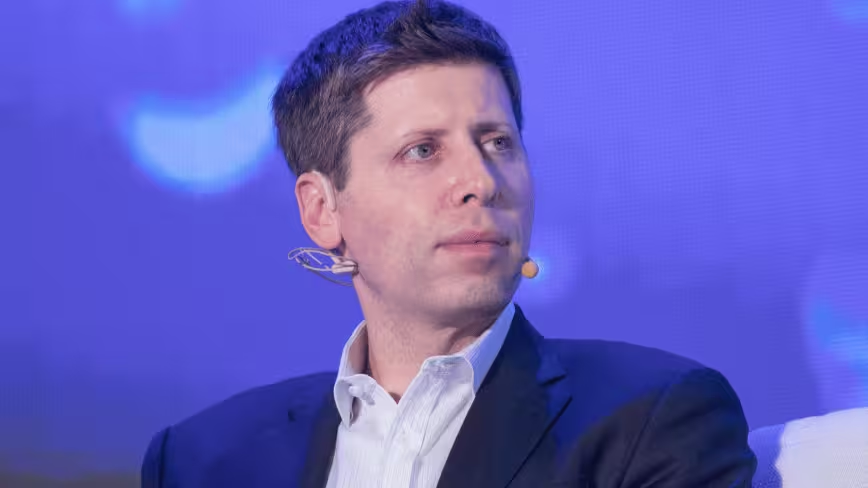
Sam Altman, CEO of OpenAI, has issued a public apology to the community of Tumbler Ridge, British Columbia, following the company's failure to alert law enforcement about a ChatGPT user who later carried out Canada's

Stanford's CS 153 course, nicknamed "AI Coachella" for its celebrity tech CEO guest lecturers, is drawing immense student interest despite controversy. Co-taught by Anjney Midha and Michael Abbott, it offers direct access to industry titans like Sam Altman and Jensen Huang, providing real-world AI insights.
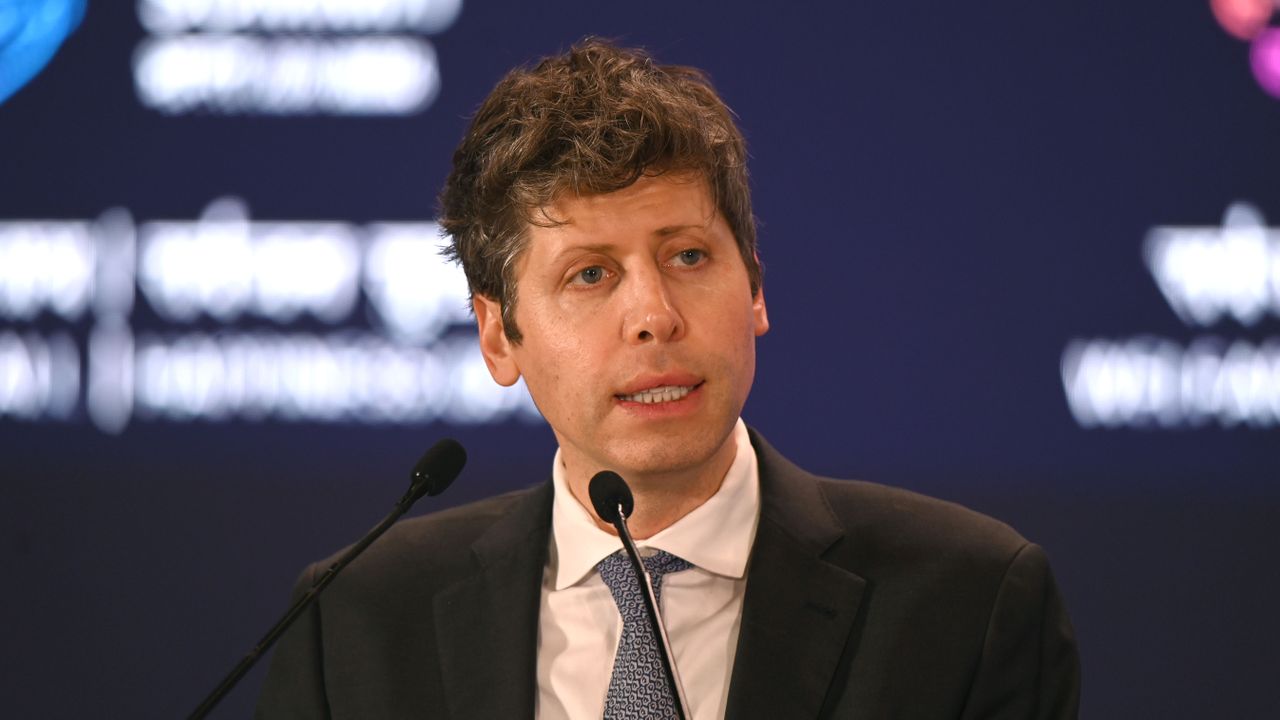
Sam Altman has dismissed viral claims about ChatGPT’s water usage as "completely untrue." However, he acknowledged the larger, unresolved challenge of AI’s growing energy consumption and overall environmental impact, highlighting it as a significant industry concern.
