119 results found

The proliferation of AI agents has opened up exciting new possibilities, but as these systems move beyond chatbots and into high-stakes environments—modifying infrastructure, moving money, or altering critical

AI video startup Higgsfield has launched Supercomputer 2.0, an autonomous agent framework for enterprise marketing. Built on NVIDIA technology, it claims adoption by 78 percent of Fortune 500 companies, aiming to automate full campaign lifecycles. The company also produced an AI-generated feature film in 14 days.

Sakana AI has launched Marlin, an "ultra deep research" agent designed for enterprise clients. Operating as a "Virtual CSO," Marlin conducts self-governing reasoning for up to eight hours to deliver comprehensive, 100+ page strategy reports. Powered by Adaptive Branching Monte Carlo Tree Search (AB-MCTS) and a multi-LLM architecture, it focuses on deep, vetted analysis over quick generation, backed by strict data privacy policies and significant venture capital.

The rapidly evolving landscape of AI agent communication is witnessing a familiar pattern: initial proliferation of protocols, followed by gradual consolidation. While significant progress has been made in standardizing

KPMG has pulled its report, "Redefining excellence in the age of agentic AI," after organizations cited within it denied the accuracy of its claims regarding their AI usage. Inaccuracies were attributed to AI hallucinations, implying KPMG used AI to write the report about AI. This follows a similar incident last month with EY.

Pool, a new AI-powered iOS app, transforms cluttered camera rolls into organized, actionable archives by categorizing screenshots and linking them to original sources. Developed by Maxime Junique and Piet Terheyden, the app uses advanced AI to help users rediscover forgotten information, from recipes to product recommendations. Having secured over $2 million in pre-seed funding, Pool is also planning a future agentic AI personal assistant app.

A recently laid-off Meta employee has been detained by US immigration agents in El Paso, Texas, according to internal company communications. The incident highlights the critical vulnerability of visa-holding tech workers during mass layoffs and has sparked urgent concern among current Meta staff.

Apple has introduced a groundbreaking architecture at WWDC26 for on-device AI, overcoming the long-standing DRAM memory limit. Its new AFM 3 Core Advanced model stores 20 billion parameters in NAND flash, using a unique Instruction-Following Pruning (IFP) method to dynamically load expert modules into DRAM. This innovation significantly boosts local AI capabilities for agentic workloads.

The landscape of database management is rapidly evolving, particularly with the increasing prevalence of AI agents interacting directly with our data systems. While these agents offer immense potential, they also

LLM-based Multi-Agent (LLM-MA) systems automate complex software tasks, but their token consumption, and thus costs, are poorly understood. New research analyzing the ChatDev framework with GPT-5 reveals that the iterative Code Review stage consumes a striking 59.4% of tokens, with input tokens making up 53.9% of total consumption. This indicates that the primary cost in agentic software engineering lies in refinement and verification, not initial generation, offering crucial insights for cost prediction and workflow optimization.

Microsoft's Build 2026 showcased a bold AI-first future with seven new in-house AI models, Project Solara for agent-first devices, and the Scout assistant. Mary Jo Foley helped decode these developments, highlighting Microsoft's push for AI self-sufficiency and the road ahead for Copilot and GitHub.

China is moving beyond super-apps to embrace AI agents from Alibaba (Qwen) and Tencent (WeChat). These agents promise unparalleled convenience by automating complex tasks through conversational requests, but their success hinges on establishing user trust through accuracy and reliability.

Coralogix, a software-monitoring startup, has raised $200 million in Series F funding, bringing its valuation to $1.6 billion. The company is betting on increased demand for tools to monitor and troubleshoot autonomous AI agents as they become critical in enterprise operations.

Cognition, the AI coding agent startup behind Devin, secured $1 billion at a $26 billion valuation this week. Despite this, CEO Scott Wu insists AI agents shouldn't replace humans, aiming for augmentation to free programmers from tedious tasks. Wu envisions Devin as a "buddy" that enhances creativity, even as it handles 89% of Cognition's internal code.

Dive into 007 First Light and begin your journey to becoming an MI6 agent. This guide offers 7 essential beginner tips, from mastering stealth and gadget management to leveraging failure and understanding when to fight. Learn to defend the Crown like a true spy.
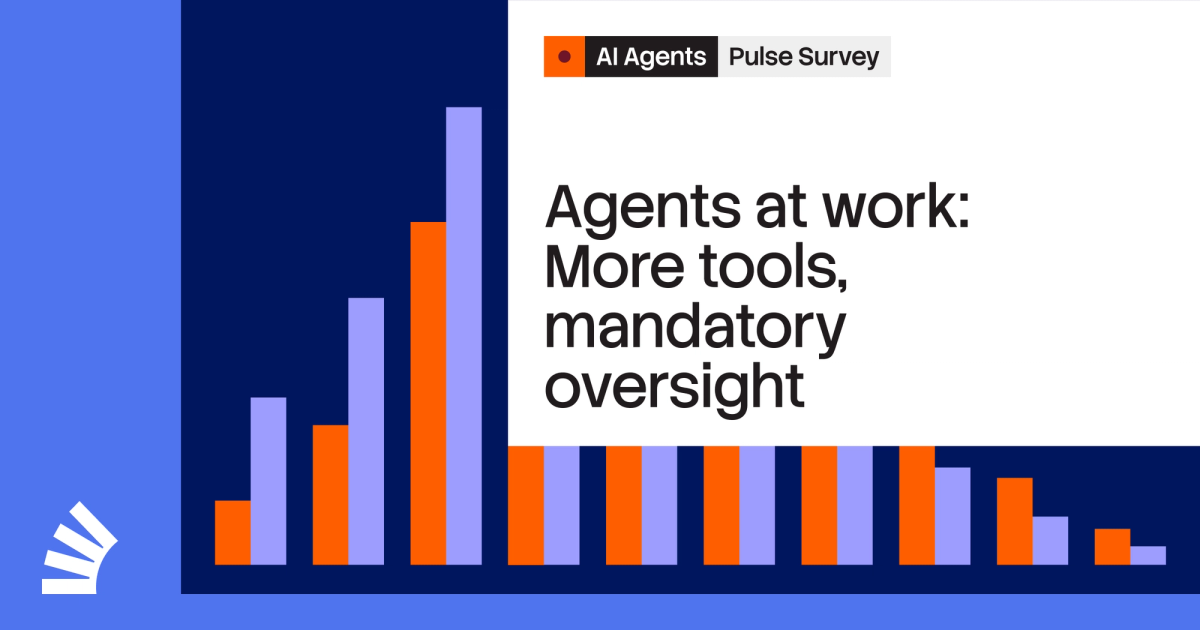
AI agent usage has nearly doubled, yet developers maintain a strong preference for human oversight. A recent survey reveals single-agent workflows are dominant, driven by concerns for accuracy and security, even as work quality improves. Fintech and media lead adoption, leveraging tools like GitHub Copilot and LangChain under careful monitoring.

AI agents are inadvertently causing significant, untracked production incidents by acting without full system context, blurring the lines between autonomous remediation and chaos engineering. Enterprises lack the frameworks to categorize these failures, leading to cascades stemming from narrow agent perspectives. Experts advocate for integrating agent governance with chaos engineering by treating agent actions as experiments and managing a shared “resilience budget” based on live system signals.

Google is transitioning from a traditional search engine to an AI agent that proactively gathers information, fundamentally redefining the act of "googling." This shift, discussed on The Vergecast after Google I/O, raises profound questions about the future of the web itself and Google's identity in the AI era.

Google unveiled a sprawling, albeit complex, ecosystem of AI agents at its I/O developer conference on Tuesday, intending to transform how consumers interact with the web and manage their digital lives. However, the
Google is transforming its search engine by 2026 with agentic AI, offering conversational AI Mode, generative UIs, and custom apps. This shift aims for efficiency but de-emphasizes traditional links, raising concerns about information diversity despite Google's market dominance.

Learn to harness Google's new AI agents to continuously monitor interests, synthesize information, and receive proactive updates, transforming how you stay informed without constant searching.

Manus AI introduces a paradigm shift from basic chatbots to intelligent agents capable of autonomously executing complex, multi-step tasks within an isolated cloud environment. This guide explores its capabilities, including web browsing, code execution, and real-site interaction, empowering developers to build sophisticated automated workflows.

Anthropic announced Monday it has acquired Stainless, a dev tools startup whose SDK automation software is widely used by rivals like OpenAI, Google, and Cloudflare. This strategic acquisition will see Anthropic wind down Stainless's hosted products, granting it exclusive access to critical technology for building AI agents and impacting competitors.

Anthropic's new `/goals` feature for Claude Code revolutionizes AI agent reliability by separating task execution from goal evaluation. This prevents agents from prematurely ending tasks, using a dedicated evaluator model to ensure specified conditions are fully met before declaring completion. The innovation offers a more robust, auditable approach to AI agent deployment.

Amazon has integrated its unified Alexa for Shopping AI assistant directly into its main search bar for US customers. This move consolidates the Rufus chatbot and Alexa+ functionalities, providing conversational answers, comparisons, and automated shopping tasks as agentic commerce intensifies. The strategic shift aims to defend Amazon's advertising business against competing AI agents.
