
Xi pitches open-source AI to BRICS amid domestic curb debates
Chinese President Xi Jinping proposed a China-led open-source AI community and invited BRICS nations to join the World AI Cooperation Organization (WAICO) at the recent BRICS summit. This push for global collaboration contrasts sharply with Beijing's ongoing internal debates about restricting its own advanced AI models. Meanwhile, the EU's comprehensive AI Act, with its clear, enforceable rules for open-source AI, highlights a significant divergence in global AI governance approaches.
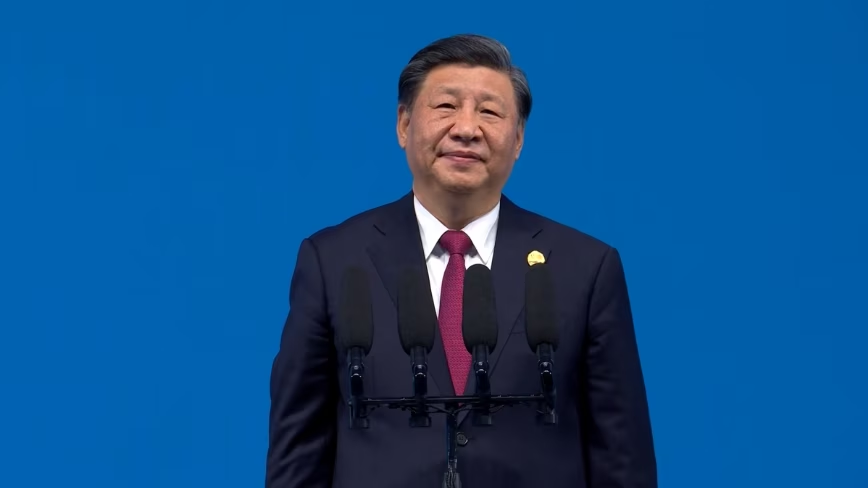
Chinese President Xi Jinping recently unveiled an ambitious proposal at the BRICS summit in New Delhi, advocating for a China-led open-source AI community and extending invitations to the newly formed World AI Cooperation Organization (WAICO). This diplomatic push for global AI collaboration starkly contrasts with Beijing's concurrent deliberations on implementing stricter domestic controls over its own advanced artificial intelligence models, creating a complex dual strategy on the world stage. The initiative also draws a clear parallel with the European Union's distinct approach, which has seen its comprehensive AI Act become enforceable since August, setting explicit boundaries for open-source AI development.
Speaking on Sunday, Xi expressed his vision for an open-source AI community designed to "support the cooperation in developing and applying large language models," complemented by various seminars and training courses. This follows his invitation a day earlier for BRICS nations to join WAICO, an organization established by Beijing in July and headquartered in Shanghai. The founding agreement for WAICO was signed by 29 countries, including key BRICS members like Russia and Brazil, along with Pakistan, Kazakhstan, and Indonesia. Notably, no European Union member state is among the signatories.
Despite Xi's fervent pitch, the joint declaration issued by the BRICS summit remained silent on his specific proposals. Instead, it focused on the broader need for international cooperation on AI resources, emphasizing the importance of ensuring the technology's "safety, security, inclusiveness and reliability."
Contrasting Global AI Governance: EU's Clear Framework
The European Union has already provided a legislative answer to the question of AI openness through its landmark AI Act. This regulation offers exemptions for providers of truly free and open-source general-purpose AI models, relieving them from specific obligations like maintaining technical documentation for regulators, supplying it downstream, or appointing an EU representative. To qualify for these exemptions, a model's weights, parameters, and architecture must be publicly accessible, and its license must permit use and modification without monetization.
However, these exemptions are not absolute. The Act stipulates that models deemed to carry "systemic risk" must comply with all regulations, regardless of their open-source status. Furthermore, all providers are mandated to publish a summary of their training data and a clear copyright policy. The EU reinforced these rules on August 2, empowering the European Commission to demand evaluations, restrict market access, and impose substantial fines of up to 3% of a company's global turnover for non-compliance, demonstrating a clear, legally defined, and enforceable framework for AI governance.
China's Internal Contradictions on AI Openness
In contrast to the EU's transparent and litigable framework, China's stance on AI openness remains largely in flux and subject to internal debate. While Xi promotes international open-source collaboration, Beijing's domestic policy discussions lean towards caution and control. At China's own AI summit in July, Xi underscored the necessity of balancing development with security. More tellingly, a social media account often indicative of official policy thinking has suggested that the most powerful AI model features might face restrictions.
This internal deliberation contrasts sharply with external rhetoric. State security minister Chen Yixin, in a recent journal article, criticized unnamed countries for employing "blacklists and closed ecosystems" to fragment global AI industrial and supply chains. Ironically, Beijing's own Ministry of Commerce spent a month this summer deliberating whether to curb overseas access to its domestic AI models, such as Qwen, Doubao, and GLM. This demonstrates a tension between China's desire to lead in global AI governance and its instinct to maintain tight control over its own advanced technological assets, creating an inherent contradiction in its current AI strategy.
Implications for the Future of AI Governance
China's dual approach signals a complex geopolitical play in the rapidly evolving AI landscape. By promoting an open-source community within BRICS and through WAICO, Beijing aims to cultivate an alternative, China-centric ecosystem for AI development, potentially challenging the influence of Western-dominated technology standards and regulations. This move could empower nations seeking alternatives to existing frameworks, fostering a digital divide in AI governance.
However, the lack of immediate endorsement from the broader BRICS declaration for Xi's specific open-source pitch, coupled with China's domestic regulatory ambiguity, suggests that this strategy is still in its nascent stages and faces internal inconsistencies. The stark difference between the EU's established, transparent, and enforceable AI Act and Beijing's still-forming, potentially restrictive domestic policies highlights a global divergence in how major powers envision the future of AI development and regulation. As the world grapples with the transformative power of AI, these contrasting approaches from influential blocs will profoundly shape the international technological and economic order, presenting both opportunities for collaboration and challenges for universal governance. The coming months will likely reveal whether Beijing reconciles its internal regulatory debates with its external diplomatic overtures, and how effective its open-source AI community will be in gaining international traction.
FAQ
Q: What was Chinese President Xi Jinping's main proposal at the BRICS summit regarding AI?
A: Xi Jinping proposed a China-led community for open-source AI, aimed at supporting the development and application of large language models, and invited BRICS members to join the World AI Cooperation Organization (WAICO).
Q: How does the EU's approach to open-source AI differ from China's current stance?
A: The EU's AI Act provides clear, legally enforceable guidelines, exempting genuinely open-source models from certain obligations unless they pose a "systemic risk," at which point full compliance and specific disclosures are required. China, conversely, is still internally deliberating potential curbs on its own advanced AI models, creating a less transparent and somewhat contradictory stance compared to its international open-source promotion.
Q: Which countries have joined the World AI Cooperation Organization (WAICO)?
A: Twenty-nine countries signed WAICO's founding agreement, including BRICS members Russia and Brazil, as well as Pakistan, Kazakhstan, and Indonesia. No European Union member states are among the signatories.
Related articles

Tesla Set to Finally Unveil Second-Generation Roadster on October 1
The much-anticipated second generation of the Tesla Roadster, a halo vehicle promising revolutionary performance, is finally slated for a public unveiling on October 1. After years of delays and a protracted development

Seattle Warned on Big Tech Reliance; Microsoft/OpenAI Sued; Apple's
A new City of Seattle study warns of the city's risky economic over-reliance on a few dominant tech companies. Simultaneously, the Seattle Times and Newsday are suing Microsoft and OpenAI for alleged AI training data theft, while Apple's new foldable iPhone Duo evokes memories of Microsoft's defunct Surface Duo.

in-depth: The Best 3-in-1 Apple Charging Stations After Testing 30
Wired has released its top picks for 3-in-1 Apple charging stations, extensively tested for iPhone, Apple Watch, and AirPods. The guide highlights six leading models, from premium speedy options to budget-friendly and compact designs, all focused on decluttering and optimizing charging for Apple users.

Nscale Adds Former OpenAI Exec Fidji Simo to Board Ahead of IPO
Nscale, the U.K.-based AI data center startup, has appointed former OpenAI, Meta, and Instacart executive Fidji Simo to its board of directors. This high-profile addition comes as Nscale prepares for a potential IPO this fall, leveraging Simo's extensive experience in scaling major tech platforms and guiding a company through a successful public offering.

Microsoft comms chief Frank Shaw to exit after nearly three decades
Frank X. Shaw, Microsoft's long-serving chief communications officer, will exit at year-end after nearly three decades shaping the company's message through pivotal periods. Shaw, 64, is not retiring but plans a break before his next move, leaving behind a legacy of adapting communications for a digital age and embracing AI tools. Microsoft is now searching for his successor.

Apple AirPods 5 Now Available for Preorder
Apple's AirPods 5 are now available for preorder, with an official launch date of September 18th. The new standard $129 model features active noise cancellation, a premium feature previously exclusive to higher-end AirPods. An upgraded $149 model offers wireless charging, longer battery life, and touch controls.