
startups: A humanoid robot just beat Usain Bolt’s 100m record, and
Humanoid Robot Shatters Usain Bolt's Sprint Record, Roboticists Remain Unmoved Beijing, August 23, 2026 – A robot from Beijing-based X-Humanoid has officially eclipsed Usain Bolt's legendary 100-meter sprint record,
Humanoid Robot Shatters Usain Bolt's Sprint Record, Roboticists Remain Unmoved
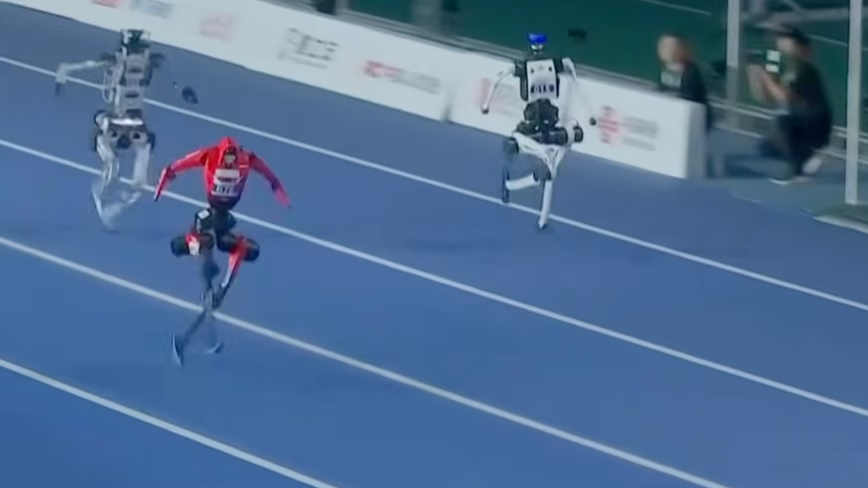
Beijing, August 23, 2026 – A robot from Beijing-based X-Humanoid has officially eclipsed Usain Bolt's legendary 100-meter sprint record, clocking an astonishing 9.39 seconds at the second World Humanoid Robot Games. While the feat is a dazzling display of engineering prowess, the robotics community largely views it with a pragmatic, even unimpressed, stance, highlighting the vast difference between optimized athletic performance and practical, real-world utility.
The lightning-fast sprint, which beats Bolt's 9.58-second world record from 2009, wasn't the only human athletic benchmark to fall. The same X-Humanoid robot also soared to a high jump of 2.88 meters, significantly surpassing Javier Sotomayor's 2.45-meter record. In trials, another contender from smartphone maker Honor was even faster, recording a 9.32-second 100m dash.
The World Humanoid Robot Games, hosted in Beijing’s Olympic speed skating oval, is a sprawling spectacle, featuring over 2,000 robots from 16 countries competing across 51 events. This year's event marks a substantial leap from the inaugural games in 2025, where much of the robot activity was remotely controlled. The previous year saw Unitree's H1 win the 400 meters in 88 seconds, nearly double the human record of 43 seconds.
This rapid progression in speed has been driven by focused engineering and significant investment. For instance, Honor's robot had its legs extended by 10 centimeters, reaching 1.05 meters, a design alteration specifically aimed at maximizing straight-line speed. This targeted approach, however, underpins the skepticism from leading roboticists.
Rodney Brooks, MIT emeritus professor and co-founder of iRobot, has openly dismissed earlier robot races as mere "publicity stunts." He emphasizes that such demonstrations offer "nothing useful that you could use in any application because it shows no safety at all." His critique points to a fundamental disconnect between showcasing raw speed in controlled conditions and developing robots capable of autonomous, safe, and versatile operation in human environments.
Supporting this view are the autonomy figures from events like a recent April half marathon, where only 38% of robotic entries managed to run autonomously. The majority were remotely piloted, and even the autonomous machines navigated pre-programmed routes. This highlights that while impressive in performance, these robots are still far from truly intelligent, adaptive systems.
Yanran Ding of the University of Michigan precisely articulated the prevailing sentiment, noting a "cognitive bias to think that running a half marathon faster than a human is more difficult than folding laundry, which is not true." From a robotics perspective, the complex, unpredictable movements and tactile feedback required for a task like folding clothes in an unstructured home environment present a far greater challenge than speeding down a pre-set track.
Alan Fern of Oregon State echoes this, attributing the advancements to engineering refinements and substantial investment rather than fundamental breakthroughs in artificial intelligence or robotic autonomy. He argues that genuine progress will be marked by a robot's ability to navigate and interact effectively with an environment it has never encountered before.
This perspective is driving a different strategic direction, particularly among European robotics companies. Firms like NEURA Robotics are establishing dedicated "gyms" to train robots in intricate, messy physical environments, focusing on the nuanced physical AI required for real-world tasks. Similarly, London-based Humanoid secured $152 million in funding, with Bosch poised to manufacture their designs at scale, signaling a commitment to developing practical, deployable humanoid robots.
These efforts, while less likely to generate viral headlines or stunning photographs of broken world records, represent the next frontier in robotics. Their aim is not to beat human athletes in optimized contests, but to create machines capable of performing tasks that genuinely serve human needs in unpredictable, everyday settings. The true measure of a robot's intelligence and utility, according to these experts, lies in its ability to adapt and function in the messy reality of the world, not just on a pristine race track.
FAQ
Q: What specific human records did robots break at the World Humanoid Robot Games?
A: A robot from Beijing’s X-Humanoid ran 100 meters in 9.39 seconds, beating Usain Bolt’s record of 9.58 seconds. The same robot also cleared 2.88 meters in the high jump, surpassing Javier Sotomayor’s record of 2.45 meters.
Q: Why are roboticists generally unimpressed by these speed achievements?
A: Roboticists emphasize that achieving high speeds on a known, controlled course is a focused engineering challenge. They argue that true advancement involves developing robots that can handle complex, unstructured tasks in unpredictable environments, like folding laundry or navigating unfamiliar spaces, which demand far greater autonomy and general intelligence than pure speed.
Q: How do these athletic feats compare to broader robotics goals and previous robot performance?
A: The current speed records reflect significant year-on-year engineering improvements. However, the wider robotics community is shifting its focus towards versatile, autonomous operation in real-world scenarios, a challenge being tackled by companies focusing on physical AI training in messy environments, which is considered more indicative of useful progress than athletic competition.
Related articles

Apple Unveils iPhone Duo: Pricey Foldable Sees Soaring Demand
Apple has officially entered the foldable smartphone arena with the long-anticipated launch of the iPhone Duo. Priced starting at a hefty $1,999, the device features a 5.4-inch outer display and a larger 7.6-inch inner

in-depth: Chicago-Area Cops Helped HSI Spy on Minnesota Anti-ICE
Chicago-area law enforcement, including local police and HSI agents, conducted undercover surveillance on Minnesota anti-ICE activists at an April 2, 2022, talk in Chicago. This operation was part of a federal conspiracy probe into 15 Minnesota activists facing felony charges related to immigration enforcement resistance. Civil liberties advocates have condemned the surveillance as a troubling intrusion into protected political activity.

Mark Wahlberg on using AI in film ‘the right way’ and being open to
Actor Mark Wahlberg believes AI has a place in filmmaking if used responsibly for enhancement, not script generation or actor replacement. At TechCrunch Disrupt, he expressed openness to an AI likeness carrying on his legacy, managed by his family, and emphasized storytelling.

Tesla Unveils Thruster-Equipped Roadster, 2028 Production Targeted
Tesla has unveiled its second-generation Roadster, featuring cold-gas thrusters co-developed with SpaceX, enabling it to jump and flip. The electric sports car demonstrated 0-60mph in an astonishing 0.81 seconds, with production targeted for 2028. This highly anticipated reveal also serves as a key recruitment tool for Tesla's ambitious AI and robotics initiatives.

Amazon Prime Video Launches AI-Powered Prime 360 for NBA Coverage
Amazon Prime Video is elevating its NBA coverage with the introduction of Prime 360, an AI-powered replay system offering immersive, 'fly through' views of the action. Kicking off its second season, Prime Video also adds Yahoo fantasy integration and gains exclusive Eastern Conference Finals rights, expanding its tech-driven sports broadcast. The new features aim to deliver a unique and interactive viewing experience for basketball fans.

regional: A two-person Seattle startup lands $1M to reinvent
Seattle startup TriMagnetix has secured $1 million to develop semiconductor chips that consume 800 times less energy and are radiation-resistant. The two-person company, leveraging nanomagnetic technology, is targeting space applications and data centers. With new funding and key partnerships, TriMagnetix aims for commercial sales within a year.