
Star Wars: Galactic Racer's Secret Sauce: A Triple-A Hit From a Tiny
When you think of a new Star Wars game, especially one hitting a stellar Metacritic score of 88, you probably picture a massive studio with hundreds, if not thousands, of developers burning the midnight oil. But for
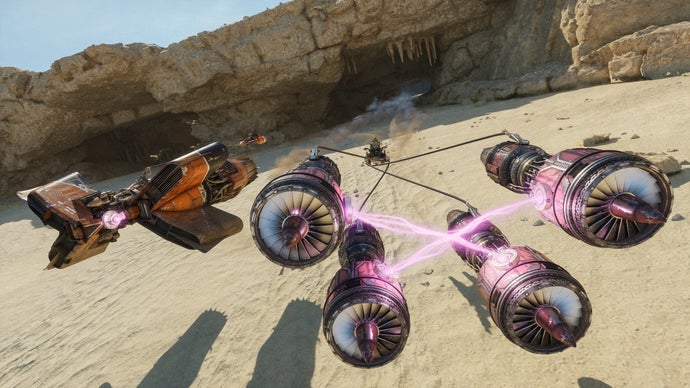
When you think of a new Star Wars game, especially one hitting a stellar Metacritic score of 88, you probably picture a massive studio with hundreds, if not thousands, of developers burning the midnight oil. But for Fuse Games' recently launched Star Wars: Galactic Racer, that couldn't be further from the truth. This innovative roguelike racer, published by the newly independent Secret Mode, has delighted critics and players alike, all while being built by a core team that typically stayed well under 75 people.
Fuse Games CEO Matt Webster is understandably "thrilled" with the reception, noting that while they felt they had something special, you "never really know" how it will land. Though sales figures are still rolling in, the audience's openness to innovation has been a huge win for the team.
Revving Up Innovation in a Galaxy Far, Far Away
Star Wars: Galactic Racer isn't just another sci-fi kart racer; it's a bold departure from genre conventions. Webster points out that traditional racing games are almost solely focused on winning. Galactic Racer, however, embraces a roguelike structure, meaning a "hard fought eighth place finish feels great." This innovative approach resonated with players, even those new to roguelikes, teaching them about learning from failure and coming back stronger – a powerful metaphor, Webster muses, for modern life itself.
The game also takes an unexpected turn by telling a sports story within the vast Star Wars universe. Inspired heavily by the Netflix series Drive to Survive, Fuse Games aimed to capture the intrigue and rivalries both on and off the track. The "paddock" areas in Galactic Racer are crucial for immersing players in the Star Wars lore and interacting with characters, but they also serve a vital gameplay purpose: providing a lower-intensity space to offset the high-octane racing. It's all about that light and shade, that ebb and flow, making the intense moments feel even more impactful.
The Distributed Development Advantage
So, how did Fuse Games deliver a critically acclaimed Star Wars experience with such a lean core team? The answer lies in their "distributed development" model. Instead of swelling to hundreds of employees, a common practice for AAA titles that often leads to painful layoffs and significant knowledge loss, Fuse committed to keeping their central team small and agile from the outset.
Webster's philosophy is clear: "When you shrink, there's a personal impact to people, but you also lose an incredible amount of knowledge, which I think is probably way more expensive to retrieve." By leveraging external partners, Fuse could scale its capabilities and capacity without the boom-and-bust cycle that plagues much of the industry. The goal was to operate at a "Premier League level" of quality and ambition, but with a sustainable, knowledge-retaining structure.
Three Tiers to Premier League Power
Fuse Games' distributed development isn't a single, monolithic approach; it’s a carefully structured three-tier system, each with varying levels of integration with the core team:
-
Traditional Outsourcing: This is the furthest tier, typically involving partners in "lower cost locations" for tasks like creating art assets. While transactional by nature, Webster emphasizes the importance of building strong relationships for better results. Think of it as specialized support for specific content creation needs.
-
External Development: One step closer, this tier involves handing a self-contained piece of work to an outside studio. A perfect example is Galactic Racer's photo mode. Because the game runs on Unreal Engine, features like this can be developed by a cross-discipline team (production, art, UI, code) externally and then smoothly integrated into the main game. It's about offloading complete, defined modules.
-
Co-development: This is the most deeply integrated tier. These partners are, in Webster's words, "to all intents and purposes, an extension of our team." They're in the daily stand-ups, Slack channels, and even the core codebase. This level of collaboration requires high-frequency communication, which is why Fuse specifically chose UK-based studios, ensuring they shared the same time zone.
The Crucial Co-Development Connection
Selecting co-development partners isn't just about technical skill; it's about cultural fit. Fuse Games meticulously chose studios that aligned with their five core values: a love of games, collaboration, iteration, being clear/kind/responsible, and curiosity. These aren't just buzzwords on a website; they are guiding principles that foster a healthy, productive working environment.
The UK, Webster notes, is particularly well-suited for co-development due to its "broad range of experience" and diverse studios. He also highlights a significant shift in recent years: co-development is now often seen as a desirable path for studios. With games taking so long to make, a co-dev role offers welcome variety, preventing teams from being stuck on a single project for years.
A Sustainable Future, But Not Without Effort
While the distributed development model has proven incredibly successful for Galactic Racer, Webster offers a vital piece of advice: "You can't just take this model and apply it. You've got to configure your studio with it from the start." It demands extensive planning, preparation, and robust management, as "every additional partner has a disproportionately higher load on you." It's a strategic commitment from day one, not an afterthought.
Beyond the Starting Grid
For Fuse Games, the launch of Galactic Racer isn't the finish line; it's just the beginning. The team has already released four patches since launch, constantly listening to audience feedback to refine and improve the game. Webster emphasizes that "the launch is the beginning," and they'll remain in a flexible, adaptable mode for a while, prioritizing updates based on what players are telling them.
Star Wars: Galactic Racer stands as a testament to what's possible when innovation extends beyond gameplay and into the very fabric of game development. Fuse Games has delivered a beloved Star Wars experience, proving that a focused, sustainable core team, empowered by smart partnerships, can indeed punch far above its weight. It's a fascinating blueprint for the future of game creation.
FAQ
Q: What exactly is Fuse Games' "distributed development" model?
A: It's a three-tiered approach to game development that keeps the core team small (under 75 people) by strategically partnering with external studios for various tasks, from art assets (outsourcing) to self-contained features (external development) and even deeply integrated team extensions (co-development). The goal is sustainability and retaining knowledge.
Q: How does Star Wars: Galactic Racer innovate on traditional racing games?
A: Galactic Racer features a roguelike structure where even a lower-place finish can feel rewarding, emphasizing learning from failure. It also blends high-intensity racing with narrative-driven "paddock" sections, inspired by Drive to Survive, to offer a more varied pace and immerse players in a sports story set in the Star Wars universe.
Q: What makes this development model sustainable for a studio?
A: By avoiding the need to hire and fire hundreds of staff for each project, Fuse Games prevents the loss of institutional knowledge and the personal impact of layoffs. It allows them to maintain a consistent, high-caliber core team while scaling capacity through trusted external partners, leading to a more stable and efficient long-term operation.
Related articles

Apple Unveils iPhone Duo: Pricey Foldable Sees Soaring Demand
Apple has officially entered the foldable smartphone arena with the long-anticipated launch of the iPhone Duo. Priced starting at a hefty $1,999, the device features a 5.4-inch outer display and a larger 7.6-inch inner

"thegentlemanpervert": A Catastrophic Failure in Digital Ethics and
"thegentlemanpervert" review: An AI CSAM production and distribution operation, led by a NJ prosecutor, proved to be an absolute and catastrophic failure, resulting in felony charges and a stark warning about digital culpability.

TCG Pocket Responds: A Much-Needed Pace Shift for Pokémon Fans
Pokémon TCG Pocket is rolling out a major update for its second anniversary, primarily addressing player concerns about overwhelming content releases by shifting to a six-week set schedule. This aims to curb player decline and improve overall engagement by giving trainers more time to collect and strategize. The update also adds new collection methods, improved deck-building features, and enhanced trading functionality.

regional: A two-person Seattle startup lands $1M to reinvent
Seattle startup TriMagnetix has secured $1 million to develop semiconductor chips that consume 800 times less energy and are radiation-resistant. The two-person company, leveraging nanomagnetic technology, is targeting space applications and data centers. With new funding and key partnerships, TriMagnetix aims for commercial sales within a year.

Kojima Compares Divisive New Film 'Digger' to MGS2's Prescient Vision
Gaming icon Hideo Kojima has praised the divisive 2026 film *Digger*, drawing intriguing parallels to his own prophetic game, *Metal Gear Solid 2*. Both works, he explains, uniquely explore the dangers of misinformation and a fragmented digital reality, anxieties he shares with *Digger*'s director, Alejandro González Iñárritu.

Ubisoft Proposes German Studio Workforce Reduction Amidst
Ubisoft is planning a voluntary departure program for about 100 employees across its Düsseldorf, Berlin, and Mainz studios in Germany. This move is part of a larger, ongoing cost-reduction and restructuring effort by the publisher, aiming to better position its studios for future projects.