
ScuffedBits AA Battery PC Experiment Review: A Fascinating, Yet
Quick Verdict ScuffedBits' YouTube experiment to power a desktop PC with 56 AA batteries is less a practical power solution and more a compelling, iterative masterclass in the immense challenges of power delivery for
Quick Verdict
ScuffedBits' YouTube experiment to power a desktop PC with 56 AA batteries is less a practical power solution and more a compelling, iterative masterclass in the immense challenges of power delivery for modern computing hardware. While ultimately achieving its highly modest goal of running Minesweeper for a few minutes, it unequivocally demonstrates why specialized, power-dense Lithium-based batteries are indispensable for any form of portable or off-grid computing. This is a brilliant educational piece, not a blueprint for your next power setup.
The Experiment Unpacked: Key Specs and Setup
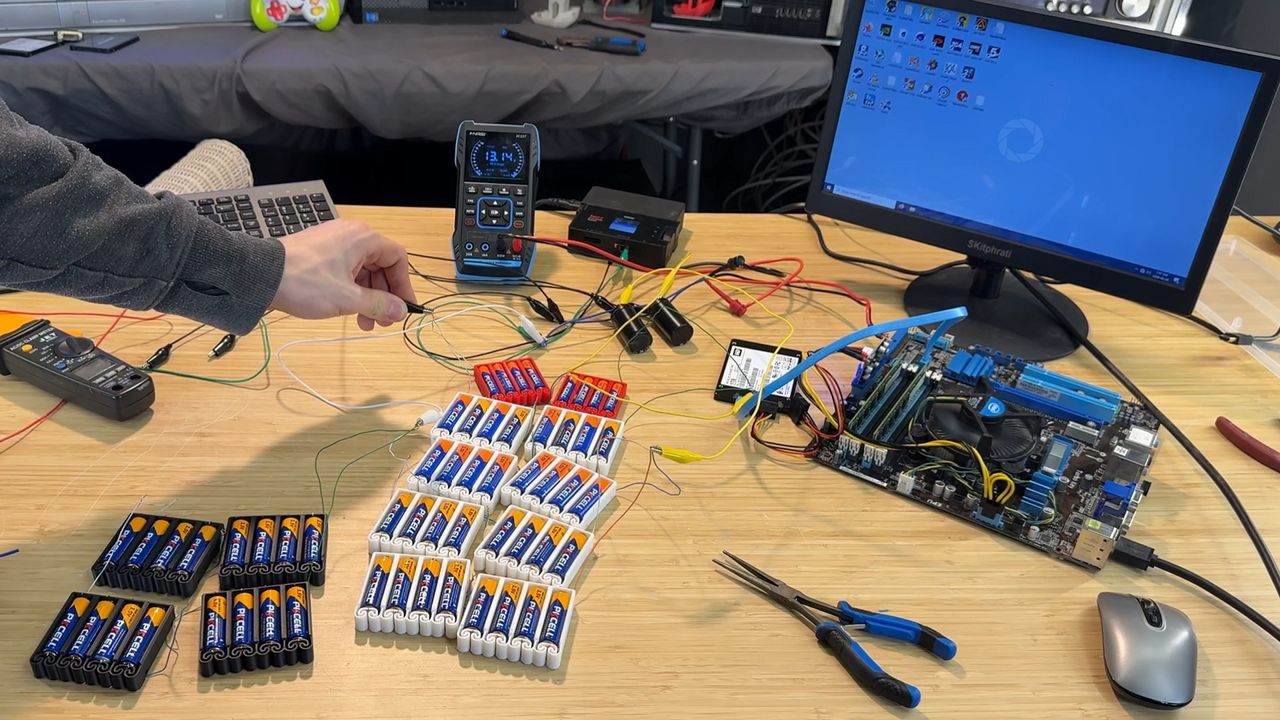
At its core, this ambitious project sought to answer a seemingly simple question: Can a standard desktop PC be powered by an array of common AA batteries? YouTube creator ScuffedBits embarked on this journey, ditching the conventional 450-watt CX430 power supply for an AliExpress ATX power supply plug designed to draw 12V from external sources. The test machine itself was an entry-level Intel CPU, accompanied by two RAM sticks and a 2.5-inch SATA SSD, running Windows 10. There were plans to incorporate a GPU later, adding another layer of complexity to the power demands.
The journey to even get the system to light up was fraught with challenges. Initially, knowing that AA batteries are 1.5 volts, ScuffedBits connected 8 cells in series to achieve the required 12 volts. Unsurprisingly, this proved insufficient, with a measured draw of only 0.06 amps and the system failing to boot beyond a brief fan spin. Scaling up, two more 8-battery packs were added in parallel, but the PC remained dormant.
Undeterred, the creator switched from carbon-zinc to alkaline batteries, known for their higher current output and longer lifespan. While an improvement, the system still only managed to turn on for a few seconds before succumbing to power starvation. The root cause was identified as the thin wiring, incapable of handling the sudden voltage spikes and current demands of a PC during startup. Addressing this, ScuffedBits implemented critical modifications: two large capacitors were integrated as power buffers, and multiple wires were used to ensure robust current delivery. This iterative process culminated in the final configuration: a whopping 56 alkaline AA batteries providing the necessary juice. A slight 'cheat' was also employed, where the PC was initially booted using an external power supply, with the AA battery system only taking over once the operating system and applications were running.
User Experience & Performance: A Marathon of Minutes
The 'user experience' of running a PC off AA batteries is, charitably, one of extreme patience and incredibly brief triumphs. With the refined 56-battery setup, the PC did manage to run on battery power alone. However, the performance metrics paint a stark picture:
- Launching Steam: A power-intensive task, it caused the PC to shut off after a mere 52 seconds.
- A Short Hike: A relatively modest game, it managed only 5 seconds of runtime before the system died.
- Minesweeper (Easy): Lowering the bar significantly, ScuffedBits finally achieved a full round on easy difficulty, lasting 4 minutes and 35 seconds, with the batteries expiring precisely as the round concluded.
Seeking to fully immerse in the AA-powered Minesweeper experience, the LED monitor's power supply was also swapped for eight rechargeable AA batteries. This particular attempt saw a reduced runtime of 2 minutes and 14 seconds, likely due to using previously depleted batteries. The wireless mouse and keyboard, already running on AAs, seamlessly integrated into this unique setup.
In a final, surprising twist, a GPU was installed to run Minesweeper in full-screen. Despite the increased power demands, the system astonishingly lasted for approximately nine seconds on battery power alone. This brief flicker of 'gaming' with a dedicated GPU on AA batteries was perhaps the most unexpected result.
Pros and Cons
Pros:
- Educational Value: Superbly illustrates the complex power demands of PC components and the challenges of current delivery.
- Demonstrates Battery Technology Evolution: Inadvertently highlights how far modern battery tech has advanced in power density and efficiency for other devices.
- Entertaining & Engaging: The iterative problem-solving and eventual, albeit brief, success make for compelling viewing.
- Ingenious Engineering: The creator's persistence in debugging and overcoming electrical challenges is commendable.
Cons:
- Extremely Impractical: Absolutely not a viable power solution for any real-world PC use.
- Abysmal Battery Life: Runtimes are measured in seconds or very few minutes, rendering it useless for productivity or sustained gaming.
- Complex and Unreliable Setup: Requires significant modification, extensive wiring, and external assistance to even boot.
- Inefficient: The sheer number of batteries required for such minimal output is highly inefficient.
- Cost: While not explicitly stated, continually replacing 56 alkaline AAs would be prohibitively expensive.
The Bigger Picture: Comparing to Modern Solutions
This experiment, while fascinating in its own right, serves as a powerful contrast to modern portable computing solutions. It underscores the incredible engineering achievements in power efficiency that allow today's devices to run for hours on compact, high-density batteries.
| Feature | AA Battery Desktop Experiment | Modern Gaming Laptop | Efficient Laptop (Snapdragon/Apple) |
|---|---|---|---|
| Power Source | 56x 1.5V Alkaline AA | Integrated Li-ion | Integrated Li-ion |
| Runtime (Gaming) | 5 seconds - 4.5 minutes | Several hours | Many hours (for applicable tasks) |
| Portability | Cumbersome, complex setup | High | Very High |
| Power Density | Very Low | High | Very High |
| Practicality | Experimental only | High | Very High |
The stark difference highlights why contemporary gaming laptops can offer hours of gameplay on their power-dense Lithium-based batteries, and why highly efficient Snapdragon or Apple Silicon devices promise all-day battery life. The suggestion from commenters to re-attempt the experiment with laptop components or these efficient platforms is highly pertinent, as it would likely yield vastly superior runtimes, albeit still a far cry from integrated solutions.
Buying Recommendation
Do not, under any circumstances, attempt to replicate this setup as a practical means to power your desktop PC. This is not a product or a viable solution; it is a captivating scientific and engineering experiment. Its value lies purely in its educational insights into electrical engineering, power delivery, and the stark contrast between antiquated power methods and modern battery technology. If you're an enthusiast interested in understanding power dynamics and the ingenuity required to overcome seemingly impossible challenges, then following ScuffedBits' work is highly recommended.
FAQ
Q: Can I really power my gaming PC with AA batteries?
A: No, not practically. This experiment clearly demonstrates the immense challenges and extremely limited runtime (minutes at best) you would achieve, making it completely impractical for any real-world use.
Q: What did this experiment teach us?
A: It provided a vivid illustration of the high power demands of desktop PC components, the complexity of stable power delivery, and highlighted the significant advancements in power efficiency and battery technology found in modern portable devices compared to traditional AA cells.
Q: Are there better ways to run a PC off-grid or on battery power?
A: Absolutely. For off-grid desktop power, large portable power stations or car batteries with appropriate inverters are far more practical. For portable computing, dedicated gaming laptops or highly efficient devices built with laptop components (like those running Snapdragon or Apple Silicon) are designed for extended battery life and vastly superior performance.
Related articles
Android 17 QPR2 Beta 7.1: The Performance Relief You've Been Waiting
Android 17 QPR2 Beta 7.1: Finally Fixing the QPR1 Performance Woes Verdict: Android 17 QPR2 Beta 7.1 is a crucial and highly anticipated software update for Google Pixel users, specifically targeting and resolving the

DJI Solo Video Setups: Smart Choices for Lone Creators
This review delves into DJI's recommended solo video setups, highlighting the Osmo Pocket 3 Creator Combo as a top pick for its integrated camera, gimbal, and mic. It also covers stabilizers like the Osmo Mobile 8 and RS 4, and the DJI Mic Mini series for enhanced audio, providing honest pros, cons, and clear buying advice.

Ars Technica's Rocket Report: Your Essential Space Industry Briefing
Quick Verdict Ars Technica's Rocket Report, presented by veteran space reporter Stephen Clark, offers an invaluable and meticulously organized weekly (or similar frequency, implied by "Edition 9.15") digest of the most

Apple iPhone Duo: A Daring Debut with Notable Compromises
Apple's highly anticipated iPhone Duo, priced at $2,000, has gone on pre-order. While hailed as "Apple's most exciting device in a decade" for its innovative foldable design and immersive display, it comes with significant drawbacks like the absence of FaceID and a premium camera.
KDE Plasma 6.8: A Future-Focused 30th Anniversary Update
Quick Verdict KDE Plasma 6.8, arriving as the "30th Anniversary Edition," is a pivotal release that decisively pushes the desktop environment into the future. With a definitive farewell to native X11 sessions and a

Ephemeral PR Preview Environments on GKE: A Deep Dive
Every development team eventually grapples with the limitations of shared staging environments. The familiar scenario: multiple features deployed simultaneously, database migrations clashing, and the phrase "it works on