
Overland AI Unveils IBEX, Marine Corps Selects Autonomous Vehicle
Seattle-based Overland AI has unveiled IBEX, a new fully autonomous ground vehicle chosen by the U.S. Marine Corps for critical missions like counter-drone defense and resupply. Built on a Polaris MRZR chassis, IBEX can carry 2,000 pounds and operates autonomously at speeds over 35 mph using proprietary software.
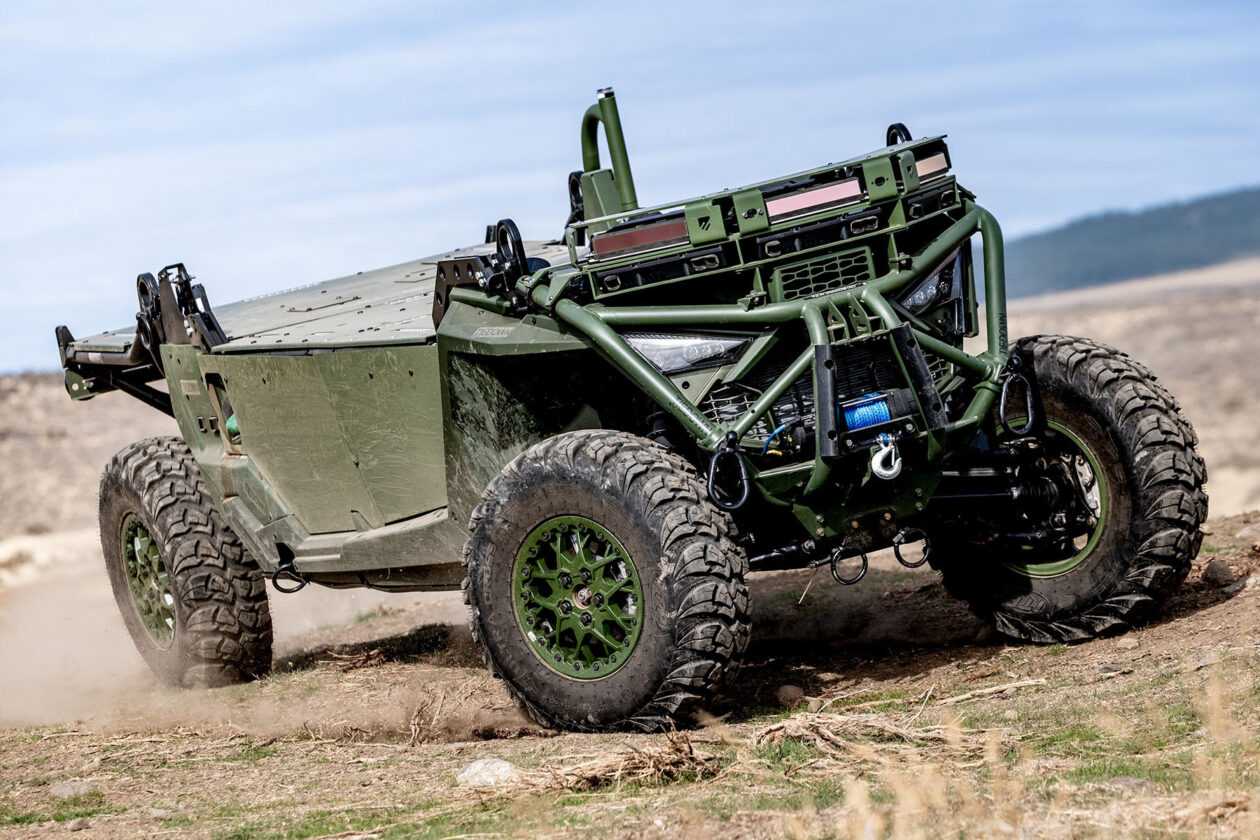
Seattle, WA – Overland AI, a rapidly growing defense startup, today announced the public unveiling of IBEX, its latest fully autonomous ground vehicle. This cutting-edge platform has been officially selected by the U.S. Marine Corps to bolster counter-drone air defense operations and take on critical, high-risk missions such as resupply, breaching, and electronic warfare on the front lines. The announcement marks a significant milestone, solidifying the company's position as a key innovator in military autonomy.
A Strategic Partnership for Military Autonomy
The development of IBEX was supported by a Department of War APFIT production contract, which recently saw its funding expand to $25 million, including additional support for the Army’s 75th Ranger Regiment. This initial $20 million deal was historic, making Overland AI the first ground autonomy startup to serve as a primary defense hardware supplier. The Marine Corps plans to integrate the IBEX platform into its advanced Marine Air Defense Integrated System (MADIS), enhancing operational capabilities.
Robust Design for Challenging Environments
Built upon the robust Polaris MRZR chassis, engine, and drivetrain, IBEX leverages a proven foundation already widely utilized and maintained across the armed forces. This ultra-light utility vehicle variant is engineered to carry a substantial 2,000-pound payload and can achieve fully autonomous speeds exceeding 35 mph. With a cruising range of 250 miles at 20 mph, the IBEX is also designed for tactical air transport, compact enough to fit inside a V-22 Osprey.
Advanced Autonomy Without GPS Reliance
At the heart of IBEX's advanced capabilities is Overland AI’s proprietary OverDrive software stack. This innovative system employs real-time terrain perception and adaptive route planning, enabling the vehicle to navigate complex, off-road environments swiftly and efficiently without dependence on GPS signals or pre-mapped routes. Furthermore, operators can command multiple uncrewed vehicles simultaneously using OverWatch, the company's intuitive command-and-control software, streamlining battlefield management.
Empowering Frontline Operations
To support its demanding missions, IBEX provides 5 kW of export power, essential for operating onboard sensors and crucial defense systems, thereby overcoming typical energy limitations in forward field deployments. Overland AI designed each vehicle to function as a self-contained power, communications, and compute node, capable of operating independently even in environments with limited or disrupted communication infrastructure. This inherent resilience ensures mission continuity in challenging scenarios.
"We pride ourselves on developing technology that is informed directly by the warfighter," stated Greg Okopal, co-founder and chief operating officer of Overland AI. He emphasized that IBEX is designed for immediate deployment and can be maintained using existing parts and fuel units already available to military personnel, minimizing logistical burdens. IBEX now stands alongside the company's existing flagship platform, ULTRA, as Overland AI continues to scale production at its Seattle manufacturing facility to meet the escalating military demand for autonomous ground systems.
Rapid Growth in the Defense Tech Landscape
Founded in 2022 as a spinout from the University of Washington, Overland AI has quickly risen as a prominent defense technology player, securing over $140 million in venture funding to date, including a significant $100 million Series B round earlier this year. The startup, recognized as No. 7 on the GeekWire 200 index of the Pacific Northwest’s top startups, is a testament to its rapid growth. In 2025, the company opened a 22,000-square-foot production facility in Seattle's Rainier Beach neighborhood, further expanding its manufacturing footprint. This summer, it established an engineering outpost in Burlingame, California, strategically tapping into the Bay Area's deep pool of robotics and autonomy talent.
Seattle's Emerging Defense Tech Hub
Overland AI's expansion is indicative of a broader defense technology boom sweeping across the Seattle region. The area is becoming a hub for both established firms and burgeoning startups that are developing significant hardware and software solutions for defense. Noteworthy examples include Shield AI, which is building a massive manufacturing facility in the Seattle area for its autonomous X-BAT fighter jet; Anduril, aiming for 1,000 engineers across its Bellevue and Seattle hubs; and Echodyne, which launched a $40 million radar factory in Woodinville to address the growing demand for drone detection technologies. This robust ecosystem underscores the region's increasing importance in national security innovation.
FAQ
Q: What is the primary mission of the IBEX autonomous vehicle?
A: IBEX is designed to support the U.S. Marine Corps in crucial frontline operations, including counter-drone air defense, resupply missions, breaching operations, and electronic warfare, particularly in high-risk environments.
Q: What are the key technical specifications of the IBEX vehicle?
A: Built on a Polaris MRZR chassis, IBEX can carry a 2,000-pound payload, reach autonomous speeds over 35 mph, and has a 250-mile cruising range at 20 mph. It's air-transportable by a V-22 Osprey and provides 5 kW of export power.
Q: How does Overland AI's technology contribute to military readiness?
A: Overland AI's OverDrive software enables IBEX to navigate complex off-road terrain without GPS, making it adaptable to diverse environments. Its design for day-one deployment using existing military parts and fuel, coupled with its ability to operate independently, enhances logistical efficiency and operational resilience for warfighters.
Related articles

Apple Unveils iPhone Duo: Pricey Foldable Sees Soaring Demand
Apple has officially entered the foldable smartphone arena with the long-anticipated launch of the iPhone Duo. Priced starting at a hefty $1,999, the device features a 5.4-inch outer display and a larger 7.6-inch inner

in-depth: Chicago-Area Cops Helped HSI Spy on Minnesota Anti-ICE
Chicago-area law enforcement, including local police and HSI agents, conducted undercover surveillance on Minnesota anti-ICE activists at an April 2, 2022, talk in Chicago. This operation was part of a federal conspiracy probe into 15 Minnesota activists facing felony charges related to immigration enforcement resistance. Civil liberties advocates have condemned the surveillance as a troubling intrusion into protected political activity.

Mark Wahlberg on using AI in film ‘the right way’ and being open to
Actor Mark Wahlberg believes AI has a place in filmmaking if used responsibly for enhancement, not script generation or actor replacement. At TechCrunch Disrupt, he expressed openness to an AI likeness carrying on his legacy, managed by his family, and emphasized storytelling.

Tesla Unveils Thruster-Equipped Roadster, 2028 Production Targeted
Tesla has unveiled its second-generation Roadster, featuring cold-gas thrusters co-developed with SpaceX, enabling it to jump and flip. The electric sports car demonstrated 0-60mph in an astonishing 0.81 seconds, with production targeted for 2028. This highly anticipated reveal also serves as a key recruitment tool for Tesla's ambitious AI and robotics initiatives.

Amazon Prime Video Launches AI-Powered Prime 360 for NBA Coverage
Amazon Prime Video is elevating its NBA coverage with the introduction of Prime 360, an AI-powered replay system offering immersive, 'fly through' views of the action. Kicking off its second season, Prime Video also adds Yahoo fantasy integration and gains exclusive Eastern Conference Finals rights, expanding its tech-driven sports broadcast. The new features aim to deliver a unique and interactive viewing experience for basketball fans.

regional: A two-person Seattle startup lands $1M to reinvent
Seattle startup TriMagnetix has secured $1 million to develop semiconductor chips that consume 800 times less energy and are radiation-resistant. The two-person company, leveraging nanomagnetic technology, is targeting space applications and data centers. With new funding and key partnerships, TriMagnetix aims for commercial sales within a year.