
Learningto/Pass: Free, AI-Powered Interview Prep for Developers
Landing a role at a top-tier tech company often hinges on mastering complex data structures and algorithms, coupled with a solid grasp of system design. The problem for many aspiring software developers is that quality
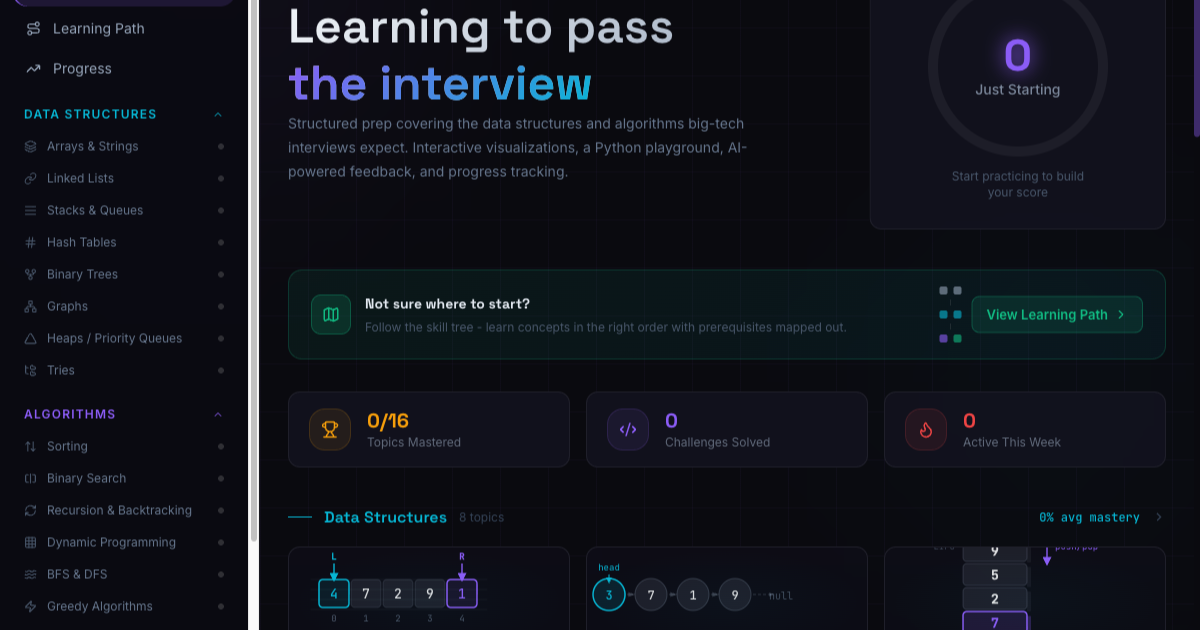
Landing a role at a top-tier tech company often hinges on mastering complex data structures and algorithms, coupled with a solid grasp of system design. The problem for many aspiring software developers is that quality interview preparation, whether through bootcamps, premium platforms, or private tutoring, can be prohibitively expensive. This financial barrier can unfairly exclude talented individuals from opportunities, creating a significant hurdle for those looking to break into or advance within big tech.
Enter learningto/pass, a new, entirely free online platform designed to democratize access to high-quality interview preparation. Born from the developer's own experience of not being able to afford paid alternatives, this tool offers a structured, interactive, and AI-powered learning environment to help engineers prepare for roles like Google L4-L6, all without a price tag or even requiring a signup.
A Comprehensive, Structured Learning Path
learningto/pass addresses the common challenge of knowing what to study and in what order. The platform features a well-defined "Learning Path" or "skill tree" that maps out prerequisites, ensuring learners build foundational knowledge before tackling more advanced concepts. This structured approach is crucial for efficient and effective preparation, guiding users through essential topics in a logical progression.
The curriculum is meticulously curated to cover the core data structures and algorithms typically expected in big-tech interviews. It's broken down into three main categories:
Data Structures
The platform covers eight fundamental data structures, each presented with typical time and space complexity insights:
- Arrays & Strings: Average O(n) space O(1).
- Linked Lists: Average O(n) space O(1).
- Stacks & Queues: Average O(1) space O(n).
- Hash Tables: Average O(1) space O(n).
- Binary Trees: Average O(log n) space O(h).
- Graphs: Average O(V + E) space O(V + E).
- Heaps / Priority Queues: Average O(log n) space O(n).
- Tries: Average O(m) space O(n * m).
Each data structure topic includes specific challenges (e.g., Arrays & Strings has 3, Linked Lists has 2), allowing users to immediately apply what they've learned.
Algorithms
Six critical algorithmic paradigms are explored, complete with their average time and space complexities:
- Sorting: Average O(n log n) space O(log n).
- Binary Search: Average O(log n) space O(1).
- Recursion & Backtracking: Average O(2^n) space O(n).
- Dynamic Programming: Average O(n^2) space O(n).
- BFS & DFS: Average O(V + E) space O(V).
- Greedy Algorithms: Average O(n log n) space O(1).
These algorithms are often the backbone of complex problem-solving in interviews, and the platform provides challenges to solidify understanding.
Concepts
Beyond core implementations, learningto/pass also delves into two essential theoretical concepts:
- Big-O Notation: The cornerstone of algorithm analysis.
- System Design Basics: Critical for senior-level interviews.
Interactive Learning with AI-Powered Feedback
A standout feature of learningto/pass is its interactive learning environment. Users can solve real Google interview questions directly in a browser-based Python playground. The platform emphasizes "Real Python, real tests - it all runs in your browser," providing an authentic coding experience without requiring local setup.
Crucially, it offers AI-powered feedback. This feature can provide personalized insights and guidance, helping users understand not just if their code works, but why it works or fails, and how to optimize it. This level of personalized assistance is often found in expensive premium offerings, making its inclusion here particularly valuable. Interactive visualizations further enhance understanding of abstract concepts, making complex algorithms easier to grasp.
Progress Tracking and Accessibility
Despite being a free, no-signup platform, learningto/pass includes progress tracking. Users can save their progress, monitoring their "Interview Ready" score, the number of topics mastered, and challenges solved. This gamified approach encourages consistent learning and provides a clear overview of one's preparation journey.
The platform's commitment to accessibility is evident in its "Try it now - no signup" policy, allowing immediate engagement. While the platform is optimized for larger screens (laptops or desktops) to best utilize the code editor and visualizations, its core content is readily available to anyone with an internet connection.
Practical Takeaways for Developers
For any developer aiming for a role at a major tech company, or simply looking to sharpen their DSA skills, learningto/pass presents a compelling, no-cost solution. Its structured curriculum, interactive coding environment, and AI-driven feedback remove significant barriers to entry for quality interview preparation. The focus on typical big-tech interview content, combined with explicit complexity analysis for each topic, makes it a highly relevant and practical tool for self-study. It's a testament to the power of community and open-source principles, offering a powerful alternative to expensive paid platforms.
FAQ
Q: What technologies enable the in-browser Python playground and AI-powered feedback?
A: The source content indicates that "Real Python, real tests - it all runs in your browser." This suggests the use of client-side execution environments, likely employing WebAssembly (e.g., Pyodide for Python) for running code directly in the browser. The AI-powered feedback would typically involve integrating with a language model API (e.g., OpenAI, Google Gemini) which processes user code and provides targeted analysis.
Q: How does learningto/pass track progress if no signup is required?
A: The platform states users can "Save your progress" without needing an account. This is typically achieved using local browser storage mechanisms like localStorage or IndexedDB. These technologies allow the website to store user-specific data on their local machine, which persists across sessions for that specific browser on that device.
Q: Is the "Google L4-L6 Prep" designation indicative of official endorsement or a specific curriculum alignment?
A: The designation "Google L4-L6 Prep" refers to the typical scope and depth of data structures and algorithms knowledge expected for mid-to-senior level software engineering roles at companies like Google. It indicates that the platform's curriculum is aligned with the common interview standards for these levels, not an official endorsement or direct partnership with Google.
Related articles

Nscale Adds Former OpenAI Exec Fidji Simo to Board Ahead of IPO
Nscale, the U.K.-based AI data center startup, has appointed former OpenAI, Meta, and Instacart executive Fidji Simo to its board of directors. This high-profile addition comes as Nscale prepares for a potential IPO this fall, leveraging Simo's extensive experience in scaling major tech platforms and guiding a company through a successful public offering.

AI's Impact on Malware Detection: Next-Gen Protection Deep Dive
The landscape of cybersecurity has transformed dramatically. Gone are the days when a simple virus attached itself to a file, easily quarantined by an antivirus scanner. Today, malware is sophisticated, multifaceted,

AI Cybersecurity: The Perpetual Cat and Mouse Game
In the rapidly evolving digital landscape, the interplay between artificial intelligence and cybersecurity has created a dynamic, ceaseless challenge—a true cat and mouse game. AI is not merely a tool for defense; it's

Onimusha: Way of the Sword Prequel Webtoon Unleashes Genma Lore
Onimusha: Way of the Sword, a 10/10 masterpiece, has an official prequel webtoon, "Fated Rivalry," now available for free on Webtoon. This canonical story follows Sasaki Ganryu's quest for vengeance and the discovery of an Oni Gauntlet, directly leading into the game's events.
The Composite Design Pattern: Unifying Individual Objects and Groups
As software engineers, we frequently encounter scenarios where we need to manage collections of objects that can be either individual entities or groups containing other entities. Think of a file system with files and

in-depth: A Stealth Startup Thinks It Just Hacked the Memory
Kepler Computing has emerged from stealth with a new chip architecture using 3D stacking and proprietary materials to solve the global memory shortage, bypassing expensive EUV lithography. Backed by $468M and a US Commerce Department commitment, the startup aims to boost HBM and SRAM density, essential for the AI boom.