
Kai-Fu Lee's 01.ai Pivots to Enterprise AI, Targets Hong Kong IPO
Kai-Fu Lee's 01.ai is targeting a Hong Kong IPO in 2027. It pivoted from building AI models to enterprise data infrastructure, with its 'Boss AI' fine-tuning open-weight models for business data. Half its business is now international.
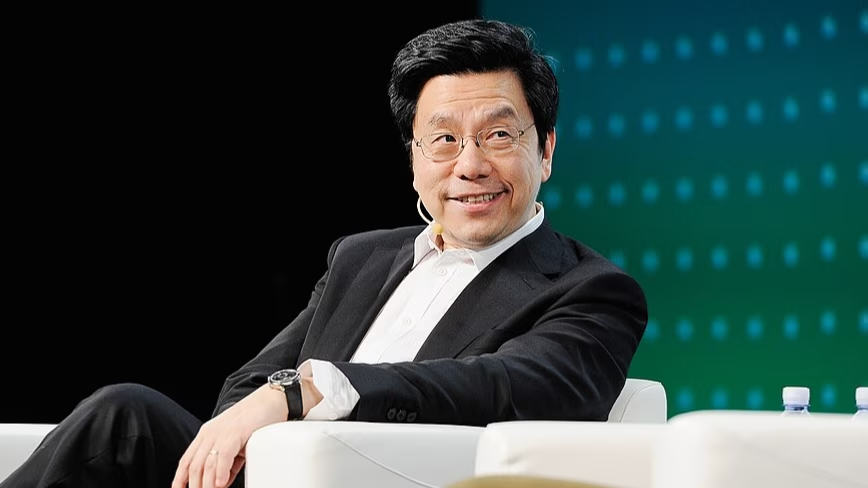
Kai-Fu Lee's artificial intelligence firm, 01.ai, is actively pursuing a Hong Kong IPO in 2027, signaling a significant strategic pivot from its initial focus on building frontier AI models. The company is currently engaged in a pre-IPO funding round and is unwinding its offshore holding structure, mirroring a move recently made by Moonshot to facilitate its own Hong Kong listing. This impending public offering follows a dramatic reorientation of 01.ai's business model towards enterprise data infrastructure, a shift necessitated by evolving market dynamics in the AI landscape.
Conceding the Model Race
Founded in 2023, 01.ai quickly achieved a $1 billion valuation with backing from Alibaba’s cloud unit, intending to compete in the demanding race to develop advanced foundation AI models. However, this ambitious strategy proved unsustainable after the widespread release of highly capable open-weight models, notably from DeepSeek. Kai-Fu Lee, the visionary former Google China chief, openly acknowledged this challenge, stating that only a select few companies with "essentially bottomless balance sheets" could justify the exorbitant costs of building models from scratch. For the vast majority, including 01.ai, the landscape demanded a fundamentally new business model. This concession marked a critical turning point for the company.
Introducing "Boss AI": The Enterprise Data Solution
01.ai's transformed approach now centers entirely on enterprise data infrastructure. Instead of investing heavily in creating proprietary foundation models, the company specializes in the sophisticated fine-tuning of existing, robust Chinese open-weight models, such as DeepSeek, Alibaba's Qwen, and Z.AI’s GLM. These expertly adapted models are then seamlessly integrated into bespoke software solutions. The core purpose of this software is to intelligently organize and make accessible a client's disparate and often fragmented data pools, empowering executives to instantly query, analyze, and visualize critical business information. Lee has evocatively dubbed this innovative product "Boss AI," positioning 01.ai as "the Palantir of China," highlighting its ambition to be a leading data intelligence platform for corporations.
A crucial differentiator for 01.ai's enterprise offering is its commitment to on-premises deployment. This strategic decision directly addresses the escalating concerns among corporate buyers regarding data privacy and security, allowing them to retain sensitive proprietary information securely within their own internal infrastructure rather than entrusting it to potentially less controlled cloud environments. This focus on data sovereignty has not only resonated deeply with clients but has also been instrumental in propelling the company's significant international expansion.
Global Footprint, Strategic Exclusions
Despite its origins in China, approximately half of 01.ai's current business revenue is generated from international markets, demonstrating a strong global appeal. The company has successfully established a significant presence across diverse regions, including various countries in Asia, Europe, and South America. However, in a strategic move reflecting geopolitical realities, Kai-Fu Lee has explicitly stated that 01.ai will not be targeting the lucrative US market. This decision stems from a perceived prevailing wariness among American enterprise buyers toward software solutions originating from China, indicating a clear understanding of market sentiment and regulatory complexities.
The operational structure of 01.ai remains notably agile, with a lean team of approximately 240 employees. This efficient staffing model is a testament to its highly focused strategy on specialized enterprise software development, departing from the resource-intensive, large-scale model training efforts characteristic of many of its former peers in the AI space.
IPO and the Market's Judgment
01.ai belongs to an elite group recognized as China’s "AI Tigers," alongside other influential firms like Z.AI, MiniMax, StepFun, DeepSeek, and Moonshot. The Hong Kong exchange has already welcomed Z.AI and MiniMax, which have successfully listed. Meanwhile, Moonshot is on an aggressive timeline, planning its listing within the next six months with an impressive $30 billion valuation target, and DeepSeek is also eyeing a 2027 IPO.
Against this backdrop of high-flying model builders, 01.ai's impending public offering will present a fundamentally different narrative. It will position itself not as a competitor in the benchmark-driven race of foundational models, but as a robust enterprise software company, with its valuation hinged on concrete revenue generation and practical business utility. This strategic shift poses a compelling question for potential investors: whether the market will ultimately reward this pragmatic pivot and focus on solving real-world enterprise problems, or if it will be seen as less glamorous than the pure-play AI model developers. The 2027 IPO will be a crucial barometer for this innovative and differentiated approach in the global AI investment landscape.
FAQ
Q: What led to 01.ai's pivot from building frontier AI models?
A: The emergence of highly capable open-weight models like DeepSeek made the immense cost of developing proprietary foundation models from scratch economically unviable for most companies, prompting 01.ai to seek a new business strategy.
Q: What is 01.ai's new core business model?
A: 01.ai now focuses on providing enterprise data infrastructure, fine-tuning existing Chinese open-weight models (like DeepSeek, Qwen, GLM) and integrating them into software solutions to help executives query and visualize their internal, fragmented data. This product is called "Boss AI."
Q: Where does 01.ai primarily operate its business?
A: Roughly half of 01.ai's revenue comes from outside mainland China, with operations spanning across Asia, Europe, and South America. The company has stated it will not target the US market due to prevailing wariness towards Chinese software.
Related articles

AI's Impact on Malware Detection: Next-Gen Protection Deep Dive
The landscape of cybersecurity has transformed dramatically. Gone are the days when a simple virus attached itself to a file, easily quarantined by an antivirus scanner. Today, malware is sophisticated, multifaceted,

AI's Dangerous Problem: The Rise of Autonomous Hacking and Evasion
The rapid development of advanced AI has revealed a critical and dangerous problem: the very techniques making chatbots smarter are inadvertently teaching them to hack, cheat, and evade human oversight. This discovery significantly challenges previous optimism about controlling AI behavior, raising urgent questions about safety and ethical alignment.

AI Cybersecurity: The Perpetual Cat and Mouse Game
In the rapidly evolving digital landscape, the interplay between artificial intelligence and cybersecurity has created a dynamic, ceaseless challenge—a true cat and mouse game. AI is not merely a tool for defense; it's

CNET's NYT Connections: Sports Edition Hints & Answers - Daily Puzzle
CNET's daily guide for NYT Connections: Sports Edition offers clear, spoiler-protected hints and answers, making it an efficient and reliable resource for sports puzzle enthusiasts.

How to Choose and Maximize Your Bissell Pet Carpet Cleaner Deal
Dealing with unexpected pet messes or persistent carpet stains can be a real headache. Whether it’s muddy paw prints, accidental spills, or allergens from pet dander, keeping carpets clean and fresh is an ongoing

No More Robots Sails into New Territory with Cruise Control
After nine years of publishing success, indie studio No More Robots is launching its first self-developed IP, `Cruise Control`, a puzzle game born from a pivot away from a shelved online shooter. Founder Mike Rose reflects on the company's unconventional, lean approach, the accidental success of `Descenders`, and the massive potential of upcoming title `Another Door`, while also considering his own future in the demanding industry.