
K2 Space Prepares to Launch High-Powered Gravitas Satellite for
K2 Space, a startup founded by former SpaceX engineers Karan and Neel Kunjur, is set to launch its inaugural high-powered satellite, Gravitas, this month aboard a SpaceX Falcon 9 rocket. The ambitious mission aims to

K2 Space, a startup founded by former SpaceX engineers Karan and Neel Kunjur, is set to launch its inaugural high-powered satellite, Gravitas, this month aboard a SpaceX Falcon 9 rocket. The ambitious mission aims to demonstrate critical technologies necessary for the future development of in-orbit data centers, marking a significant step towards enabling advanced space compute capabilities.
The Gravitas satellite, a substantial spacecraft weighing two metric tons with a 40-meter solar panel wingspan, is designed to generate an impressive 20 kilowatts (kW) of electricity. This power output significantly surpasses that of most existing satellites, positioning it among the most potent spacecraft ever constructed. For context, while larger satellites like ViaSat-3 can exceed 25 kW, and Starlink V3 satellites are projected to hit 20 kW, Gravitas stands out in its class, intended to power sophisticated payloads such as advanced sensors, transceivers, and onboard computers.
“The future is higher power,” stated CEO Karan Kunjur, underscoring the company’s vision. K2 Space has rapidly grown since its 2022 founding, securing $450 million in funding and reaching a $3 billion valuation by December 2025. This maiden launch represents what Kunjur describes as “the start of our iterative journey” into real space operations.
The mission will carry 12 undisclosed payload modules for several customers, including the Department of Defense. It will also test a 20 kW electric thruster, expected to be the most powerful ever flown in space. Kunjur outlined a multi-tiered success evaluation, focusing first on spacecraft deployment and power generation, then on payload operation and thruster testing, and finally on using the thruster to elevate Gravitas into a higher orbit.
With 85% of Gravitas’s components designed and built in-house, Kunjur acknowledges the inherent challenges of launching a new spacecraft. He emphasizes the importance of maximizing data collection from this mission to refine future designs. K2 Space plans an aggressive launch schedule, with 11 more satellites slated for the next two years, mixing demonstration and commercial objectives. By 2028, the company aims to produce high-powered space vehicles for customers to build out their own commercial networks.
The increasing demand for orbital power is driven by several factors, including the need for more robust communications networks that offer higher throughput and resistance to jamming. As data processing in space becomes more critical, powerful satellites are essential for operating advanced processors. Major players like Starlink and Amazon LEO, hyperscalers exploring orbital compute, and the Pentagon's plans for a vast missile defense system all underscore the growing requirement for electrically robust satellites.
K2 Space's initial strategy heavily factored in the anticipated cost reductions from SpaceX’s Starship. While Starship’s full operational capacity and low-cost service timelines remain uncertain, Kunjur argues that Gravitas still offers a compelling value proposition. Priced at approximately $15 million, it remains more cost-effective than high-powered satellites from traditional contractors, while being more capable than similarly priced smaller spacecraft, even at current Falcon 9 launch rates of around $7.2 million.
The company is already looking ahead, with designs prepared for a 100 kW satellite, ready for deployment once larger, more economical launch vehicles like Starship and Blue Origin’s New Glenn become widely available. Kunjur stated, “The thinking is, let’s build all the components that we’re going to go need to be a first mover when Starship and New Glenn are available for everybody else.” This foresight positions K2 Space to capitalize on the next generation of space infrastructure.
FAQ
Q: What is the primary purpose of K2 Space's Gravitas satellite?
A: The Gravitas satellite's primary purpose is to demonstrate technologies vital for building data centers in orbit and providing high-powered space compute capabilities, addressing a growing demand for electricity in space.
Q: How does Gravitas's power generation compare to other satellites?
A: Gravitas is capable of producing 20 kW of electricity, making it one of the highest-powered spacecraft ever built. This is significantly more than most satellites, which typically generate only a few kilowatts, and comparable to the latest Starlink V3 satellites.
Q: What are K2 Space's future plans after the Gravitas launch?
A: Following the Gravitas launch, K2 Space plans to launch 11 more satellites over the next two years for both demonstration and commercial purposes. By 2028, the company expects to be producing satellites for customers to establish their own high-powered commercial space networks, with designs already prepared for even larger 100 kW satellites.
Related articles

Apple Unveils iPhone Duo: Pricey Foldable Sees Soaring Demand
Apple has officially entered the foldable smartphone arena with the long-anticipated launch of the iPhone Duo. Priced starting at a hefty $1,999, the device features a 5.4-inch outer display and a larger 7.6-inch inner

in-depth: Chicago-Area Cops Helped HSI Spy on Minnesota Anti-ICE
Chicago-area law enforcement, including local police and HSI agents, conducted undercover surveillance on Minnesota anti-ICE activists at an April 2, 2022, talk in Chicago. This operation was part of a federal conspiracy probe into 15 Minnesota activists facing felony charges related to immigration enforcement resistance. Civil liberties advocates have condemned the surveillance as a troubling intrusion into protected political activity.

Mark Wahlberg on using AI in film ‘the right way’ and being open to
Actor Mark Wahlberg believes AI has a place in filmmaking if used responsibly for enhancement, not script generation or actor replacement. At TechCrunch Disrupt, he expressed openness to an AI likeness carrying on his legacy, managed by his family, and emphasized storytelling.

Ars Technica's Rocket Report: Your Essential Space Industry Briefing
Quick Verdict Ars Technica's Rocket Report, presented by veteran space reporter Stephen Clark, offers an invaluable and meticulously organized weekly (or similar frequency, implied by "Edition 9.15") digest of the most
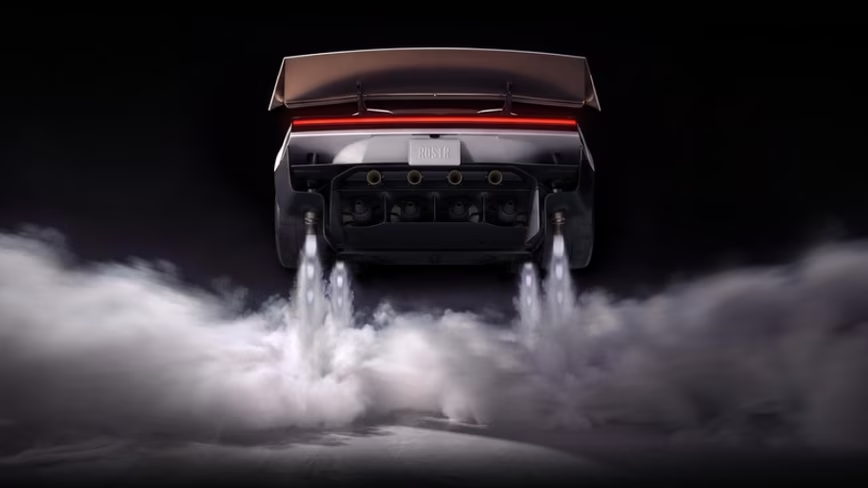
Tesla Unveils Thruster-Equipped Roadster, 2028 Production Targeted
Tesla has unveiled its second-generation Roadster, featuring cold-gas thrusters co-developed with SpaceX, enabling it to jump and flip. The electric sports car demonstrated 0-60mph in an astonishing 0.81 seconds, with production targeted for 2028. This highly anticipated reveal also serves as a key recruitment tool for Tesla's ambitious AI and robotics initiatives.

Amazon Prime Video Launches AI-Powered Prime 360 for NBA Coverage
Amazon Prime Video is elevating its NBA coverage with the introduction of Prime 360, an AI-powered replay system offering immersive, 'fly through' views of the action. Kicking off its second season, Prime Video also adds Yahoo fantasy integration and gains exclusive Eastern Conference Finals rights, expanding its tech-driven sports broadcast. The new features aim to deliver a unique and interactive viewing experience for basketball fans.