
HeyGears G1X Review: Industrial Power, Desktop Price
HeyGears G1X: Our Quick Verdict The HeyGears G1X series is a revolutionary step for creators and small businesses, making previously inaccessible industrial-grade full-color 3D and UV printing technology genuinely
HeyGears G1X: Our Quick Verdict
The HeyGears G1X series is a revolutionary step for creators and small businesses, making previously inaccessible industrial-grade full-color 3D and UV printing technology genuinely affordable. While it has a few quirks to navigate, the sheer versatility, quality, and speed it offers at its price point make it a game-changer for homemade manufacturing.
Unboxing and Initial Impressions
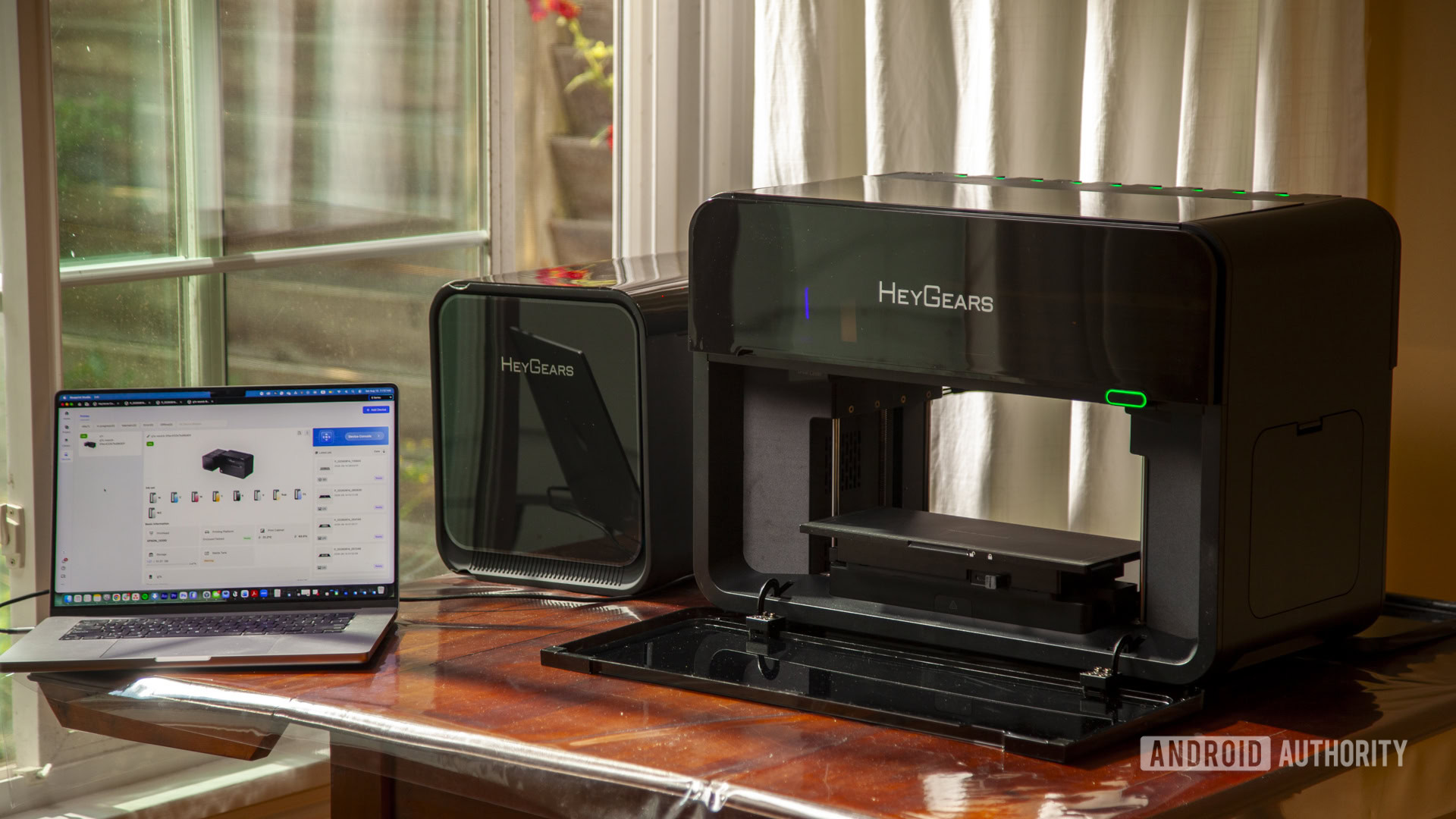
Out of the box, the HeyGears G1X presents itself as a more compact solution than its industrial counterparts. For anyone daunted by the complexity often associated with resin printing or UV technology, the G1X makes a surprising effort to be approachable. The initial setup is relatively straightforward, involving filling the UV resin ink and running a few calibration tests. HeyGears’ Blueprint Studio slicer software is intuitive, making it easy to get started once those initial steps are complete.
While HeyGears states their resin is safe and non-toxic, the reviewer wisely notes that operating the printer in a well-ventilated space is always good practice. The G1X does come equipped with a built-in air filtration system that captures particles, ink mist, and odors, and can even be connected to an external exhaust for additional peace of mind.
Versatile 2D UV Printing: Beyond the Surface
Starting with 2D UV printing, the G1X excels in versatility. For just $2,799 (after cashback for the Starter Pack), you can print vibrant designs on an impressive range of over 400 materials, including plastic, metal, wood, glass, ceramic, leather, and acrylic. The process within Blueprint Studio is seamless: place your material, initiate a project, and the software automatically calibrates and finds the edges for precise image placement and scaling.
This isn't just about versatility; it's also about performance. The G1X boasts print speeds up to 12 times faster than traditional F1080 UV printers. Coupled with G7 highest-level color certification and HeyGears' proprietary wide-gamut inks (including light cyan and light magenta), the prints deliver exceptional color accuracy and a truly professional finish. For cylindrical items, a rotary attachment will be available at launch, further expanding possibilities for custom water bottles or vases.
Adding Dimension: 3D Texture Printing
Moving beyond flat surfaces, the G1X offers a 3D-texture mode, allowing you to add tactile relief effects up to 150mm, with a recommended height of 5mm. This feature can truly elevate a product, giving it a unique feel. However, the reviewer found a minor hiccup here: printing too thick a relief on thin materials can cause them to curl and lift from the print bed. This can spoil a print and necessitates replacing the expendable positioning sheet.
While the G1X ships with several spare sheets, the reviewer hopes for future firmware updates to include print-failure detection for lifting substrates, which would be a welcome addition to prevent wasted materials and time. For now, knowing the relief height recommendations and using double-sided sticky tape can mitigate this issue.
Stepping into Full-Color 3D Printing
The true marvel of the HeyGears G1X Full-3D Pack ($3,099 after cashback) is its ability to deliver industrial-grade full-color 3D printing to the desktop. With a maximum build volume of 420 × 330 × 130 mm, it can reproduce millions of colors, smooth gradients, and combine transparent and multi-color sections in a single continuous build. This capability far surpasses what traditional FDM 3D printers can achieve in terms of color fidelity and intricacy.
One significant advantage is the use of water-soluble supports, a huge relief compared to the often arduous removal process of FDM supports. While switching between the 2D UV and 3D Printing Modules in the Epson I3200 printhead is necessary and tutorial-guided, the reviewer did experience some initial calibration issues with the 3D module, requiring multiple attempts and clearing of potential blockages. Once resolved, the results are impressive, producing highly detailed models with complex textures and vibrant colors. The Blueprint Studio software supports various 3D file formats (.fbx, .obj, .stl, .glb, .3mf, .bpsx) and offers a HeyVerse Library of pre-colored models and a Playground for custom creations.
HeyGears G1X: Is It Worth the Investment?
The HeyGears G1X represents a paradigm shift in accessibility for advanced manufacturing. Previously, machines capable of full-color 3D printing or high-quality UV printing would cost tens of thousands, often exceeding $50,000 to $200,000. The G1X slashes this barrier, making these sophisticated capabilities attainable for a fraction of the price. The G1X clearly benefits from HeyGears’ decade-long experience in industrial photopolymer 3D printing, bringing refined technology to a consumer-friendly package.
| Feature | HeyGears G1X (Kickstarter Price) | Industrial Alternatives (Estimate) |
|---|---|---|
| 2D UV Printing | $2,799 (Starter Pack) | Often standalone, high cost |
| Full-Color 3D | $3,099 (Full-3D Pack) | $50,000 - $200,000+ |
| Footprint | Compact desktop | Often large, industrial |
| Ease of Use | Surprisingly user-friendly | Requires professional training |
| Color Fidelity | G7 certified, millions of colors | High, but at premium cost |
| Support Removal | Water-soluble (for 3D) | Varies, often complex |
Pros:
- Unprecedented affordability for industrial-grade full-color 3D and UV printing.
- Highly versatile: 2D UV on 400+ materials, 3D texture, full-color 3D, and textile options.
- Exceptional print quality, color accuracy (G7 certified), and smooth gradients.
- Fast 2D UV printing (up to 12x faster than traditional F1080).
- Intuitive Blueprint Studio software.
- Water-soluble supports for easier 3D print post-processing.
- Built-in air filtration system with external exhaust option.
- Benefits from HeyGears' extensive industrial experience.
- Relatively compact design compared to professional machines.
Cons:
- Potential for failed 3D texture prints if material thickness isn't accounted for.
- Lacks automatic print-failure detection for lifting substrates.
- Requires manual module switching between 2D and 3D printing.
- Initial calibration of 3D printing module can be finicky (air bubbles/blockages).
- Resin still necessitates proper handling and ventilation best practices.
- Uses expendable positioning sheets for the print bed.
- Kickstarter backing means typical crowdfunding risks and waiting periods.
Recommendation:
If you're a creator, DIY enthusiast, or a small business owner looking to produce custom products with professional-grade quality, the HeyGears G1X is an outstanding investment. Its ability to offer advanced UV and full-color 3D printing at such an accessible price point makes it an undeniable value proposition. Choose the pack that aligns with your primary creative ambitions, and consider leveraging the current Kickstarter offers for additional value.
FAQ
Q: What are the main differences between the G1X packs?
A: The G1X Starter Pack ($2,799 after cashback) focuses on 2D UV and 3D Texture Printing. The Fabric Printing Pack ($2,849 after cashback) uses aqueous inks for True DTF and DTG textile printing. The G1X Full-3D Pack ($3,099 after cashback) is designed for full-color 3D printing with water-soluble supports. Each pack caters to specific manufacturing needs.
Q: Is the HeyGears G1X difficult to use for a beginner?
A: The G1X is surprisingly user-friendly, especially given its advanced capabilities. The Blueprint Studio software is intuitive, and initial setup is guided. While there are some nuances like managing material thickness for 3D textures or occasional calibration challenges with the 3D module, it's significantly more accessible than industrial alternatives and less intimidating for resin newbies than other resin printers.
Q: How does the G1X compare to traditional FDM 3D printers?
A: The G1X excels where FDM printers typically fall short: color fidelity and intricate detail. It can produce millions of colors and smooth gradients, offering a superior aesthetic to multi-filament FDM prints. Additionally, its water-soluble supports for 3D models are much easier to remove than FDM supports, allowing for more complex geometries without post-processing headaches.
Related articles

Chuwi UniBox AI495 Pro Review: A Mini AI Powerhouse
Chuwi's UniBox AI495 Pro review: A powerful mini workstation with 192GB RAM and an AMD Ryzen AI chip for local LLM processing, packed into a compact, Mac Pro-esque design.

Unions Level Up: How Collective Power is Reshaping Game Dev
The gaming industry is seeing a massive shift as unionization rises globally, securing vital worker protections, better pay, and AI safeguards. This collective movement is empowering developers and fundamentally changing workplace dynamics. It's a win for workers, and ultimately, for the games we play.
Pixel Connectivity: Battery Drain, Not Data Speed, Is the Real
Google's Pixel series has consistently offered a compelling Android experience, often earning a spot on recommendation lists for its clean software and camera prowess. However, a recurring shadow has loomed over the

CNET's NYT Connections: Sports Edition Hints & Answers - Daily Puzzle
CNET's daily guide for NYT Connections: Sports Edition offers clear, spoiler-protected hints and answers, making it an efficient and reliable resource for sports puzzle enthusiasts.
Unofficial Sony Headphone PC Apps: Ditch Your Phone, Take Control
Tired of Sony's mobile app? These unofficial, open-source PC tools like Sony Device Center and SonyBridge offer desktop control over your Sony headphones' ANC, EQ, and more. A convenient, albeit unofficial, solution for Windows, Linux, and Mac users looking to ditch their phone for audio adjustments.

Learningto/Pass: Free, AI-Powered Interview Prep for Developers
Landing a role at a top-tier tech company often hinges on mastering complex data structures and algorithms, coupled with a solid grasp of system design. The problem for many aspiring software developers is that quality