
Google's Maps Update Puts Gemini in the Passenger Seat
Google Maps introduces its biggest update in a decade with "Ask Maps," a Gemini-powered conversational AI feature, and "Immersive Navigation," which delivers photorealistic 3D turn-by-turn directions. This overhaul allows users to pose complex queries and experience a more visually intuitive journey, rolling out initially in the US and India.
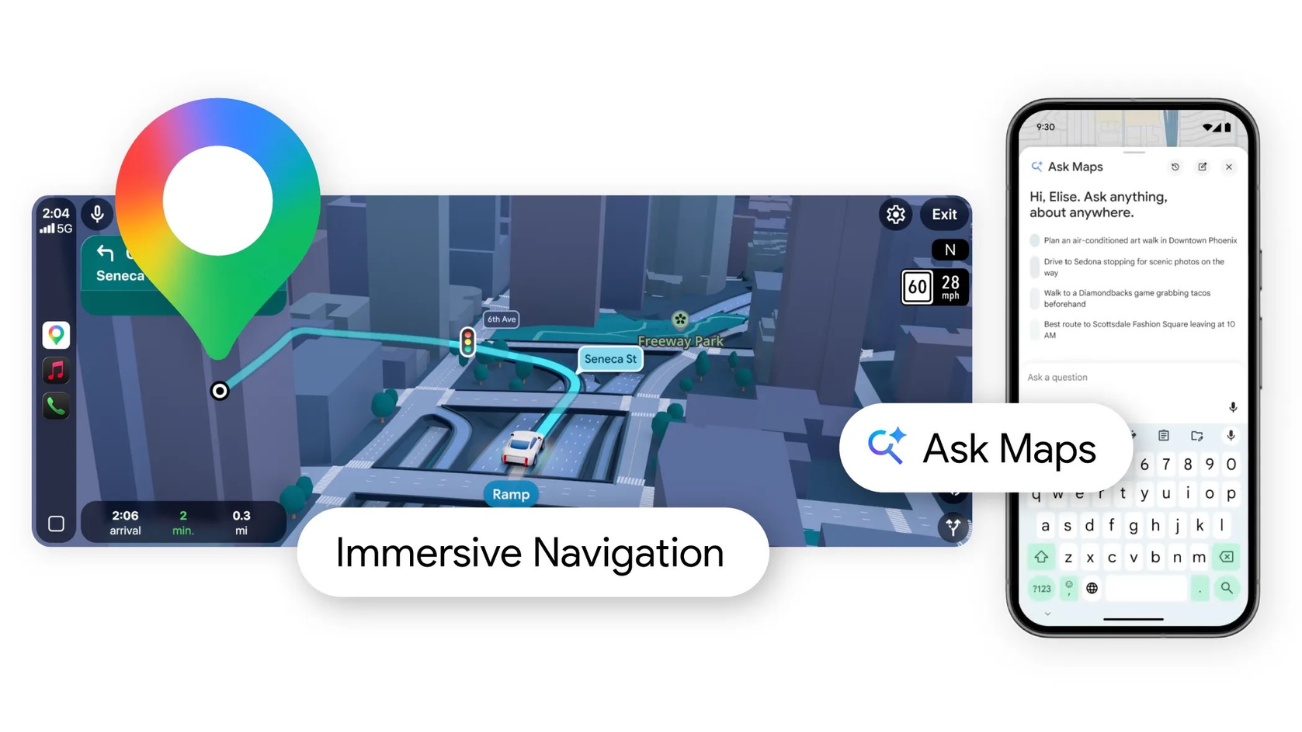
Google Maps is rolling out its most significant update in over a decade, integrating advanced conversational AI powered by Gemini and introducing a visually stunning 3D navigation experience. This dual overhaul, featuring "Ask Maps" and "Immersive Navigation," aims to transform how users interact with the world around them, making digital cartography more intelligent and intuitive.
The update, announced on March 12 and now commencing its rollout, introduces a new era of personalized guidance. Ask Maps leverages Google's Gemini AI to understand complex, natural language queries, moving beyond simple keyword searches. For instance, users can now ask intricate questions like, "My phone is dying, where can I charge it without a long wait for coffee?" or "Is there a public tennis court with lights on that I can play at tonight?" The system processes these requests by drawing on personalization signals, including a user’s saved places and past searches, to provide highly relevant and contextual answers.
Initially, Ask Maps is becoming available to users in the United States and India on both Android and iOS devices, with a desktop version slated for a later release. Google has yet to provide a timeline for its wider international expansion.
A New Dimension of Navigation
Complementing the AI-driven search is Immersive Navigation, a complete redesign of the turn-by-turn directions. This feature replaces the traditional flat-map overlay with a photorealistic 3D view that accurately renders nearby buildings, overpasses, and terrain. Essential visual cues such as lane markings, traffic lights, crosswalks, and stop signs are incorporated directly into the 3D environment, offering a more intuitive visual guide than abstract text instructions.
Voice guidance has also been refined to utilize landmark-based phrasing, such as, "Go past this exit and take the next one for Illinois 43 South," instead of relying solely on distance-based prompts. This shift aims to make directions clearer and more natural to follow in real-world scenarios.
This deployment of detailed 3D rendering for navigation brings Google Maps closer to the visual depth offered by competitors like Apple Maps, which introduced similar features years ago. The delay reflects the significant computational cost of real-time 3D rendering on mobile devices and the extensive effort required to build the underlying high-resolution map data.
The Strategic Importance of AI in Maps
The integration of Ask Maps represents Gemini's most direct deployment into a Google product used by over a billion people monthly. Previously, Gemini's presence in Maps was limited to AI-powered summaries of places and reviews. This expansion into full conversational navigation positions Google in more direct competition with AI-native tools like Perplexity, which has developed search-style answers for location-based queries.
The update also arrives as Apple continues to enhance its Maps intelligence and OpenAI explores location-aware features within ChatGPT. For Google, a company that derives a substantial portion of its advertising revenue from local search queries, maintaining Maps as the primary interface for spatial intent is strategically critical. Ask Maps is a clear statement of Google's intent to defend and expand its dominance in this crucial area.
While the technological infrastructure for conversational navigation is now firmly in place, the open question remains whether users will fully embrace talking to their maps or continue to default to the familiar search box. Google has introduced conversational search features in the past, with adoption sometimes proving slower than initial product announcements might suggest. Nevertheless, this update signals a profound shift in the capabilities and potential of digital mapping, setting a new benchmark for what users can expect from their navigation tools.
FAQ
Q: What are the two main new features introduced in this Google Maps update?
A: The two main features are "Ask Maps," a conversational AI powered by Gemini, and "Immersive Navigation," which provides photorealistic 3D turn-by-turn directions.
Q: Where is Ask Maps currently available?
A: Ask Maps is rolling out now in the US and India on both Android and iOS devices. A desktop version is expected to follow, but there is no timeline yet for wider international expansion.
Q: How does Ask Maps use AI to answer user queries?
A: Ask Maps uses Gemini AI to understand complex, natural language questions. It processes these queries by leveraging personalization signals, such as a user's saved places and past searches, to provide highly contextual and relevant answers.
Related articles

OpenAI's Bubeck Denies Credit Stripping, Apologizes Amidst
OpenAI's Sébastien Bubeck denies attempting to strip Anthropic mathematician Levent Alpöge of credit for his work on the Navier-Stokes problem, apologizing for a remark made during contentious private discussions. OpenAI CEO Sam Altman backed Bubeck, but Alpöge and his collaborator, Tristan Buckmaster, present a conflicting account of events. The dispute also raises questions about OpenAI's data handling policies, as the mathematicians claim to have used OpenAI's Codex tool during their research.

New Masculinity Standards Drive Men to Risky DIY Health Trends
New masculinity standards are pushing men to risky DIY health experiments, Victoria Song reports. Online communities promote 'looksmaxxing' with unapproved substances like testosterone, posing significant health risks and mirroring historical exploitation of insecurities.

in-depth: Best Bluetooth Speaker (2026): JBL, Sonos, Marshall, and
WIRED's 2026 guide names the JBL Flip 7 the top Bluetooth speaker, recognizing its balance of sound, durability, and affordability. The updated list highlights significant advancements across the portable audio market, with specialized picks from Sonos, Marshall, and KEF offering enhanced smart features, battery life, and sound quality for diverse user needs.

Failing NASA Satellite Embarks on Its Final Cosmic Mission
NASA's Swift Observatory Begins Final Observations Before Atmospheric Reentry NASA's Neil Gehrels Swift Observatory, a venerable sentinel of the cosmos for 21 years, is embarking on its final mission as it inexorably

Apple Unleashes iPhone Duo: Three-Screen Foldable Debuts at $2,000
Apple has introduced its first foldable smartphone, the iPhone Duo, on September 9, 2026. Featuring three screens and a book-like hinge, this $1,999 device is the most significant iPhone design change since 2007, establishing a new ultra-premium tier for Apple.

policy: Apple just raised prices on new and older iPhones. Here’s
Apple has raised prices on its new iPhone 18 line, including the first $2,000 iPhone, and surprisingly, on some older models. The tech giant attributes these increases to "artificial intelligence-related inflation." This move defies typical industry patterns for older devices and is already drawing significant consumer criticism.