
Google Appeals Search Monopoly Ruling, Citing 'Fair and Square' Win
Google has officially initiated its appeal against a federal court ruling that declared the tech giant an illegal search monopolist. The company contends that it "prevailed in the marketplace fair and square," arguing

Google has officially initiated its appeal against a federal court ruling that declared the tech giant an illegal search monopolist. The company contends that it "prevailed in the marketplace fair and square," arguing the initial decision by Judge Amit Mehta was flawed and exceeded legal boundaries. This move intensifies the ongoing antitrust battle surrounding Google's dominance in the search market.
The appeal, filed on Friday, May 22, 2026, targets both the August 2024 judgment on monopolization and the subsequent September 2025 remedies decision. That remedies order notably required Google to share specific search data with its competitors, a mandate Google is fiercely challenging.
Google's Core Defense
In its legal brief, Google asserts that Judge Mehta made errors in concluding that its search distribution agreements with browser and device manufacturers were anticompetitive. Instead, the company maintains that market participants simply chose Google's services due to their perceived superiority. Lee-Anne Mulholland, Google's VP of regulatory affairs, reinforced this stance, stating, "We are asking the court to overturn this flawed decision – partners and users have many options and choose Google because it provides the best, most helpful results."
Challenging Remedial Orders and AI Implications
Google's appeal also takes strong exception to the remedies imposed by Judge Mehta, alleging he "egregiously exceeded" his judicial discretion. The company describes the order to boost rivals through data transfer and syndication as an "extraordinary step" that unfairly favors competitors.
A significant point of contention for Google is the requirement to share data with generative AI companies. The company argues that these AI players "could not have been affected by Google’s conduct because they did not even exist during the relevant period." Furthermore, Google claims these burgeoning AI technologies are already experiencing immense success "without any need to free-ride on Google’s success," implying that mandated data sharing would be an unwarranted boon to rival innovators.
The Broader Antitrust Battle
Google's appeal is not the only one in this complex legal saga. The United States government, along with a coalition of states that joined the original lawsuit, has also appealed parts of the same decision. Their appeal, filed in February, seeks to push for even more extensive remedies than those initially ordered by Judge Mehta, indicating a desire for a more significant restructuring of Google's business practices.
This dual-pronged appeal process sets the stage for a prolonged and high-stakes legal confrontation, with both sides seeking to redefine the landscape of digital search and competition. The outcome could have profound implications for how tech giants operate and how antitrust laws are applied in the rapidly evolving digital economy, particularly concerning data sharing and the rise of new AI technologies.
FAQ
Q: What specific parts of the federal ruling is Google appealing?
A: Google is appealing both the August 2024 decision that found it to be an illegal search monopolist and the September 2025 remedies decision, which ordered it to share search data with competitors.
Q: What is Google's primary argument in its appeal?
A: Google argues that it won its market position "fair and square" through competitive merit, that its distribution agreements were not anticompetitive, and that Judge Mehta erred in his findings and exceeded his judicial discretion, particularly concerning data sharing with rivals and nascent AI companies.
Q: Are other parties involved in appealing this decision?
A: Yes, the US Department of Justice and a coalition of states that sued Google are also appealing the decision. They contend that Judge Mehta should have imposed even stricter remedies on the company.
Related articles

Apple Unveils iPhone Duo: Pricey Foldable Sees Soaring Demand
Apple has officially entered the foldable smartphone arena with the long-anticipated launch of the iPhone Duo. Priced starting at a hefty $1,999, the device features a 5.4-inch outer display and a larger 7.6-inch inner
Android 17 QPR2 Beta 7.1: The Performance Relief You've Been Waiting
Android 17 QPR2 Beta 7.1: Finally Fixing the QPR1 Performance Woes Verdict: Android 17 QPR2 Beta 7.1 is a crucial and highly anticipated software update for Google Pixel users, specifically targeting and resolving the

in-depth: Chicago-Area Cops Helped HSI Spy on Minnesota Anti-ICE
Chicago-area law enforcement, including local police and HSI agents, conducted undercover surveillance on Minnesota anti-ICE activists at an April 2, 2022, talk in Chicago. This operation was part of a federal conspiracy probe into 15 Minnesota activists facing felony charges related to immigration enforcement resistance. Civil liberties advocates have condemned the surveillance as a troubling intrusion into protected political activity.

Mark Wahlberg on using AI in film ‘the right way’ and being open to
Actor Mark Wahlberg believes AI has a place in filmmaking if used responsibly for enhancement, not script generation or actor replacement. At TechCrunch Disrupt, he expressed openness to an AI likeness carrying on his legacy, managed by his family, and emphasized storytelling.

Apple iPhone Duo: A Daring Debut with Notable Compromises
Apple's highly anticipated iPhone Duo, priced at $2,000, has gone on pre-order. While hailed as "Apple's most exciting device in a decade" for its innovative foldable design and immersive display, it comes with significant drawbacks like the absence of FaceID and a premium camera.
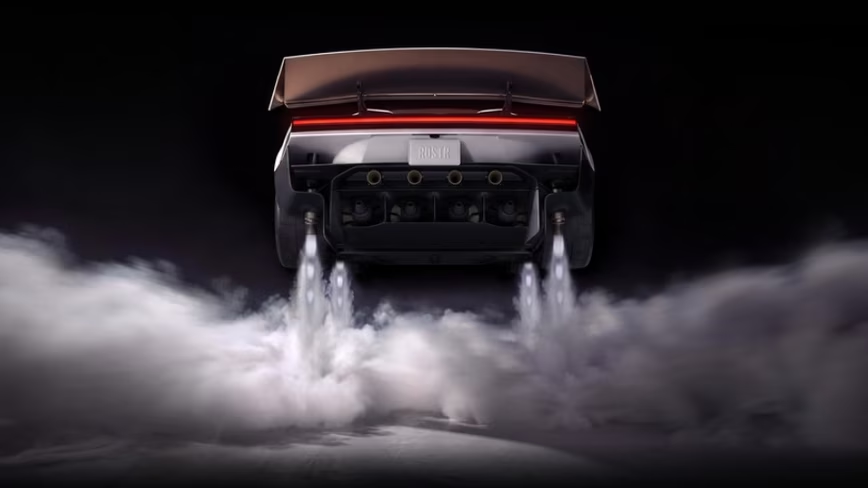
Tesla Unveils Thruster-Equipped Roadster, 2028 Production Targeted
Tesla has unveiled its second-generation Roadster, featuring cold-gas thrusters co-developed with SpaceX, enabling it to jump and flip. The electric sports car demonstrated 0-60mph in an astonishing 0.81 seconds, with production targeted for 2028. This highly anticipated reveal also serves as a key recruitment tool for Tesla's ambitious AI and robotics initiatives.