
France's Pasqal Public on Nasdaq, Raises $360M at 100x Revenue
French quantum computing pioneer Pasqal has successfully debuted on the Nasdaq exchange under the ticker PSQL, concluding its merger with Bleichroeder Acquisition Corp. II. The company secured approximately $360 million
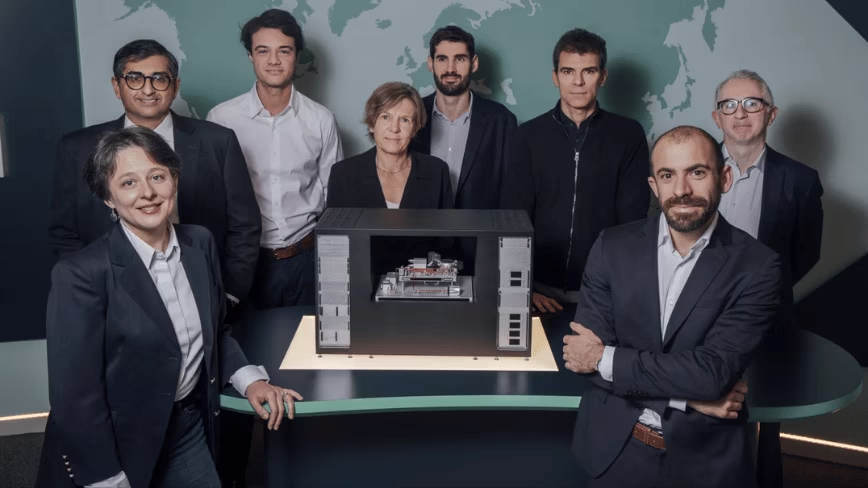
French quantum computing pioneer Pasqal has successfully debuted on the Nasdaq exchange under the ticker PSQL, concluding its merger with Bleichroeder Acquisition Corp. II. The company secured approximately $360 million in cash, positioning itself with one of the largest capital injections for a European quantum firm. This public offering values Pasqal at roughly 100 times its projected 2025 revenue, a significant multiple reflecting the nascent but highly speculative quantum technology market.
Shares of the neutral-atom quantum specialist surged on its Friday debut, August 28, 2026, signaling robust investor interest in the high-growth, high-risk sector. While the $360 million raised fell short of the $500 million initially anticipated in filings—a common occurrence in SPAC deals due to shareholder redemptions—it still represents a substantial sum.
To put this in perspective, Pasqal's new cash pile of €309 million accounts for nearly a third of Europe's total quantum sector funding, which reached approximately €1.05 billion during 2026. The pre-money valuation was set at $2 billion against a 2025 revenue forecast of €16.5 million, highlighting a market belief in future potential rather than current financial performance.
Technology and Market Traction
Pasqal distinguishes itself with deployed hardware, moving beyond mere roadmaps. The company currently has seven neutral-atom quantum processing units (QPUs) operating in the field, with an additional three in production. These systems support over 25 commercial and research applications spanning critical sectors like energy, financial services, and materials science.
Pasqal boasts an impressive customer roster including Saudi Aramco, which houses Saudi Arabia's first quantum computer, Crédit Agricole CIB, and LG Electronics. Strategic alliances with classical computing giant Nvidia and integration into the IBM Quantum Network further solidify its market position, embedding it within established quantum ecosystems.
Neutral-atom systems offer inherent advantages over superconducting qubits, primarily by avoiding the extreme cryogenic cooling requirements and scaling efficiently. Pasqal notably demonstrated its scalability by surpassing 1,000 atoms in a processor back in 2024.
Strategic Vision and Future Growth
Wasiq Bokhari, Pasqal's chief executive, emphasized that the listing marks an "acceleration point," signaling a definitive transition from foundational scientific research to industrial-scale deployment. The newly acquired capital will fuel significant investments, including expanding manufacturing capacity at its Palaiseau headquarters in France, advancing fault tolerance research, and developing its cloud and software platform.
Plans also include deeper integration with classical high-performance computing and broader international expansion. The company also intends a dual listing on Euronext Paris, maintaining a strong connection to its European roots while tapping into global capital markets.
European Ambition and French Safeguards
Pasqal's leadership structure deliberately upholds its French heritage, with Nobel Prize laureate and co-founder Alain Aspect chairing the board in a non-executive capacity, and Bpifrance, a French public investment bank, holding a seat. The French government has also taken unusual steps to protect its domestic champion.
France retains a veto over significant non-French and non-EU stakes in Pasqal, requiring approval from the Ministry of the Economy even for a company listed on a US exchange. This move underscores France's commitment to its national quantum strategy, which includes a €500 million program specifically designed to back domestic quantum firms.
Pasqal’s decision to list on Nasdaq, as articulated by Bokhari, was driven by the depth of capital available in the US market, a rationale increasingly adopted by other European deeptech ventures. Pasqal is now the first of these French champions to face the daily scrutiny of public share prices.
Outlook in a Nascent Market
Joining a cohort of quantum companies that have gone public, Pasqal will now navigate a market segment known for trading on future promise rather than immediate profitability. Such companies typically experience considerable share price volatility, as their commercial traction is still in very early stages.
Pasqal’s current revenue, while present, is acknowledged by investors as a minor figure, with the underlying technology and its long-term potential serving as the primary asset driving its valuation. The path from cutting-edge science to widespread commercial viability for quantum computing remains a complex and challenging endeavor, relying heavily on continued innovation and market development.
FAQ
Q: What is Pasqal's core quantum computing technology?
A: Pasqal specializes in neutral-atom quantum processing units (QPUs), which use arrays of laser light to trap and manipulate individual atoms, avoiding the extreme cryogenics required by other quantum architectures.
Q: How much capital did Pasqal raise in its public offering?
A: Pasqal raised approximately $360 million in cash through its merger with Bleichroeder Acquisition Corp. II and subsequent listing on Nasdaq.
Q: Why did Pasqal choose to list on Nasdaq instead of a European exchange?
A: Pasqal's CEO, Wasiq Bokhari, stated that the decision to list on Nasdaq was driven by the depth of capital available in the US market, a common reason for European deep tech companies seeking significant funding for advanced technologies.
Related articles

Apple Unveils iPhone Duo: Pricey Foldable Sees Soaring Demand
Apple has officially entered the foldable smartphone arena with the long-anticipated launch of the iPhone Duo. Priced starting at a hefty $1,999, the device features a 5.4-inch outer display and a larger 7.6-inch inner

in-depth: Chicago-Area Cops Helped HSI Spy on Minnesota Anti-ICE
Chicago-area law enforcement, including local police and HSI agents, conducted undercover surveillance on Minnesota anti-ICE activists at an April 2, 2022, talk in Chicago. This operation was part of a federal conspiracy probe into 15 Minnesota activists facing felony charges related to immigration enforcement resistance. Civil liberties advocates have condemned the surveillance as a troubling intrusion into protected political activity.

Mark Wahlberg on using AI in film ‘the right way’ and being open to
Actor Mark Wahlberg believes AI has a place in filmmaking if used responsibly for enhancement, not script generation or actor replacement. At TechCrunch Disrupt, he expressed openness to an AI likeness carrying on his legacy, managed by his family, and emphasized storytelling.

Tesla Unveils Thruster-Equipped Roadster, 2028 Production Targeted
Tesla has unveiled its second-generation Roadster, featuring cold-gas thrusters co-developed with SpaceX, enabling it to jump and flip. The electric sports car demonstrated 0-60mph in an astonishing 0.81 seconds, with production targeted for 2028. This highly anticipated reveal also serves as a key recruitment tool for Tesla's ambitious AI and robotics initiatives.

Amazon Prime Video Launches AI-Powered Prime 360 for NBA Coverage
Amazon Prime Video is elevating its NBA coverage with the introduction of Prime 360, an AI-powered replay system offering immersive, 'fly through' views of the action. Kicking off its second season, Prime Video also adds Yahoo fantasy integration and gains exclusive Eastern Conference Finals rights, expanding its tech-driven sports broadcast. The new features aim to deliver a unique and interactive viewing experience for basketball fans.

regional: A two-person Seattle startup lands $1M to reinvent
Seattle startup TriMagnetix has secured $1 million to develop semiconductor chips that consume 800 times less energy and are radiation-resistant. The two-person company, leveraging nanomagnetic technology, is targeting space applications and data centers. With new funding and key partnerships, TriMagnetix aims for commercial sales within a year.