
Fitbit Air vs. Apple Watch Ultra 3: 10K Run Test Differences
Our 10km run test reveals the Google Fitbit Air's surprising heart rate and calorie accuracy against the Apple Watch Ultra 3, but significant GPS deficiencies for precise pace and distance tracking.
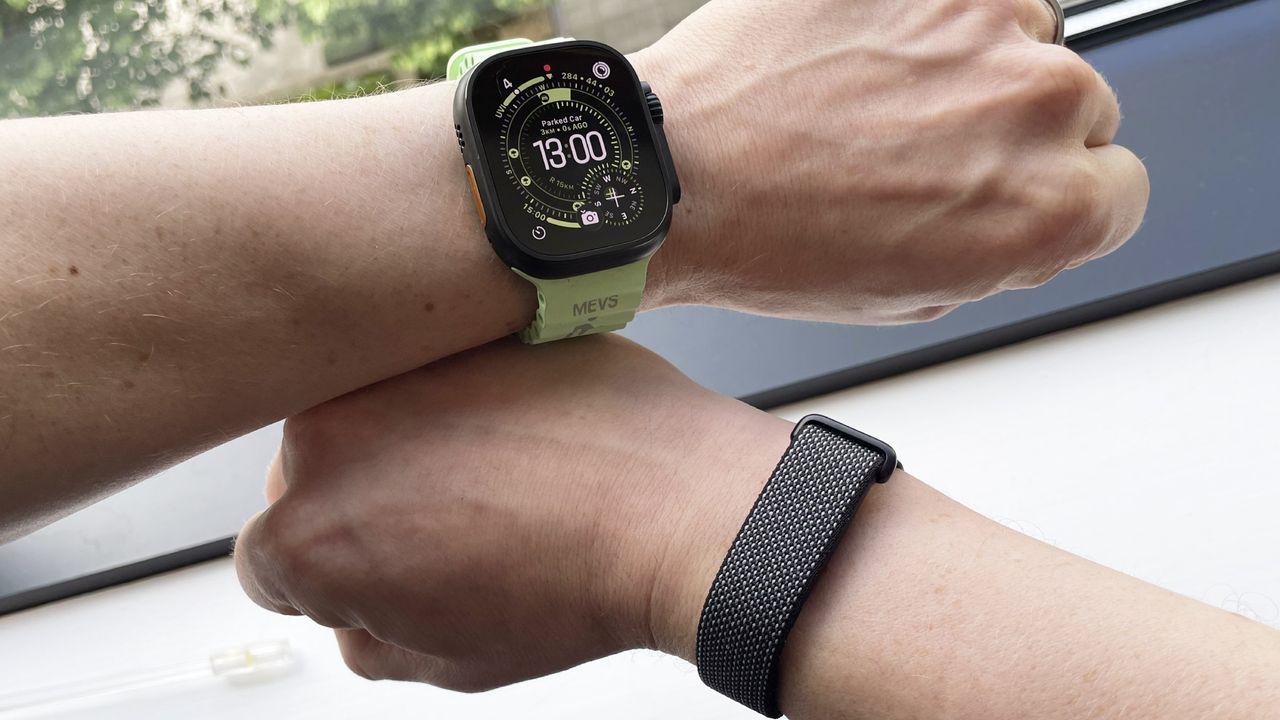
Quick Verdict: The Google Fitbit Air delivers impressive heart rate and calorie accuracy for its price, but its phone-dependent GPS significantly hinders pace and distance precision compared to the premium Apple Watch Ultra 3.
Introduction: A 10K Showdown for Fitness Trackers
The fitness wearable market offers devices from minimalist trackers to feature-rich smartwatches. Google's new Fitbit Air, a screenless device with an AI-powered premium Google Health Coach, contrasts sharply with the established Apple Watch Ultra 3. To compare their real-world capabilities, I wore both on a 10-kilometer run, focusing on heart rate, calories, and GPS-dependent accuracy. A planned external chest strap validation unfortunately malfunctioned, so the comparison focuses solely on the two wrist-based trackers.
Design, Specs, and Price: Two Philosophies
The Google Fitbit Air's screenless design prioritizes passive tracking and app-driven insights, enhanced by its premium Health Coach. Priced affordably at $99.99 / £84.99 / AU$199, it targets budget-conscious users. The Apple Watch Ultra 3, a premium smartwatch at $799 / £749 / AU$1,399, offers a full display and extensive features.
Both use optical heart rate sensors. A crucial difference is GPS: the Ultra 3 has built-in GPS, while the Fitbit Air requires a connected iPhone for location data. This distinction proves critical in performance.
Heart Rate and Calorie Accuracy: A Surprising Tie
For fundamental physiological metrics, the Google Fitbit Air performed admirably, closely mirroring the Apple Watch Ultra 3. My 10km run showed just a 3 beats per minute (bpm) difference in average heart rate. Given the Ultra 3's proven precision, the Fitbit Air's optical sensor demonstrated impressive reliability for its price.
Calorie estimations were equally consistent, with the Fitbit Air calculating less than 25 calories more than the Ultra 3. This minimal variance suggests both provide reliable calorie burn estimates for daily use. For accurate heart rate and calorie data without a hefty price tag, the Fitbit Air is surprisingly competent.
GPS Performance: Where the Gap Becomes Apparent
The situation changes considerably for GPS-dependent metrics. The Google Fitbit Air's reliance on a paired phone for location data led to notable inaccuracies. It overestimated my average pace by a significant 10 seconds per kilometer compared to the Apple Watch Ultra 3. Considering the challenging run conditions, the Ultra 3's pace assessment felt much more accurate.
Distance measurement also revealed a substantial discrepancy. Despite identical route maps, the Fitbit Air reported 10.43km, over 400 meters longer than the Ultra 3's 10.03km. Such errors significantly compromise serious running analysis.
The Apple Watch Ultra 3 also offered richer running dynamics like stride length and vertical oscillation, valuable for technique. The Fitbit Air, conversely, only provided total steps taken (9,342) as an additional workout metric.
User Experience and Broader Ecosystem
User experience diverges dramatically. The screenless Fitbit Air funnels all data interaction through its app and Google Health Coach. While its AI features are a draw, previous user "disappointment and anger" over app changes suggest potential usability hurdles.
The Apple Watch Ultra 3, a full smartwatch, provides real-time data on its display and integrates seamlessly into the Apple ecosystem, offering extensive apps and notifications beyond fitness. Its detailed run summaries and advanced metrics cater to those desiring comprehensive insights and an interactive on-device experience.
Ultimately, the choice hinges on priorities. The Fitbit Air excels in core physiological tracking at an unbeatable price for casual users. The Apple Watch Ultra 3 delivers unparalleled precision for GPS activities and advanced data, serving serious athletes needing detailed analysis and a richer smartwatch experience.
Performance Snapshot: Key Metrics Compared (10km Run)
| Feature / Metric | Google Fitbit Air | Apple Watch Ultra 3 | Notes |
|---|---|---|---|
| Price | $99.99 / £84.99 / AU$199 | $799 / £749 / AU$1,399 | Vast difference in cost |
| GPS Capability | Phone-dependent (no onboard) | Built-in GPS | Impacts distance & pace accuracy |
| Average Heart Rate | 3bpm higher than AW Ultra 3 | 3bpm lower than Fitbit Air | Both showed excellent optical HR accuracy |
| Calories Burned | < 25 calories more than AW Ultra 3 | < 25 calories less than Fitbit Air | Very similar and reliable estimates |
| Average Pace | Overestimated by 10 seconds/km | Accurate (tester's assessment) | Fitbit less reliable for pace |
| Total Distance | Overestimated (10.43km) | Accurate (10.03km) | Fitbit 400m over 10km run |
| Advanced Run Data | Steps taken (9,342) | Stride length, Vertical Oscillation | AW offers deeper biomechanical insights |
| Display | Screenless | Full-color touchscreen | UX differentiator |
The Verdict: Who Should Buy Which?
The Google Fitbit Air is an excellent choice for the casual user or budget-conscious individual prioritizing accurate heart rate, calorie tracking, and step counts. Its core physiological monitoring is robust for its price, valuable for general health awareness. If you’re content carrying your phone for runs and accepting estimated pace and distance, the Fitbit Air offers great value, though be aware of potential app-related frustrations.
For serious runners, athletes, or anyone demanding precise, detailed run analysis, the Apple Watch Ultra 3 is clearly superior. Its built-in GPS delivers pinpoint accuracy for pace and distance, and its advanced metrics like stride length and vertical oscillation are invaluable for performance and technique. This comprehensive package, alongside its broader smartwatch capabilities, justifies its premium price for those who need and can afford top-tier wrist-based tracking.
FAQ
Q: Is the Google Fitbit Air suitable for tracking all types of workouts? A: While it offers accurate heart rate and calorie data, its lack of built-in GPS makes it less suitable for outdoor activities like running or cycling where precise pace and distance are crucial. It's better for indoor workouts or activities where location tracking is less critical.
Q: How does the Google Fitbit Air's screenless design impact its usability? A: The screenless design means all data review occurs via the companion app. This offers a minimalist on-wrist experience but requires using your phone for real-time data or post-workout analysis, which might be less convenient for some.
Q: Can I use the Google Fitbit Air as a standalone device without a phone? A: It can track basic metrics like heart rate and steps independently. However, for GPS-dependent features such as mapping routes, precise pace, or accurate distance, it requires a connection to your iPhone to utilize its GPS.
Related articles

Ars Technica's Rocket Report: Your Essential Space Industry Briefing
Quick Verdict Ars Technica's Rocket Report, presented by veteran space reporter Stephen Clark, offers an invaluable and meticulously organized weekly (or similar frequency, implied by "Edition 9.15") digest of the most

Apple iPhone Duo: A Daring Debut with Notable Compromises
Apple's highly anticipated iPhone Duo, priced at $2,000, has gone on pre-order. While hailed as "Apple's most exciting device in a decade" for its innovative foldable design and immersive display, it comes with significant drawbacks like the absence of FaceID and a premium camera.

AI's Confidence vs. Formal Methods' Rigor: Design Flaws & Verification
While AI accelerates code generation, formal methods remain critical for ensuring system correctness. Languages like TLA+ and tools like Quint enable developers to model and verify system designs before coding, catching subtle flaws. Quint makes formal methods more accessible with developer-friendly syntax and executability. This approach is vital for verifying AI-generated code through trace validation and model-based testing, ensuring reliability against real-world data.
KDE Plasma 6.8: A Future-Focused 30th Anniversary Update
Quick Verdict KDE Plasma 6.8, arriving as the "30th Anniversary Edition," is a pivotal release that decisively pushes the desktop environment into the future. With a definitive farewell to native X11 sessions and a

Ephemeral PR Preview Environments on GKE: A Deep Dive
Every development team eventually grapples with the limitations of shared staging environments. The familiar scenario: multiple features deployed simultaneously, database migrations clashing, and the phrase "it works on
Galaxy Watch One UI 9 Beta: Promising Progress, But Patience Needed
Galaxy Watch 8, Watch Ultra, and Watch 7 are receiving a new One UI 9 Watch beta build with bug fixes and a security patch. Active development signals progress, but a stable release date remains elusive.