
Empowering AI Agents: Safely Controlling Cloud Infrastructure
Cloud infrastructure has undergone a significant transformation, evolving from manual configuration to deeply programmable systems. Over the past decade, nearly every platform has exposed robust APIs, enabling

Cloud infrastructure has undergone a significant transformation, evolving from manual configuration to deeply programmable systems. Over the past decade, nearly every platform has exposed robust APIs, enabling developers to automate tasks like provisioning databases, configuring networks, and deploying applications through Infrastructure as Code (IaC) and CI/CD pipelines.
Now, we're on the cusp of another revolution: AI agents directly participating in development workflows. These agents are becoming increasingly adept at reading code, generating implementations, and debugging systems. The next logical frontier is empowering them to interact directly with the infrastructure itself. Imagine asking an AI agent in natural language to check system state, deploy a service, or retrieve metrics, and having it perform these tasks by interacting with cloud APIs on your behalf. This capability heralds a new era of conversational, programmable, and deeply integrated infrastructure management within our development environments.
This article will delve into how AI agents can interface with cloud infrastructure through APIs, address the inherent challenges of exposing vast API surfaces to AI systems, and explore architectural patterns like the Model Context Protocol (MCP) combined with the search-and-execute approach to enable safe and efficient infrastructure operations.
AI Agents as First-Class Development Environment Citizens
Modern developer tools are increasingly embedding AI assistants directly into coding environments. Editors such as Cursor and integrated AI features like Claude Code allow developers to generate code, refactor functions, and even debug errors without ever leaving their primary workspace. This shift moves beyond traditional boilerplate generation, enabling developers to describe desired outcomes in natural language, with the AI interpreting and executing the necessary actions.
However, while AI excels at code-centric tasks, infrastructure management often remains an external, manual process involving dashboards, command-line interfaces, or separate tooling. For AI agents to truly become effective development partners, they need seamless, structured access to the same systems developers interact with daily – specifically, the APIs that manage applications, databases, deployments, and other critical infrastructure resources.
Connecting AI Agents to External Systems: The Role of MCP
AI agents, by themselves, lack inherent knowledge of how to interact with arbitrary external services. They require a standardized framework to discover and safely invoke external tools and access data. The Model Context Protocol (MCP) provides precisely such a framework.
An MCP server acts as an intermediary, exposing a set of 'tools' that an AI agent can call upon to gather information or perform actions. These tools can be incredibly diverse, ranging from querying databases, retrieving logs, interacting with third-party APIs, or executing commands on remote systems. When a user provides a request, the AI agent, through its reasoning process, determines which MCP tool is most appropriate to fulfill the request. It then executes this tool via the MCP server, and the results are returned to the agent, allowing it to continue its reasoning or present information back to the user. This architecture establishes a clear, secure boundary between the AI agent's internal logic and the external environment it interacts with.
The Scale Challenge: Large Cloud APIs
While MCP offers a robust mechanism for connecting AI agents to external systems, cloud platforms introduce a significant challenge: the sheer scale and complexity of their APIs. A typical cloud provider exposes hundreds, if not thousands, of API endpoints covering everything from compute instances, storage, networking, and databases to identity management, monitoring, and deployment pipelines.
If an MCP server were to expose each of these endpoints as a distinct, individually defined tool, it would rapidly lead to several practical problems:
- Increased Context Load: The AI agent would need to understand the purpose, parameters, and schemas of hundreds of tools, significantly increasing the contextual information it needs to process for effective operation.
- Maintenance Burden: Developers building and maintaining the MCP server would face a daunting task of constantly updating and documenting a vast and ever-changing toolset.
- Rigidity: The system would become inflexible, requiring a new tool definition every time a new API endpoint is introduced or an existing one is modified.
For large, dynamic cloud APIs, this one-to-one mapping approach quickly becomes impractical and unsustainable.
A Simpler Pattern: Search-and-Execute for API Access
To overcome the limitations of exposing every API endpoint individually, a more efficient and scalable architecture emerges: the search-and-execute pattern. This approach dramatically reduces the number of tools exposed to the AI agent by abstracting the API interaction into two core capabilities:
- API Specification Search: The first capability allows the AI agent to dynamically search the cloud platform's API specification (e.g., OpenAPI documentation). This enables the agent to discover available endpoints, understand their parameters, and inspect the required request and response schemas on demand.
- Code Execution for API Calls: The second capability empowers the agent to execute code that makes calls to the API. Crucially, the AI agent dynamically generates this code based on its understanding derived from the API search.
By leveraging this pattern, the MCP server no longer needs to pre-define individual tools for every API endpoint. Instead, the AI agent itself becomes responsible for understanding the API structure and constructing the necessary calls, significantly simplifying the integration while providing full access to the underlying platform's capabilities.
The Critical Role of Sandboxed Code Execution
Allowing an AI agent to dynamically generate and execute code—especially code that interacts with critical infrastructure—immediately raises significant security and stability concerns. Unrestricted code execution could inadvertently or maliciously access sensitive system components, perform unintended operations, or introduce vulnerabilities.
The solution lies in enforcing a tightly controlled, sandboxed execution environment. In this setup, the generated code runs within an isolated runtime (e.g., a V8 sandbox for JavaScript) with strictly limited permissions. This environment is carefully configured to expose only specific, pre-approved helper functions that facilitate interaction with the platform's API. The code cannot directly access the host system or perform arbitrary operations, drastically mitigating the risk of unintended behavior or security breaches. This combination of dynamic code generation and secure sandboxed execution is fundamental to enabling AI agents to safely and flexibly interact with complex cloud APIs.
Practical Example with Sevalla
The practical implementation of this search-and-execute architecture can be observed in the Sevalla MCP server. Sevalla, a PaaS provider, exposes its comprehensive API to AI agents using this streamlined pattern, alongside other options for platforms like AWS and Azure.
Instead of hundreds of specific tools, the Sevalla MCP server offers just two primary tools:
-
search: This tool allows the AI agent to query Sevalla's OpenAPI specification. When a user asks the agent to perform an infrastructure task, the agent can dynamically explore the API. For instance, if the user requests to list all applications, the agent would use: plaintext const endpoints = await sevalla.search("list all applications")The
searchtool returns relevant API definitions, including the correct path and required parameters. This means the agent doesn't need prior knowledge of the entire API structure; it discovers it dynamically. -
execute: Once the agent identifies the correct endpoint and understands its parameters via thesearchtool, it generates the necessary JavaScript code to make the API call. This code is then executed within an isolated V8 sandbox. The sandbox provides a helper function,sevalla.request, which is the only permitted mechanism for the generated code to interact with the platform's API. An example call might look like: plaintext const apps = await sevalla.request({ method: "GET", path: "/applications" })This sandboxed execution ensures that even dynamically generated code cannot access the host system directly, maintaining a secure boundary while allowing the agent to perform operations like retrieving application data, inspecting deployments, querying metrics, or managing resources.
This design significantly reduces context usage for the AI model. While traditional integrations might require hundreds of tool definitions, the search-and-execute pattern grants access to an entire API surface through just these two highly versatile tools, making the integration simpler, more efficient, and scalable.
What This Means for Developers
The advent of AI agents capable of interacting with infrastructure APIs represents a paradigm shift for developers. Instead of navigating complex dashboards, memorizing intricate CLI commands, or writing lengthy automation scripts, developers can articulate their intentions in natural language. The AI agent then intelligently interprets the request, dynamically discovers the appropriate API endpoints, and safely executes the required operations.
Beyond direct control, this approach enhances observability and debugging. When issues arise, an agent can autonomously query logs, inspect metrics, and retrieve system state, dramatically accelerating the troubleshooting process by minimizing manual information gathering. Over time, this integration promises to significantly reduce the cognitive load and friction associated with managing increasingly complex cloud systems.
The Next Evolution of Infrastructure Automation
Infrastructure automation has progressed through several distinct stages. We moved from initial manual configurations via web interfaces to Infrastructure as Code, which allowed system definitions through version-controlled scripts. Subsequently, CI/CD pipelines automated the deployment and update processes, integrating infrastructure management into the software delivery lifecycle.
AI agents are the logical next step in this evolution. By combining robust cloud APIs with flexible integration frameworks like MCP and the security of sandboxed execution environments, developers can empower intelligent systems to reason about, understand, and safely interact with infrastructure at an unprecedented level. Instead of relying on static, pre-configured integrations, agents can dynamically discover and invoke APIs as needed, making infrastructure management more agile, accessible, and resilient, all while maintaining the reliability and programmability we've come to expect from modern systems. As AI becomes more deeply embedded in our development toolchains, the ability for these agents to intelligently control infrastructure will undoubtedly become a standard and indispensable capability.
FAQ
Q: What is the primary limitation of connecting AI agents to cloud infrastructure by exposing every API endpoint as a separate tool?
A: The primary limitation is the rapid increase in context required for the AI agent, leading to diminished effectiveness. It also creates a significant maintenance burden for developers building the MCP server and makes the system rigid, requiring new tool definitions for every new or modified API endpoint.
Q: How does the "search-and-execute" pattern address the complexity of large cloud APIs?
A: It simplifies complexity by drastically reducing the number of tools exposed to the AI agent. Instead of hundreds of specific tools, it offers just two general capabilities: one for dynamically searching the API specification to understand available endpoints, and another for executing dynamically generated code that interacts with those APIs, abstracting away the need for pre-defined individual tools.
Q: Why is sandboxed code execution essential when AI agents interact with cloud APIs?
A: Sandboxed code execution is crucial for security and stability. It prevents dynamically generated code from accessing sensitive parts of the host system or performing unintended operations. By running the code in an isolated runtime with limited permissions, and allowing interaction only through specific, controlled helper functions, it greatly reduces the risk of accidental or malicious actions while preserving the agent's flexibility to construct custom API calls.
Related articles

in-depth: Chicago-Area Cops Helped HSI Spy on Minnesota Anti-ICE
Chicago-area law enforcement, including local police and HSI agents, conducted undercover surveillance on Minnesota anti-ICE activists at an April 2, 2022, talk in Chicago. This operation was part of a federal conspiracy probe into 15 Minnesota activists facing felony charges related to immigration enforcement resistance. Civil liberties advocates have condemned the surveillance as a troubling intrusion into protected political activity.

AI's Confidence vs. Formal Methods' Rigor: Design Flaws & Verification
While AI accelerates code generation, formal methods remain critical for ensuring system correctness. Languages like TLA+ and tools like Quint enable developers to model and verify system designs before coding, catching subtle flaws. Quint makes formal methods more accessible with developer-friendly syntax and executability. This approach is vital for verifying AI-generated code through trace validation and model-based testing, ensuring reliability against real-world data.
Ephemeral PR Preview Environments on GKE: A Deep Dive
Every development team eventually grapples with the limitations of shared staging environments. The familiar scenario: multiple features deployed simultaneously, database migrations clashing, and the phrase "it works on
Secure Internal API Access for AI Agents with MCP
AI agents accessing internal APIs directly pose significant risks, including identity loss, unrestricted queries, and security bypasses. The Model Context Protocol (MCP) offers a solution by defining explicit tools. A secure architecture involves an MCP server wrapping the API with strict input validation, coupled with a gateway that handles authentication, rate limiting, and audit logging, ensuring safe and accountable access.

Flox Intelligence Harnesses AI to Safeguard Wildlife and
Flox Intelligence, a KTH spin-off and TechCrunch Disrupt finalist, is deploying AI-powered edge devices to deter wildlife from critical infrastructure like railways and airports. The system identifies animals and uses species-specific sounds, learning and adapting to prevent costly collisions and delays. With 150 devices deployed globally and $5 million raised, Flox aims to scale significantly with a new Series A round.
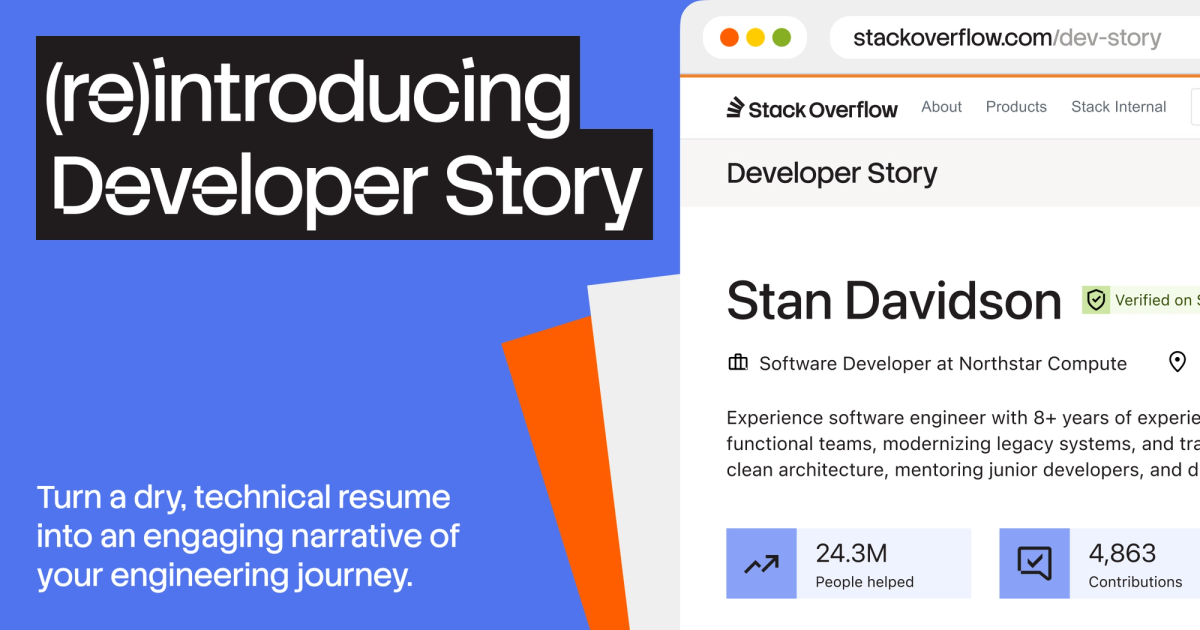
Beyond the Resume Noise: Developer Story Rethinks Tech Hiring
Stack Overflow is addressing the growing challenges in tech hiring, exacerbated by AI's influence leading to untrustworthy and generic resumes. Their solution, the re-introduced Developer Story, offers a platform for developers to authentically showcase their work, expertise, and impact through verifiable contributions and personal projects. This aims to provide hiring teams with more objective insights and help genuine talent stand out in a crowded market.