
"At Home in Space" Exhibition: A Stellar Conclusion
Verdict After years of anticipation and a significant investment, the National Air and Space Museum's "At Home in Space" gallery emerges as a compelling and richly detailed capstone to its extensive renovation. This
Verdict
After years of anticipation and a significant investment, the National Air and Space Museum's "At Home in Space" gallery emerges as a compelling and richly detailed capstone to its extensive renovation. This final spaceflight exhibition successfully immerses visitors in humanity's journey from transient space visitors to burgeoning residents, offering a unique blend of rare artifacts, thoughtful design, and interactive experiences. While a few elements serve as placeholders for future additions, the overall presentation makes it a must-visit for anyone with an interest in orbital living and the future of human space exploration. It's a fitting culmination, delivering both educational depth and emotional resonance.
Overview: Living Beyond Earth's Embrace
The Smithsonian's National Air and Space Museum in Washington, DC, has concluded its seven-year, nearly $1 billion renovation with the grand opening of "At Home in Space." Debuting on October 30, this gallery, guided by curator Jennifer Levasseur, focuses on the story of long-duration spaceflight, tracing the progression from early space shuttle missions to the continuous human presence aboard the International Space Station (ISS), and ultimately looking towards future lunar and Martian settlements. It picks up where previous galleries left off, specifically complementing the themes explored in "Moving Beyond Earth."
This exhibition is designed to illustrate the more than five decades of effort dedicated to enabling humans to live and work sustainably in space. It highlights the technological advancements, human ingenuity, and sheer perseverance required to transition from merely visiting to truly 'living' in the cosmic frontier.
Key Exhibition Highlights & Artifacts
"At Home in Space" distinguishes itself through a remarkable collection of artifacts, many of which are displayed to the public for the first time or are exceptionally rare:
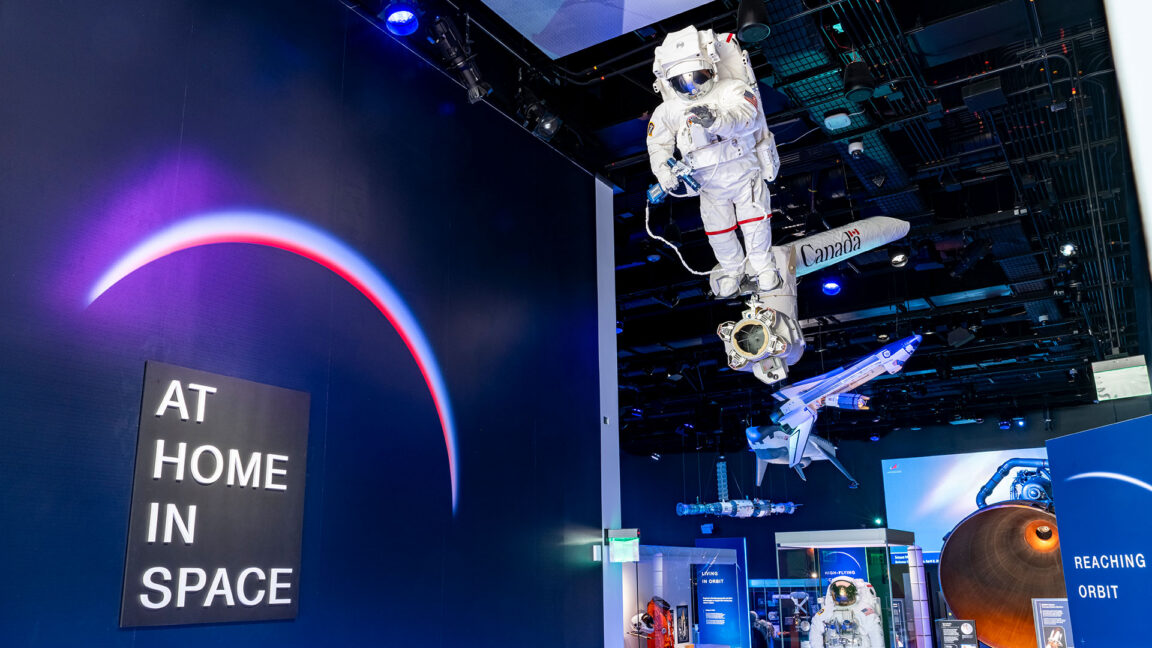
- Immersive Entrance: Visitors are greeted by an overhead mock-up of an astronaut on a spacewalk, seemingly attached to a robotic arm, set against a full-size photo mural of the ISS. The astronaut wears an Expedition 60 patch, hinting at a specific mission identity.
- Rare EMU Spacesuit: A centerpiece is a fully flown Extravehicular Mobility Unit (EMU) spacesuit. This is touted as the first, and potentially only, public display of such a complete, flight-certified suit globally, offering a deep dive into the engineering of astronaut attire. While the functioning portable life support system (PLSS) backpack remains in active service, a shell is present, maintaining the visual integrity of the display.
- Historic Flight Suits: On display are the "shirt-sleeve" in-flight suits worn by two pivotal figures in American space history: Guy Bluford, the first African American in space, and Sally Ride, the first US woman in space. Notably, Sally Ride's jacket is absent from the display, a deliberate curatorial choice for visual contrast.
- Shuttle Tragedy Remembrance: The gallery includes poignant recovered components from the Space Shuttle Challenger and Columbia disasters. This marks only the second public display of such debris, following an exhibit at the Kennedy Space Center Visitor Complex. Artifacts include an elevon hinge and a wiring panel fragment from Challenger, and a reinforced carbon-carbon (RCC) T-panel from Columbia's starboard wing, alongside a compact disc on loan from David Brown's family.
- ISS Destiny Module Walk-Through: A full-size mock-up of the ISS's US Destiny laboratory module allows visitors to walk through and experience the cramped, multi-directional environment of an orbital laboratory. The design thoughtfully addresses accessibility concerns regarding the floor detailing. This section showcases a variety of crew equipment, including microgravity-engineered coffee cups, a miniPCR biotech toolkit, and the MinION portable DNA sequencing device.
- Sensory Experience: A standout feature, and a personal favorite of the curator, involves scent oils that allow visitors to experience what space and the ISS reportedly smell like – a truly unique interactive element.
- Pioneering Technology: The first 3D printer used in space, responsible for producing hundreds of objects on the ISS, is also on display.
- Artemis Future: The gallery reserves a dedicated space for the Artemis I Orion capsule, which flew to the Moon without a crew in 2022. Until the actual spacecraft arrives, a Lockheed Martin scale model stands in its place. Also on display is a piece of the historic Wright Flyer fabric that journeyed to the Moon aboard Artemis II.
Design & User Experience
The exhibition’s design excels in its ability to transport visitors. The immersive entrance, with the spacewalking astronaut and vast ISS mural, immediately sets the tone. The full-scale Destiny module mock-up is a masterstroke, allowing for a tangible understanding of living and working in microgravity, complete with interactive elements and artifact displays integrated directly into the module. Curators went to lengths to ensure the environment felt three-dimensional, acknowledging that activity happens on the floor and ceiling in space.
The inclusion of interactive elements like the scent oils is a stroke of genius, offering a multi-sensory experience that goes beyond visual and textual information. The meticulous placement and description of artifacts, from the groundbreaking EMU to the somber Challenger/Columbia debris, demonstrate a deep respect for the history and technology.
Accessibility was considered, with the original mosaic floor design in the Destiny module changed to prevent tripping hazards, a testament to thoughtful planning. The gallery seamlessly connects to the museum’s broader narrative, providing context for the future of space exploration that other new exhibits touch upon.
Pros & Cons
Pros:
- Unparalleled Artifacts: The fully flown EMU spacesuit and the Challenger and Columbia debris represent incredibly rare and significant items, offering unparalleled historical value and insight.
- Immersive ISS Experience: The full-scale Destiny module mock-up is a highly effective way to convey the realities of orbital living, enhanced by interactive displays and unique crew equipment.
- Innovative Sensory Engagement: The "smell of space" exhibit is a memorable and highly creative way to engage visitors, appealing to a sense often overlooked in museum displays.
- Comprehensive Narrative: The gallery skillfully tells the story of long-duration spaceflight, from its origins to its future aspirations, providing excellent context for the entire space exhibition wing.
- Thoughtful Design: Attention to detail, such as the three-dimensional labeling in the Destiny module and accessibility considerations, enhances the visitor experience.
- Free Admission: Despite the substantial renovation, entry remains free, making this world-class experience accessible (timed passes required).
Cons:
- Artemis Placeholder: The real Artemis I capsule is still awaiting delivery, so visitors will initially see a scale model, which might be a slight disappointment for those expecting the actual spacecraft immediately.
- EMU Completeness: While the EMU is fully flown, the absence of a functioning PLSS due to ongoing NASA needs means a small part of the complete system isn't on display.
- Missing Jacket Detail: Sally Ride's flight jacket is intentionally omitted, a minor detail but potentially noticeable for keen observers expecting a complete ensemble.
The "At Home in Space" Experience Compared
This exhibition doesn't stand alone but is part of a larger, cohesive experience within the newly renovated National Air and Space Museum. It serves as a vital bridge between earlier historical accounts, such as "Destination Moon" and "Moving Beyond Earth," and future-focused galleries like "Futures in Space." While other galleries showcase initial forays and robotic exploration, "At Home in Space" uniquely focuses on the sustained human presence in orbit. Its collection of artifacts, particularly the fully flown EMU and the Challenger/Columbia debris (a distinction shared only with Kennedy Space Center for the latter), gives it a distinct edge in terms of rarity and historical significance within the global landscape of space museums. The interactive elements, especially the scent experience and the walk-through Destiny module, provide a tactile and immersive quality that complements the visual richness of its sibling galleries.
Final Recommendation
"At Home in Space" is more than just another museum gallery; it's a meticulously crafted journey through the evolution of human life in orbit. Its blend of rare historical artifacts, engaging interactives, and a clear narrative makes it an essential visit. Whether you're a seasoned space enthusiast, a budding astronaut, or simply curious about humanity's future beyond Earth, this exhibition offers a compelling and deeply informative experience. While the Artemis I capsule is currently a placeholder, the wealth of other unique exhibits more than justifies a visit. Coupled with the other newly opened galleries, it solidifies the National Air and Space Museum's position as a premier destination for understanding our place in the cosmos. Remember to secure your timed-entry pass!
FAQ
Q: Is a timed-entry pass required to visit "At Home in Space"?
A: Yes, admission to all galleries at the National Air and Space Museum remains free, but timed-entry passes for the building are required to visit, including "At Home in Space."
Q: How does "At Home in Space" connect with the rest of the renovated museum?
A: "At Home in Space" serves as the final spaceflight gallery to open, effectively capping the museum's renovation. It builds upon themes introduced in earlier galleries like "Moving Beyond Earth" and sets the stage for future concepts explored in "Futures in Space," completing the narrative arc of human space exploration from first steps to living off-world.
Q: Are there any truly unique exhibits that can't be seen elsewhere?
A: Yes, the fully flown Extravehicular Mobility Unit (EMU) spacesuit is presented as the first and potentially only public display of its kind worldwide. Additionally, the inclusion of recovered Challenger and Columbia debris is a rare public display, with only one other such exhibit existing globally at the Kennedy Space Center. The sensory "smell of space" interactive is also a highly unique feature.
Related articles

Stellar Blade on Switch 2: Is This Action Gem Still a Cut Above
Remember 2024? The year Shift Up dropped a bombshell on PlayStation 5 with Stellar Blade, a game that quickly carved out a reputation as one of the decade's premier action experiences. Its blend of lightning-fast sword

AI Safety Evolution: Mitigating Subtle Yet Significant Risks
While AI's grand existential threats often dominate headlines, the more immediate and insidious dangers lie in its everyday interactions. The recent work by AI safety company Alice, in collaboration with Inflection AI

CNET's Strands Guide: Instant Answers, Mixed Blessings
CNET's Strands Guide: Instant Answers, Mixed Blessings Quick Verdict: CNET's guide for NYT Strands puzzle #974 on Monday, November 2, 2026, serves as a direct and efficient solution for players seeking immediate answers

Binance Reopens After Historic Heist: A Fragile Recovery
Verdict Binance, one of the world's largest cryptocurrency exchanges, has reopened transactions after suffering a staggering $6.3 billion crypto heist, one of the largest in history. While the platform has commendably

Touchscreen MacBook Pro: Uninspired and Unconvincing
Apple's new touchscreen MacBook Pro with its PROLED XDR Display feels like an uninspired addition. Despite the beautiful OLED panel, the touchscreen functionality is uncomfortable for extended use and doesn't justify its premium.

GeekWire Week in Review: A Curated Dose of PNW Tech News
Verdict: Your Weekly Dose of Pacific Northwest Tech Insights GeekWire's "Week in Review" for October 25, 2026, serves as a highly efficient digest for anyone looking to stay abreast of the significant tech and startup