
Asus Zephyrus M16: Liquid Metal Calamity & The User's Triumph
Quick Verdict The Asus Zephyrus M16, a gaming laptop designed for high performance, has been marred by a critical flaw in its factory liquid metal application, leading to severe overheating, performance degradation, and
Quick Verdict
The Asus Zephyrus M16, a gaming laptop designed for high performance, has been marred by a critical flaw in its factory liquid metal application, leading to severe overheating, performance degradation, and potential hardware destruction. A user's intervention, involving a thermal paste replacement, not only averted disaster but also dramatically improved performance, tripling framerates and eliminating hard crashes. This highlights a significant quality control issue with liquid metal application in portable devices and serves as a stark warning for consumers.
The Promise and Peril of Liquid Metal in Laptops
Asus has, for a number of years, embraced liquid metal as a thermal interface material (TIM) on the mobile dies within its gaming laptops, including models like the Zephyrus M16. The theoretical advantage is clear: liquid metal offers superior thermal conductivity compared to traditional thermal pastes, promising cooler operation and sustained performance for high-power components. However, this advanced solution comes with significant inherent challenges, particularly in a portable form factor where movement, temperature fluctuations, and long-term stability are crucial considerations. As one user's experience painfully demonstrates, the real-world application of liquid metal can be far from perfect, turning a supposed advantage into a serious liability.
A Three-Year Descent into Instability
Take the case of Reddit user u/nicknickmeetnick, whose 2022 Asus Zephyrus M16, equipped with an Intel Core i9-12900H processor, began exhibiting alarming symptoms after just over three years of relatively light use. While initially not a dedicated gaming machine, the laptop started struggling when tasked with even moderate loads. The symptoms were classic signs of thermal throttling: excessive overheating, significant drops in game performance (to the point where a simple game played with children became a struggle), and eventual hard crashes. The machine, once a capable performer, was clearly in distress.
Fearing an aging thermal paste application, Nick prepared to refresh the TIM, initially planning to use PTM7950 phase change material and GD900 thermal paste. What he discovered upon opening his laptop was nothing short of shocking and alarming.
The Uncovered Catastrophe: Corrosion and Spillage
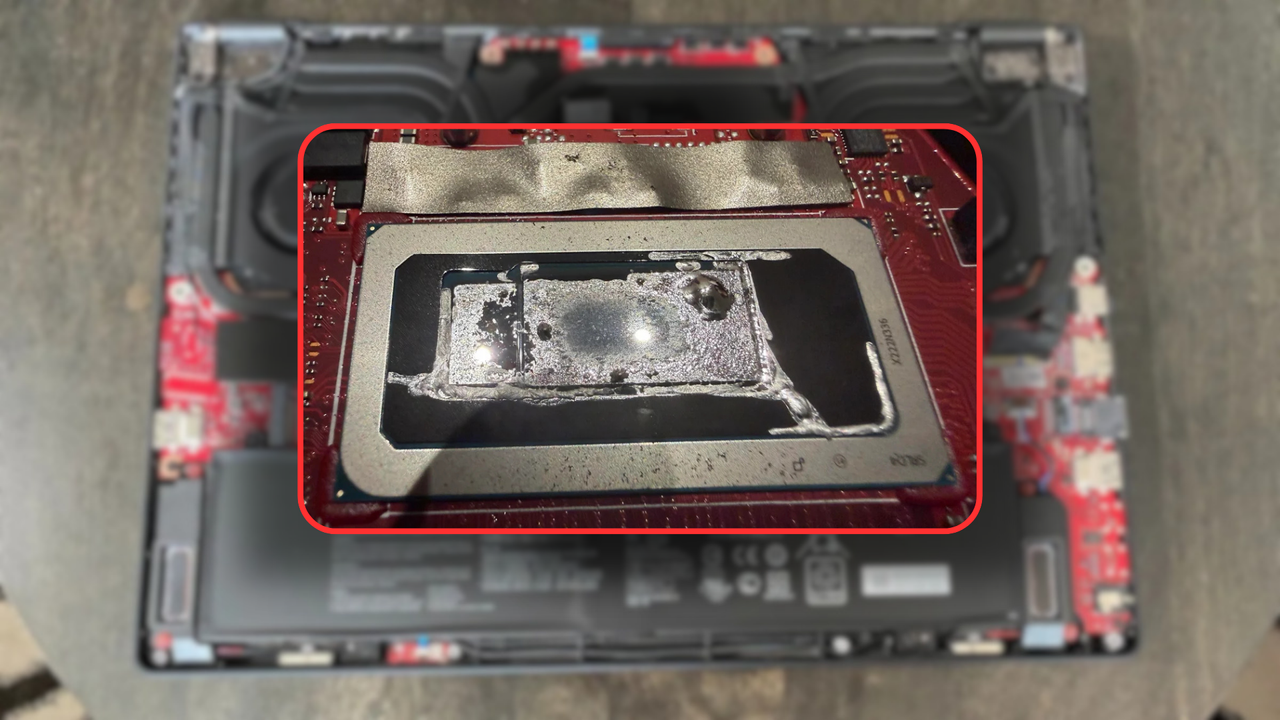
The liquid metal applied to the CPU was found to be in a disastrous state. It wasn't merely dried out or ineffective; it had actively caused damage. The heatsink directly above the CPU showed clear signs of the liquid metal having burned onto it. More critically, the liquid metal had spilled out of its designated cavity on the processor's thin lid, which normally protects the sensitive silicon die underneath. This spillage and the subsequent contact with other components presented an immediate and severe risk. Liquid metal is highly electrically conductive, meaning any contact with the surrounding circuitry could create microbridges that would short out components, potentially leading to catastrophic and irreversible damage to the CPU or motherboard.
Even more concerning was the visible corrosion. The liquid metal had eaten away at the heatsink, and critically, had almost penetrated the thin lid protecting the CPU's silicon. The user speculated that Asus might be mixing abrasive chemicals into their liquid metal to enhance adhesion, an unfortunate decision if it leads to such corrosive effects over time. This isn't merely an application error; it points to a potential chemical incompatibility or an oversight in material science that risks the longevity and safety of the device.
The Repair and Remarkable Revival
Facing a near-death experience for his laptop, u/nicknickmeetnick meticulously undertook the delicate task of cleaning the CPU. He carefully manipulated the existing liquid metal using dried cotton, effectively sanding away the corrosion on the heatsink. He then used isopropyl alcohol and cotton sticks to gather the rogue liquid metal into a blob that could be safely removed with painter's tape, preventing any further spread or damage.
Once the CPU and heatsink were thoroughly cleaned, he applied GD900 thermal paste as a temporary measure while awaiting the arrival of PTM7950. The results were immediate and astounding. The laptop's temperatures plummeted, and the random reboots ceased entirely. The most dramatic improvement was in gaming performance: the only game Nick plays with his kids now ran three times as smoothly. This single act of replacing the flawed liquid metal application with a standard thermal paste effectively restored the Zephyrus M16 to its full glory.
A Widespread Quality Control Issue
This incident is not an isolated one. The source article points to dozens of different posts on Reddit detailing similar liquid metal woes on Asus laptops. This pattern suggests a systemic quality control problem with how Asus applies liquid metal in its manufacturing process. While liquid metal can offer thermal benefits, its volatile nature and the precision required for its application make it a risky choice for mass-produced, portable devices. The movement inherent in a laptop's use, coupled with inconsistent factory application, increases the likelihood of spills, migration, and the corrosive damage seen here.
This issue extends beyond laptops, with even discrete GPUs designed for stationary use facing problems when liquid metal is poorly applied. For consumers, this raises serious questions about the long-term reliability of devices utilizing factory-applied liquid metal.
Buying Recommendation
Given the significant risks and documented failures, we issue a strong word of caution regarding Asus laptops that utilize factory-applied liquid metal. While the Zephyrus M16's underlying hardware (Intel Core i9-12900H) is capable, its performance can be severely hampered, and its lifespan drastically cut short, by poor thermal management. If you own an Asus Zephyrus M16 (especially a 2022 model) or any other Asus laptop known to use liquid metal, and you are experiencing overheating, thermal throttling, or unexpected crashes, a thermal paste replacement is highly recommended. It’s a necessary, albeit inconvenient, intervention to ensure your investment performs as intended and avoids potential hardware failure. For prospective buyers, we recommend seeking out models that use traditional thermal paste or phase change materials, or be prepared to undertake a repaste relatively soon after purchase. The performance gains observed by u/nicknickmeetnick demonstrate the true potential of these machines, but only once this critical flaw is addressed.
Conclusion
The Asus Zephyrus M16, in this instance, represents a cautionary tale. What should be a premium thermal solution – liquid metal – was instead a ticking time bomb due to flawed factory application. The user's incredible intervention saved his laptop from certain destruction and revealed the massive performance untapped beneath layers of heat and instability. Until Asus can demonstrate consistent and reliable liquid metal application that withstands the rigors of laptop use, consumers should approach such models with extreme caution or be ready to perform the necessary maintenance themselves. The moral of the story is clear: sometimes, the simpler, more reliable solution is the better one.
FAQ
Q: Is liquid metal inherently bad for laptops?
A: Liquid metal offers excellent thermal conductivity, making it theoretically good for high-performance devices. However, its electrically conductive nature, potential for corrosion, and susceptibility to spills with movement make its application in portable laptops very risky if not done with extreme precision and robust containment. This particular case highlights that mass production processes may struggle with this precision, leading to significant problems over time.
Q: How can I tell if my Asus laptop has this issue or is at risk?
A: If you own an Asus Zephyrus M16 (especially a 2022 model or similar era) or another Asus laptop known to use liquid metal, and you experience symptoms like excessive heat, loud fan noise, sudden drops in gaming performance, stuttering, or hard crashes under load, your liquid metal application could be failing. While opening your laptop yourself voids warranty and requires technical skill, these symptoms are strong indicators that a thermal repaste might be necessary.
Q: Will replacing liquid metal with traditional thermal paste hurt performance?
A: As demonstrated by this user's experience, replacing poorly applied, corroded liquid metal with even a good quality traditional thermal paste (like GD900 or PTM7950) can dramatically improve performance. While high-quality liquid metal applied perfectly might offer slightly better peak thermal transfer, a well-applied conventional paste is far superior to a compromised liquid metal application. The stability, lower temperatures, and eliminated crashes will result in a much better overall user experience and sustained performance.
Related articles
Android 17 QPR2 Beta 7.1: The Performance Relief You've Been Waiting
Android 17 QPR2 Beta 7.1: Finally Fixing the QPR1 Performance Woes Verdict: Android 17 QPR2 Beta 7.1 is a crucial and highly anticipated software update for Google Pixel users, specifically targeting and resolving the

DJI Solo Video Setups: Smart Choices for Lone Creators
This review delves into DJI's recommended solo video setups, highlighting the Osmo Pocket 3 Creator Combo as a top pick for its integrated camera, gimbal, and mic. It also covers stabilizers like the Osmo Mobile 8 and RS 4, and the DJI Mic Mini series for enhanced audio, providing honest pros, cons, and clear buying advice.
Ars Technica's Rocket Report: Your Essential Space Industry Briefing
Quick Verdict Ars Technica's Rocket Report, presented by veteran space reporter Stephen Clark, offers an invaluable and meticulously organized weekly (or similar frequency, implied by "Edition 9.15") digest of the most

Apple iPhone Duo: A Daring Debut with Notable Compromises
Apple's highly anticipated iPhone Duo, priced at $2,000, has gone on pre-order. While hailed as "Apple's most exciting device in a decade" for its innovative foldable design and immersive display, it comes with significant drawbacks like the absence of FaceID and a premium camera.
KDE Plasma 6.8: A Future-Focused 30th Anniversary Update
Quick Verdict KDE Plasma 6.8, arriving as the "30th Anniversary Edition," is a pivotal release that decisively pushes the desktop environment into the future. With a definitive farewell to native X11 sessions and a

Kojima Compares Divisive New Film 'Digger' to MGS2's Prescient Vision
Gaming icon Hideo Kojima has praised the divisive 2026 film *Digger*, drawing intriguing parallels to his own prophetic game, *Metal Gear Solid 2*. Both works, he explains, uniquely explore the dangers of misinformation and a fragmented digital reality, anxieties he shares with *Digger*'s director, Alejandro González Iñárritu.